The Philly photographer who spent decades photographing the beauty and majesty of Black cowboys

More than 30 years ago, Pulitzer Prize-winning photographer Ron Tarver began photographing Black cowboys, rodeo queens, and ranchers across the southern plains of east Texas, the low hills of Oklahoma, and the urban pathways of Philadelphia.

On assignment for National Geographic and The Philadelphia Inquirer, Tarver captured generations of cowboys and cowgirls working in their stables, strutting in small-town parades, or cooking breakfast inside their ranch-style homes. After failed attempts to thread the detailed portraits and textured landscapes into a book project, Tarver put away nearly 20,000 pictures in a storage container.

In the years since, Tarver published a book about the experiences of African American war veterans and became an associate art professor at Swarthmore College after a 30-plus-year career in photojournalism.

His new book The Long Ride Home: Black Cowboys in America finally releases on Saturday. A week later, Tarver will be doing a book signing, sponsored by the Print Center, at the 20 / 20 Photo Festival Photo Book Fair at Cherry Street Pier on Sept. 7. The book photos will also be on display at InLiquid Gallery as part of their Brotherly Lens: A Portrait of Philadelphia exhibition, which is also part of the 20 / 20 festival.

“This is one of those projects that wouldn’t leave me alone for the longest time,” said Tarver. “It’s always been on my mind because it’s such an important project to get out into the public.”

Black cowboy culture’s recent renaissance in pop culture may have started with the 2020 North Philadelphia-set western Concrete Cowboy, starring Idris Elba. Musicians from Lil Nas X to Beyoncé have also straddled horses and donned bolo ties for songs honoring the Old West.

For Tarver, the timing is perfect. “It’s out in the zeitgeist now,” he said. His book’s 110 images showcase the deep roots of the country’s Black cowboys and cowgirls.

Tarver’s The Long Ride Home isn’t the act of an outsider looking into Black cowboy culture. He lived it.

Tarver grew up in Fort Gibson, Okla., where he rode horses bareback, attended rodeo shows, and spent his summers working on local farms and his cousin’s ranch.

His grandfather, Thomas Wilson, was a working cowboy in the 1940s. His father, Richard, introduced Tarver to the world of documentary-style photography.

It wasn’t until Tarver, now an Elkins Park resident, moved to Philadelphia in 1983 that he realized how unacquainted people were with the Black West.

“The bottom line was people didn’t think there was such a thing as a Black cowboy. I got all kind of strange feedback [on the book] from people literally saying, ‘I don’t think there’s an audience for this. I don’t think there’s any kind of thing or entity as a Black cowboy.’ So, that’s why I put this thing in a box and just said, ‘Forget about it.’”

According to Smithsonian Magazine, one out of every four cowboys who were “trailblazing, sharpshooting, and horseback-riding” on the American frontier were Black. And with the release of The Long Ride Home, Tarver plans to paint a vivid picture of the culture’s history and grandeur.

Liz Spungen, executive director of the Print Center, said Tarver faced many roadblocks with the book’s release. But she’s thrilled to see the decades-long project come to life, and to have the capacity to showcase his work in a planned exhibition in fall 2026.

“I think there’s probably a more receptive audience for it now … people are now more eager, I hope, to understand the larger contributions of Black Americans in the West. We are more attuned to hearing these stories now, so I’m hoping it will receive a fabulous audience.”

With renewed interest in his Black Western project, Tarver was tasked with cutting down his 20,000-image collection to a book-size number. He focused on the years between 1992 and 1996, and zeroed in on photos of everything from the rodeo shows to the after-hour hangs.

“I wanted to show that this isn’t a fad,” Tarver said. “I wanted to show the broad spectrum of Black Western lifestyle, and its vibrance even as far back as then.”

Tarver narrowed it down to 250 photos, and then tapped longtime friend and former NatGeo magazine photo editor Elizabeth Krist to pare the project down even further.

Through the editing process, Krist was impressed by the stark contrast between Tarver’s detail-rich portraits and “visceral action shots.”

A founding member of the Visual Thinking Collective, Krist is hopeful the book opens people’s eyes to the lived culture of Black cowboys, both then and now. “It’s an ongoing culture. It’s not something you look back and think, ‘OK, that was the 1800 or 1900s.’ This is something that is still going on. I hope people really understand it on a deep level when they see his work.”

Once the final lineup of photos was selected, New Mexico-based designer David Skolkin stepped in. He was in awe of Tarver’s ability to meld his journalistic practices with his creative nuance.

The two men connected on long phone calls and Zoom meetings for months to finalize the layout and photo sequencing for The Long Ride Home. “It was like figuring out a puzzle,” Tarver said.

“The images felt very real to me. I could feel the people, sense their emotions, and could even sense how things smelled in the environment of the photographs. They had a texture that was very accessible to me,” Skolkin said of the final book.

As Tarver prepares for the book’s release, he’s reminded of the people he connected with throughout his career. Many of the children he photographed in the early 1990s have carried on their family’s legacy of farming and cowboy culture.

He hopes to develop another book that’s dedicated to the families he first photographed. He also wants his images to be placed in national museums and global showcases to continue sharing the story of the Black West for people to celebrate its largely undocumented glory.

“We all built this country,” Tarver said, “and to remind people that we were in this culture and have been for a long time is important. I hope this book carries out that idea, as well as the beauty and majesty of it.”

After years of decorating parties with balloons, this artist is now making art with them

North Philly artist Brian Ward grew up in the events industry. His family’s kitchen had three refrigerators and he ate Cheerios every morning with drapes, linen cloth, and other party decor hanging from both ends of the dining room table.

His parents, a baker and an event coordinator, brought him into the family business at age 14. He thought about being a part-time magician, party clown, or face painter to earn extra money for school clothes, but none of them stuck. The only one that did was balloon art.

Ward started out making inflatable hats, swords, and balloon animals at kids’ parties. Then he graduated to shaping archways and columns for prom send-offs, birthday bashes, weddings, and other celebrations.

After working as a balloon artist for a decade, Ward, now 26, is pursuing a different kind of art. Instead of contorting balloons into party-ready pieces, he is crafting sculptures and artwork with them. Only this time, they’d all be deflated.

“I wanted to create something that lasted longer with balloons as my medium,” Ward said. “Balloon decor doesn’t have much life expectancy, and I didn’t want to jump to painting or carpentry. People know me as a balloon artist, so I wanted to merge the two.”

With pencils, markers, paint, glue, and deflated balloons, he has made sculptures of basketballs and small dogs. He has also reimagined one of Evelyne Axell’s paintings, whose work inspired Ward to explore vibrant colors.

It’s a tedious process, Ward said. The materials are a small cost, but a typical art piece can take anywhere between 18 hours to three weeks to complete. But he’s found his rhythm and grown more confident in his artistic pursuits.

He went from selling $300 balloon decor packages to $2,000 art pieces bought by a big-name entertainer. And now he’s ready to show his work to a wider audience.

Ward has been a part of hundreds of events, but on Saturday he is putting on his first art show, for nearly 400 attendees at the Bridge Studio in Philly. The self-funded exhibition, titled “Who is Brian Ward?” will be filled with interactive art pieces and installations, including a play pit full of balloon-made balls.

Kamaya Jackson, a friend who has watched Ward evolve as an artist, said he’s always had the ambition to go big, and she’s happy others will get to see his art and know his story.

“I want [Ward] to feel the love the community has for him,” Jackson said. “I hope he can soak up that moment and see how much of an impact he’s made on that community. Just all the good things that can happen, that’s what I want it to be.”

Ward’s first canvas painting will be a highlight of the show.

His father, Brian Ward Sr., gifted him a canvas in July 2023. Ward used it to craft a balloon-filled collage that was inspired by the last painting his grandfather, John Ward Sr., made before his death in 2013.

Ward gifted the canvas back to his dad, who loved it. His father’s reaction gave Ward the confidence to fully pursue his new artistic journey.

“I knew my dad would be proud,” Ward Sr. said. “He was already proud of his grandkids, but he didn’t get a chance to see Brian do the art that he’s doing now. I know he would be proud to see it, and I think that was reassurance for [Ward].”

While the art world is relatively new ground for Ward, he’s establishing himself as an ascending talent. His first and most notable collector is Grammy-nominated artist Smino, who purchased a balloon-made painting of Mickey Mouse during the 2024 Roots Picnic weekend.

The transaction, Ward said, was nothing short of motivational. “[Smino] was like, ‘I’ll Zelle you the money right now. Just ship to L.A.,’ and I’m like, ‘Bro, I’ll carry this jawn on my back and bring it to you.’ I was on my cloud nine after that.”

His new venture hasn’t been without its detractors. Longtime friend Alissa Smith said Ward has encountered naysayers throughout his artistic journey. But the entrepreneurial spirit his parents embedded in him continues to push him forward.

“People didn’t believe in his vision,” Smith said. “He overcame doubt and slower [business] seasons as a balloon artist. People told him it’s not really a normal job. But I think he took that adversity and used it as motivation. He’s created so many different connections, and I’ve seen him push past people not believing in him or trying to slow him down.”

While Ward is still developing his artistic style, he has never questioned whether he had a story to tell. The Strawberry Mansion resident said his upbringing is one of the pillars of his creativity, and he’s driven to inspire others to create their own art — whatever medium they may choose.

“I always tell people I’m inspired by life,” he said. “Some people may say that’s cliché, but I’m inspired by the possibilities of the things that you can do. And I’m just continuing to write my story.”

– The Philadelphia Inquirer

5 Best Moments From Megan Thee Stallion’s Twerk-Fueled Lollapalooza 2024 Headlining Set

With Lollapalooza 2024 marking the final stop on the Hot Girl Summer tour, Megan Thee Stallion closed out the first day of the festival with an electrifying performance — and a timely message — on Thursday night (Aug. 1). 

After performing at Vice President Kamala Harris’ first presidential campaign rally in Atlanta earlier this week, Megan continued a stellar week by headlining Lollapalooza on Thursday night, three years after her first main stage appearance at the festival and a few weeks after replacing Tyler, The Creator at the top of the Lolla bill. The combination of political statements and twerk-ready hits made sense in the context of her high-wattage show, and went over well with festival-goers, who were equally in awe of her candid stances and catalog of rapid-fire records.

Decked out in a pink sequence jumpsuit and cowboy boots, Meg started her hour-long set with the venomous “Hiss” before transitioning to her more salacious club anthems. The rap star went on to play records like “Thot S**t” and “Megan Piano,” encouraging the crowd to join her as she twerked in the evening drizzle. And with a black towel in hand and a roaring crowd on its feet, she rolled through fan-favorite bangers like “WAP” and “Wanna Be.” “Tonight, I’m not giving y’all my lightest twerk,” she said. “I’m giving y’all my hardest twerk in the motherf–king rain, because I want the hotties to have a good-ass time.” 

Despite the weather and the wrapping-up of her summer tour, Meg made her return to Chicago worth fans’ while. She even brought a special hometown guest to the stage, and played a new viral hit in front of thousands.

Here are five of the best moments from the Meg Thee Stallion’s headlining Lollapalooza performance. 

The ‘Hotties for Harris’ Campaign

Days after her campaign rally appearance, the “Houston Hottie” paused her Lolla show to double down on her support of the presumptive Democratic nominee. “Let me pop my s**t real quick, because [people] were fake mad that I was popping it for Kamala,” Megan said to the crowd at Grant Park’s T-Mobile stage. “I don’t think they heard what she said. Kamala said she wants a ceasefire. Kamala said she supports women’s rights. And she said she’s tired of those high-ass gas prices … It’s ‘Hotties for Harris,’ goddammit!” There were no audible rejections from the audience — the campaign is in full effect. 

The Twerk Encouragement

It isn’t enough for Megan to simply twerk on her own — she’s a masterful hype woman who encourages her backup dancers to shine during brief intermissions in her set. She even had one of her dancers shine with a solo moment while she performed “Gift & A Curse.” The same courtesy was given to the crowd, as fans broke out into twerk circles and hyped each other up from across the park.

The Newest Hit

In short time, Megan has established herself as one of the biggest rappers in hip-hop, as her catalog of trap-infused hits, sharp-tongued diss records and femme-powered jams have elevated her to superstardom. The international appeal of the viral hit “Mamushi,” featuring Tokyo’s Yuki Chiba and given a TikTok dance, has broadened her horizons as well, and went off like a firecracker during her Thursday night set. But overall, her Lallapooloza performance was evidence of her ascension and rightful place as a headliner. 

The Special Guest

While GloRilla was sadly absent from Meg’s Lollapalooza performance after a rumored appearance, the Houston-born rapper invited a familiar face for Chicago sports fans to the stage. The special guest was WNBA all-star forward Angel Reese, who danced with Megan as she rapped “Where Them Girls At.” The Chicago Sky star mostly stood toward the back half of the stage, but she and Meg shared several videos and hugs during the must-see moment. 

The Day-One Hotties

After playing songs from her recent album Megan and Traumazine, Megan traveled back in time, and fully morphed into her alter ego Tina Snow, for stomping hits like “Hot Girl” and night club anthems like “Big Ole Freak.” And while her newly initiated hotties were welcomed with open arms, Megan acknowledged the festival-goers who supported her as she ascended the rap music ladder. 

– Billboard

5 Best Moments From Chappell Roan’s Jam-Packed Set at Lollapalooza 2024

Even with the unforgiving heat looming over the crowd during the opening afternoon at Lollapalooza 2024, seemingly every fan in attendance left their pockets of summer shade on Thursday (Aug. 1) for a clear view of Chappell Roan’s entrance. The vertically challenged climbed their partners’ shoulders; others slipped through gaps in the tightly packed parkway in Chicago’s Grant Park. 

As the clock struck 5 p.m., the exploding pop star rose onto the T-Mobile Stage, and was welcomed with cheers that stretched across the southern section of Grant Park. Roan came out to the anthem “Femininomenon” while dressed in a cotton-candy-colored outfit with a luchador-style mask covering her face, but once she dove into dance-pop tunes like “Naked in Manhattan” and “Red Wine Supernova,” she unveiled the face that has quickly become a mainstream fixture, and let her fiery amber hair loose. She swooned the crowd with her theatrical moves and striking vocal runs, as flashing lights and fireworks helped turn Lollapalooza into a 1980s-style music video. 

Roan’s command of an audience as large as Lolla’s shouldn’t be a surprise. The self-proclaimed “Midwest Princess” has sprinkled her musical fairy dust across continental lines on her global tour, and her enchanting stage presence was on full display during the opening day of the festival. Roan transitioned from sultry tunes like “After Midnight” to campy dance jams like “Good Luck, Babe!,” giving license to sequenced fist pumps, dance moves and percussive chants among the crowd. “Thank you for having me Lolla!” she screamed — although on Thursday afternoon, Lolla was no doubt thankful to have the ascendant star on its main stage.

Here are five of the best moments from Roan’s Lollapalooza set. 

The Slower Moments

While the sonic potpourri of Roan’s 2000s-inspired pop records garnered the biggest receptions at Lollapalooza, Roan fell to her knees to deliver tales of past hookups on “Casual” and the emotionally rich heartbreaker “Subway.” These setlist entries brought balance to Roan’s high-powered performance, which prompted shared hugs and kisses among festival-goers. 

The Vocal Shapeshifting

Roan has amassed a sprawling fan base for several reasons, but those not paying close attention may not expect the breadth of her vocal ability. At Lollapalooza, Roan continued to prove she’s a musical acrobat who can seamlessly leap from whimsical pop tunes to roaring ballads on a dime. Her vocal power allows for such versatility — and part of the fun of attending a Chappell Roan show is watching the audience try to match it, howling and bellowing in charming attempts to match her flowing harmonics.  

The Outfit

Roan, whose aesthetic is often influenced by glittery drag style, chose to go with a (relatively) muted outfit choice at Lollapalooza: the artist dressed in a wrestling-inspired short-sleeved bodysuit, with colors bursting in blue and pink highlights, lots of fringe and a silver star belt. Despite the 90-degree heat, she sported a luchador mask — but only for a few minutes. Once she settled on stage, Roan turned to the crowd to let her strawberry-colored hair and silver face paint grace the sun. 

The Welcomed Theatrics

Long before she rose to pop stardom, Roan was a theater kid whose Hollywood dreams first bloomed in her hometown of Springfield, Mo. Her Lollapalooza set was full of flashes of her dramatic training, as she twirled on stage, belted out ballads with Broadway fervor and often grabbed her chest to further emphasize the emotional notes. Then she made a full split halfway through her set, leading to some of the loudest audience roars of the day.

The Global Fandom

While she’s crowned the “Midwest Princess,” Chappell Roan’s fandom stretches far and wide, beyond the confines of Lollapalooza. Festival-goers ventured from around the world to attend Chicago’s annual music festival, and shots of the crowd size started going viral before the set had concluded. Roan’s mountainous vocals and crowd-pleasing tunes forged one of the better performances on day one, and with her global success in full bloom, it’s safe to say Roan has graduated from “Midwest Princess” to international star.

– Billboard

Lisa Ann Walter wants some Philly restaurant recommendations

After decades of acting in theater, film, and TV, Lisa Ann Walter is settling into stardom.

That’s thanks to Melissa Schemmenti, the hilarious and ever-resourceful second grade teacher she plays on the ABC hit Abbott Elementary. Now, with her star on the rise — she’s appearing in the new reboot of Who Wants to be a Millionaire, which launched earlier this month — Walter is recording her comedy show in Philly.

Starting Thursday, Walter will be in Philly for a three-night stint at Helium Comedy Club with a gift in mind. After a decade of headlining live shows, the actor will record her debut comedy special at the Center City venue. Her Abbott Elementary costar and “work-wife” Sheryl Lee Ralph will coproduce and codirect the project with Walter.

“I think anyone who’s been to a Philly sports event knows that Philadelphians don’t hold back,” said Walter, who slipped in and out of Schemmenti’s South Philly accent during a Zoom interview. That passion, she says, makes Philly the ideal spot to record. “[People in the audience] are loud, but they’re not trying to heckle. They love being at the show, they love being enthusiastic, and they’re smart. That is the perfect combination for a great comedy audience, and Philly has really embraced me.”

Ahead of her shows, we talked to Walter about her disco dancing, the weeks she spent studying Bradley Cooper’s Philly accent, and her love of Dalessandro’s Steaks.

This interview has been lightly edited for length and clarity.

Is Philly your favorite city to do comedy?

I did a show last year, and I never felt more at home in a place that wasn’t where I grew up. One person came up to me and said, “You know, we didn’t even want to like you.” They were very conscious of the fact I was coming to the city as a newbie. But they said, “You’re one of us.” People hugged me, kissed me, and gave me food everywhere I went. If you do those things, then I’m home.

You’re from Maryland. How did you master the South Philly accent?

When Bradley Cooper did an Abbott Elementary episode, I told him I studied his videos. When he was first coming up, he went on talk shows and they would make him do the accent — almost like it was a circus trick or something. But he was so good at it that I would find those interviews and study them. I can’t tell you the number of hours, days, and weeks I spent making sure the accent was perfect. I tell people from Philly all the time, “Let me know if I can do it better. Hook a girl up.”

You brought a flask to the 30th SAG Awards. How much more Philly can you get?

My favorite part of that was how they had me hand the flask to Sheryl Lee Ralph, and she didn’t know it was coming. And the look on her face was so pure. Like, “If you don’t put that away … we are in public.” It was so Sheryl, but also [her Abbott Elementary character] Barbara.

The chemistry you and Sheryl Lee Ralph have is incredible. No wonder you’re working on this special together.

We’ve all heard stories about TV actors who played lovers for over 10 years, but it turned out they hated each other. Like, “Oh, he had bad breath or body odor and wooden teeth.” Right? But I think it’s very hard to act the kind of chemistry she and I have.

We fell in love as “workwives” on day one because we had so much in common. We were single moms raising our kids in Los Angeles. All the ways we connected were so pure, and we loved hanging out. We immediately started going shopping together because there were so many events we had to go to. We were outside a Zara dressing room while she threw clothes at me for like three hours. She dressed me for the next five events. We truly are that close. I adore her.

If you ever meet someone like her, you have to keep them in your life. She’s blessed from the moment she gets up in the morning.

What is it about stand-up that keeps you coming back on stage?

I think it’s connecting with people. It gives me immediate gratification, and it’s exactly what I intended to do when I was on stage as an actress in high school and I started doing dinner theater.

In my first professional show at 16, I made the audience laugh and cry. And I said, “I always want to do this.” Then I started doing stand-up and connecting with different audiences. That kind of experience in one room has chemistry. Comics know this, which is why I didn’t want to do the special in a big theater. I want to do it the way I came up in comedy. On a small stage at the level of the front tables, watching as the laughter travels from the front to the back of a room. It’s the closest thing to me knowing why God put me here on Earth.

You were also a disco dance instructor, right?

When I was coming up in D.C. as a kid, disco was huge. In D.C., they invented the hustle, and all my high school friends could dance. One of my best girlfriends was Colombian and she had four sisters, and they all had guys that could dance. I learned how to dance and they would yell at me “gringa,” and I learned how to move my hips. I started competing in disco competitions and I would win them. My mom, a crazy Sicilian, would drive me downtown to these clubs while I did these competitions. And then I got a job at 16 at Arthur Murray teaching old businessmen how to do the hustle, which is really just the salsa. I taught them the cha-cha, the waltz, and all these ballroom dances. And my grandfather, the old Italian, he taught me all those. And then when I turned 17, people wanted me to go to disco competitions in Rio de Janeiro, and my mom was like, “No, you are not.” So I had to quit Arthur Murray.

In the past, you’ve talked about the L.A. dating scene. How’s your dating life now?

Listen, I could always find a fella — and they found me. I’ve always had young guys slide into my DMs. Always. But you don’t want to date people because you’re famous. You want to be with people who are down with you for who you are. Having said that, every relationship is transactional.

My first husband [Sam Braun] is my buddy, and I have a joke on stage about him. He was a lovely Jewish man, but turns out we had too much in common — we both like men. The second husband was a cheater, and while cheating is not technically a religion, he practiced it like it was. But my first husband, I adore. We spend every Sunday night together watching our favorite show, 90 Day Fiancé.

I’ve already had my babies and I’m making money. What dating app am I going on?

Have you had a Philly cheesesteak?

People have sent me to some really good places. In fact, I want to go back to a couple of them. Cheesesteaks and hoagies aren’t the only good things that Philly has to offer. I know you got water ice and everything else, but what else do I need to know? I have a list of a few places.

The last time I asked on [social media], people were being very lovely and helpful at first. But then it took a hard left turn. Someone was like, “If you don’t go to Dalessandro’s, then you’re a dick.” OK, I guess I better go. I went and it was worth the trip. You should have seen my hotel room — it was disgusting. I had half-eaten cheesesteaks and hoagies all over the place.

– The Philadelphia Inquirer

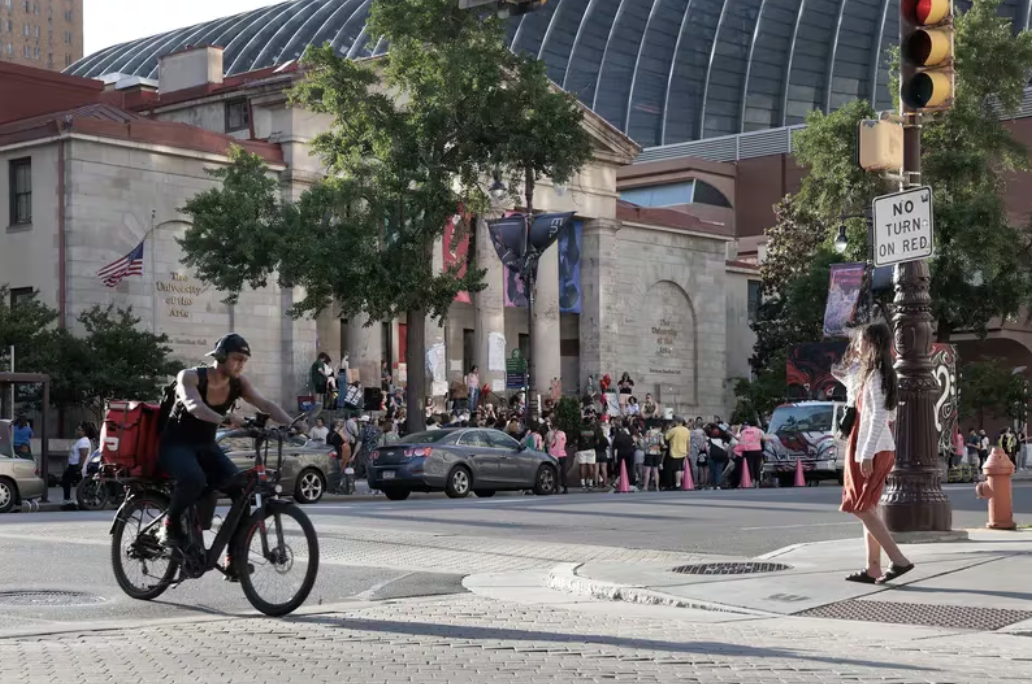
Artists, advocates, and family members rush to save artworks inside UArts

Legendary Philly artist Sam Maitin built a life and career at the University of the Arts. A nearly 50-year-old painting of his still adorns the northside stairwell of the former Gershman Y building, owned by UArts since 2000. The three-panel painting — with a 16-foot-long central piece and two 8-by-4-foot flanking paintings — bursts with vibrant colors.

After the sudden announcement of UArts’ closure, Maitin’s daughter, Ani, made a trip to the arts college to ensure her father’s work would be saved. She covered the triptych with sticky notes with her email and phone number. She left another Post-it with a more urgent message: “Anyone told to remove these artworks please contact me in advance. They require special handling.”

Former staff member Elisa Seeherman understood the urgency.

“It’s not just about the monetary value of these pieces, it’s about the historical value of them,” said Seeherman, who was the school’s director of career services. “He was a Philadelphia icon.”

Ani Maitin talked to Seeherman, UArts Board members, and a representative from the company handling the closing of UArts, and was told she could take custody of the paintings. Still, much like the fate of the students, faculty and staff of UArts, the future of Maitin’s work — and that of many other pieces in the UArts system — remains up in the air.

Seeherman said it would take a crew to remove Maitin’s painting from the building, most recently home to the UArts’ Student Center and Lightbox Film Center. The biggest issue, she said, is finding a place that will properly restore and house the slightly abraded artwork.

“These pieces are huge and won’t fit into most homes,” Seeherman said. “It’s complicated. And that’s probably why the former Gershman Y people left them in the building after they left.”

Sam Maitin: Mayor of the Arts

Sam Maitin was born in 1928 above a grocery store run by his Russian Jewish immigrant parents in North Philadelphia.

After graduating from Simon Gratz High School at age 16, he won a citywide art scholarship to the Philadelphia Museum School of Industrial Arts, now known as UArts. He simultaneously attended the University of Pennsylvania, and would later go on to teach at both schools and the Moore College of Art and Fleisher Art Memorial. He died in 2004.

“His work is an important piece of Philadelphia. But whether or not people loved his work, he was recognized as an endlessly generous person who did so much for other people and organizations,” Ani Maitin said. “It’s an incredible gift to manage his work. ”

The “Mayor of the Arts” — as Maitin was often called — was connected to the Gershman Y through his involvement with the center’s Y Arts Council. He was the in-house designer during the 1960s, working with figures like Joan Kron, Audrey Sabol, and others to promote the Arts Council’s visual, literary, and performing arts programs.

He was commissioned to create a set of paintings for the building’s lobby, and the result was the vibrant three-panel painting adorned with a Hebrew message that represented the mission he and the culture center shared.

The Hebrew phrase “Al tafrosh min hatzibur” translates to “Do not separate yourself from the community.” The painting also contains “Simcha” and “Sasson,” which translates to “joy” and “happiness.”

“I think the message still translates today,” said Craig Stover, Maitin’s former studio assistant and longtime friend. “If UArts made it their mission, their closure may not have happened.”

When the painting was unveiled in the early 1970s, Ani Maitin was only in preschool. But she remembers how it enlivened the Jewish family center, even as the building took on other iterations. “It felt very much like home to me when I was a kid,” she said.

An uncertain future

On Monday, Ani Maitin received a phone call from Alvarez & Marsal, the company tasked with managing and liquidating UArts properties after its closure. Though the consulting firm didn’t respond to The Inquirer’s queries, it informed Maitin that she or anyone from her family could come take Sam Maitin’s artwork from the building.

“Given the circumstances, I’m now feeling more reassured that the company is making efforts to handle things thoughtfully,” she said. “It’s all definitely an unexpected and time-consuming part of caring for my dad’s work and legacy.”

Ani Maitin said she’s scouting for nearby preservation sites and hopes to find a place to house the paintings soon. Her trip to UArts, however, opened her eyes to another glaring problem: No one knows what’s happening to other artists’ works displayed on campus.

“It was clear to me it wasn’t just about my dad’s artwork,” she said. “I felt like I was channeling my dad because he was such an activist. He taught me when you do something, you do it to uplift others too. Don’t just do things to support yourself.”

Based on their phone call, Ani Maitin said Alvarez & Marsal intends “to take their time to deaccession” the other works on UArts campus. This process involves the removal of artwork from an institution’s collection in order to sell or dispose of it. But no further details were provided, she said.

UArts faculty and staff can submit access requests to retrieve their personal items from university buildings, but it’s unclear whether the families of artists are given the same courtesy — or what will happen to artworks that don’t have family advocates like Ani Maitin.

An art piece has slipped through the cracks before, Seeherman said.

In June 2022, Seeherman said, she held a meeting to express concern for a sculpture named A Woman of Courage by Gladys Barry, a donation that had been in the Gershman Hall foyer since 1979.

With a new lobby construction set to begin, she was worried the sculpture would get damaged or misplaced. And when the construction project was completed in 2023, her fears were proven right — the sculpture was missing.

Seeherman is hopeful that outcome can be avoided this time around, citing the work of Ani Maitin and what others are doing to advocate for artists’ work on UArts campus.

“I wish [the art] could find a home where it can be appreciated for the art it is. Whether it’s in a museum, a private collection, or goes back to any of the families connected to it,” she said.

“UArts may have closed, but we’re still a community.”

– The Philadelphia Inquirer

A stolen musket from the Revolutionary War returns to Philly

An 18th-century musket that’s linked to the Revolutionary War was stolen in 1968 from Valley Forge Park, leading to years of investigation. When the cherry wood and brass-made firearm, once a part of the Valley Forge Historical Society Museum collection, went missing, it left many historians and investigators in limbo for decades.

But with help from Upper Merion Township detectives and the FBI’s Art Crime Team, the prized relic was returned to the Museum of the American Revolution on Monday.

The .78-caliber musket was displayed on a blue cloth-covered table, just under the dramatic painting, Siege of Yorktown in Virginia. Museum president and CEO Scott Stephenson held the antique in his hands, noting how the details etched in the gun’s 45-inch barrel and engraved butt plate noted its historic origins.

“There were no machines cranking these parts out,” Stephenson said. “This is literally hammer in hand, steel, iron, brass, and wood carefully pinning these pieces together.”

The retrieval of the 250-year-old firearm was a battle on its own. Until recent months, there was no trace of the musket for 56 years.

In 2009, Kevin Steele of the Montgomery County District Attorney’s Office reopened a cold case on the theft of antique firearms from the Valley Forge Historical Society Museum and several law enforcement agencies joined the effort to retrieve them. Among these firearms was the New England musket.

On the local level, Upper Merion Township Detectives Brendan Dougherty and Andrew Rathfon were tasked with retrieving the musket, as well as other Revolutionary War antiquities. Between 2016-2022, they were joined by the FBI Art Crime Team, the U.S. Attorney’s Office, and others on the investigation.

The collective effort resulted in the arrest of two people and the recovery of 50-60 historic items that were returned to 25 different museums along the East Coast. But dozens of artifacts were still missing, including the treasured musket.

In March, Massachusetts-based arms appraiser Joel Bohy spotted an early 1770s firearm during an antique gun show in Baltimore, which ended up being the one stolen from Valley Forge Park.

Bohy knew it was Rhode Island-made. The engraved butt plate signals its New England origins. But he didn’t know the significance of the artifact until he saw a press release from Upper Merion Township detectives.

“When I first saw the gun at the show, I was pretty excited about it because it’s a really rare gun,” Bohy said. “It was even more exciting when three weeks later, Upper Merion Township police sent me a press release with the missing things retrieved from the cases they worked on before. As as soon as I saw [the musket], I clicked on the images and went, ‘Oh my God, I saw this gun weeks ago.’”

Bohy reached out to Dougherty and Rathfon, who he had worked with on cases before. The next day, the FBI team interviewed Bohy, and the two parties were able to track down the musket and deliver it to the insurance solutions company, Chubb.

Chubb paid the insurance claim for the missing relic back in 1969, which meant that it was now its official owner. Since the Museum of the American Revolution acquired the collection of the Valley Forge Historical Society back in 2003, the organization decided to gift the musket to the museum.

“We’ve obviously devoted many years to this investigation and we’re still going. But it’s special because it was stolen from our home,” Dougherty said. “And to know after 56 years it’s home is nice because it’s such a local historic item.”

With the firearm now in the hands of Stephenson and the museum’s curators just days before July Fourth, Chubb executive Maria Thackston said it’s a “poetic” story of repatriation.

“We’re thrilled to give it back to them, allow them to continue to study it, and make it available for the public to enjoy it,” she said. “It’s our privilege.”

While there are no current plans to exhibit the rare firearm, the museum will continue to study the artifact until plans for display unfold at a later date.

Staff writer Raymond Ragland contributed to this article.

– The Philadelphia Inquirer

The song that has moved Philadelphians closer to the world for decades

The 6abc Action News theme is a sound that’s as Philly as it gets. Like the sizzle of a cheesesteak rib eye, cheers for an Eagles touchdown, and the quiet crumple of a soft pretzel wrapper.

Even 52 years later, the funky groove of the 1970s theme remains iconic for longtime Philly residents, who grew up watching the legendary Jim Gardner and other anchors relay the evening news into their living rooms.

Philly comedian Chip Chantry is one such viewer. While others may stand for the American flag, Chantry regards the Action News opener “Move Closer to Your World” with the same patriotism. “If you’re in my home, you better stand for the Action News theme song,” Chantry said in the viral clip from a Helium Club routine in April, which has amassed over 500,000 views since June 7.

Growing up near Norristown, Chantry said the theme brought the excitement of the city into his childhood home. “When I hear Action News, I think dinner time,” said Chantry, whose forthcoming special is called “Move Closer” in honor of the classic theme. “It’s such an iconic theme, and it’s almost like a sports theme for people who don’t like sports. This is like the Rocky theme in your house.”

The theme is reminiscent of an era where broadcast news was the next big thing in journalism, helping usher in a new crop of star news anchors and generations of local news junkies. The widely popular song has been covered extensively — from high school bands to bands like The Roots.

The idea for “Move Closer to Your World” came from former 6abc promotions manager Walter Liss, who wanted a theme similar to a popular Coca-Cola commercial that featured the jingle, “I’d Like to Teach the World to Sing (In Perfect Harmony).”

That song was recorded by the American folk group the Hillside Singers, an ensemble created by the advertising agency McCann Erickson just to sing in the Coke ad. Liss reached out to Hillside Singers producer Al Ham to create something similar for Action News. Ham wrote the music and Liss wrote the lyrics in 1970. Two years later, the song debuted on what was then called WPVI-TV and has been in rotation ever since.

“To people in Philadelphia, things that are ours matter to us. And hearing that music every day, it makes people feel like they’re home,” said Mike Monsell, 6abc’s vice president of marketing. “Nothing can encapsulate that more than [Chantry’s video]. That pretty much sums up the way people feel around here.”

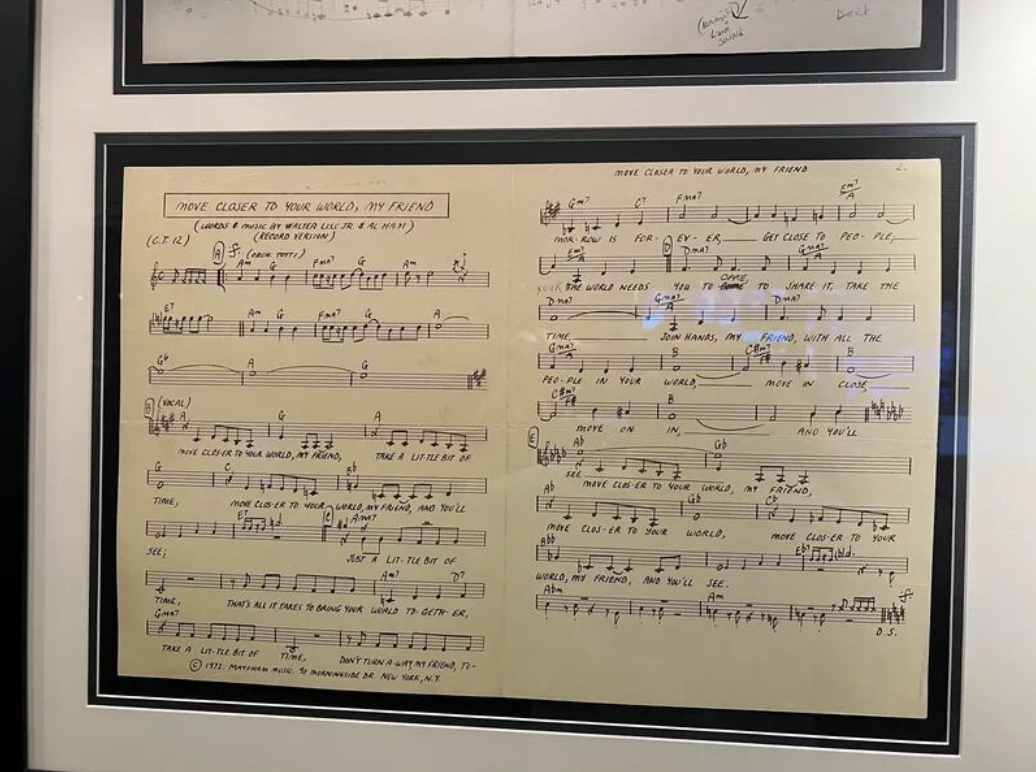
In the middle of office building renovations in 2012, Monsell found original handwritten notes from Liss and Ham, and a photocopy of the theme’s sheet music inside his desk drawer. Those now hang on the TV station’s history wall.

After a decade on display, the ink on the sheet music and handwritten notes began to fade and Monsell was tasked with finding a place that could restore the artifacts.

In September 2022, he reached out to the Conservation Center for Art & Historic Artifacts, where senior paper conservator Heather Hendry and others were able to treat the sheet music and handwritten notes.

Jessica Silverman, CCAHA’s director of conservation, said the center was able to remove the tape from the documents. Conservators also used pigmented inks to mitigate the fading issues, and developed a replica of the Liss-Ham notes page for display.

While every project is rewarding, Silverman said the Action News preservation has become a “tour favorite.” “People get real jazzed up about it,” she said.

After the project wrapped in April, the revived sheet music and replicated notes page are now on display at 6abc. The original light-sensitive notes, Monsell said, are stored in a temperature-controlled storage container.

The CCAHA project signifies the theme’s importance for people of the region, but 6abc is not shying away from addressing one of the more controversial moments in the station’s history: the changing of the theme song in 1996.

Planned for a late summer release, 6abc president Bernie Prazenica said, a mini-documentary will chronicle how viewers reacted to an “orchestrated” version of the opening theme that debuted on Sept. 20, 1996.

Liss and Ham’s original was updated by the London Philharmonic Orchestra, but viewers immediately took to their phones to bash the new interpretation. The criticism forced 6abc to pull it from the airwaves and place the original song back after three days.

“I think people who view it will get a real kick out of it,” Prazenica said. “I think it’s going to be fun to look back on that, especially for those who have heard the story but haven’t heard the music. They will get a chance to sample it.”

If you ask anyone at 6abc, Monsell said, there’s no way the Action News theme will be changed in the future. The original will always remain an integral part of the city’s identity, and he and others will continue to commemorate the song’s storied legacy.

Somewhere in a living room near Norristown, Chantry and his family are cheering that. Standing up, of course.

– The Philadelphia Inquirer