Benjamin Franklin’s oldest surviving letter is on display for the first time, thanks to a former Flyers president

In 1738, Benjamin Franklin wasn’t yet the revolutionary history remembers him to be. It had been 10 years since he had set up a printing house and nine since he began to publish the Pennsylvania Gazette, which often carried a list of his stock of imported books.

On June 2, 1738, he wrote a letter to John Ladd, a 17th century surveyor who helped fellow Quaker William Penn map out the city of Philadelphia, confirming Ladd’s book purchase. Ladd had bought The Ladies Library and the balance of a set of Cervantes, assumed to be John Ozell’s revision of Peter Motteux’s English translation.

Franklin also used the letter to advertise a “beautifully printed” five-volume set of The Odyssey.

“I send you the Ladies Library & the other two Vols. of Don Quixote,” it reads. “The Homers I have are done by Pope. The Iliads are in 6 vols. 12mo price 45/. The Odysseys 5 vols. 12mo price 37/6. They are beautifully printed and neatly bound. I will not part with them until I hear from you.”

This letter of receipt and everyday business, offering a glimpse into Franklin’s career as a prosperous Philadelphia bookseller and printer, belongs to the collection of Jay T. Snider, the former president of the Flyers and Spectacor.
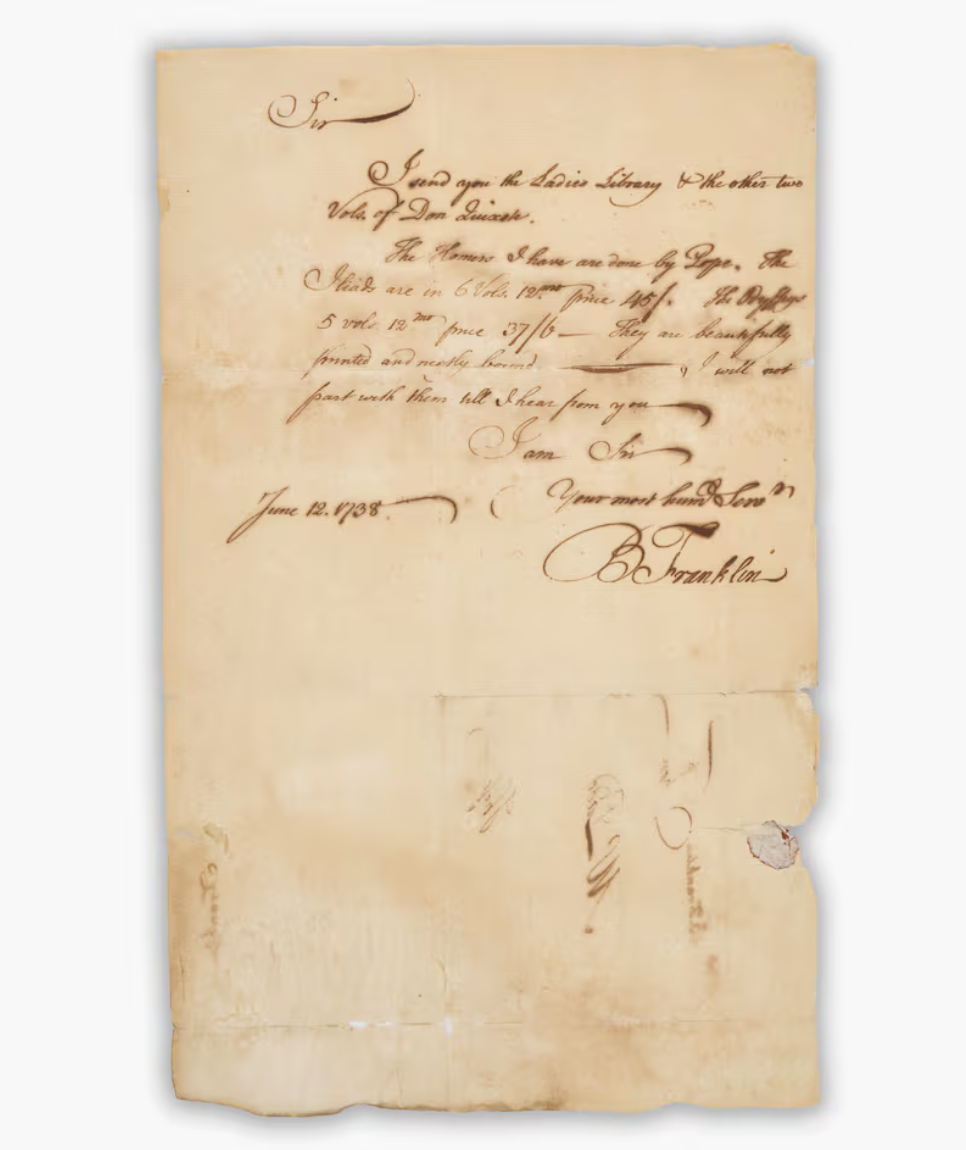
For Snider, who purchased the centuries-old letter from a Los Angeles-based academic nearly a decade ago, Franklin is “an endlessly fascinating human being.”

Two hundred and eighty-eight years after it was written, that letter — along with other highlights from Snider’s extremely valuable private collection of Franklin memorabilia – will be displayed at Library Company of Philadelphia, the institution that the author of the letter founded in 1731.

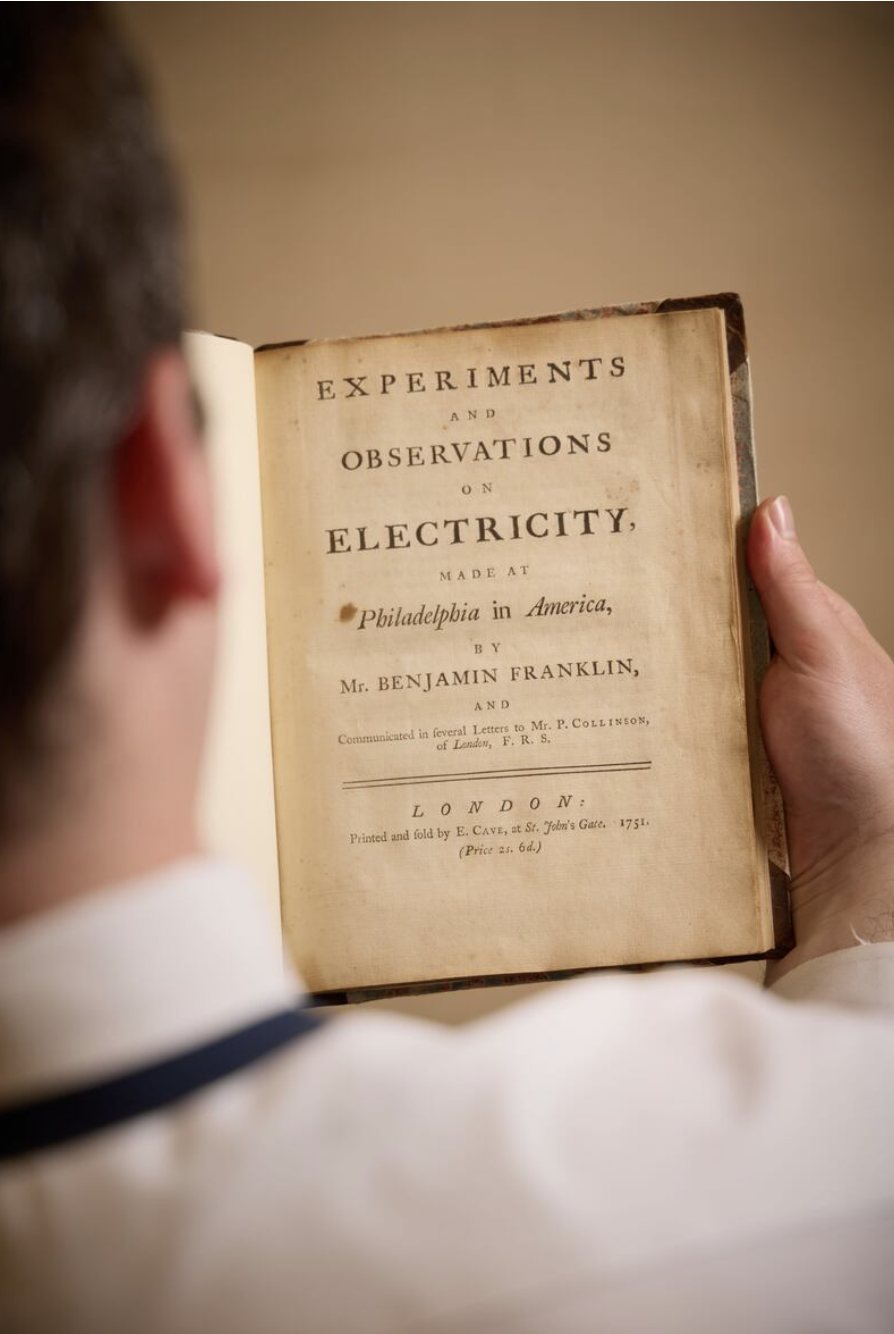
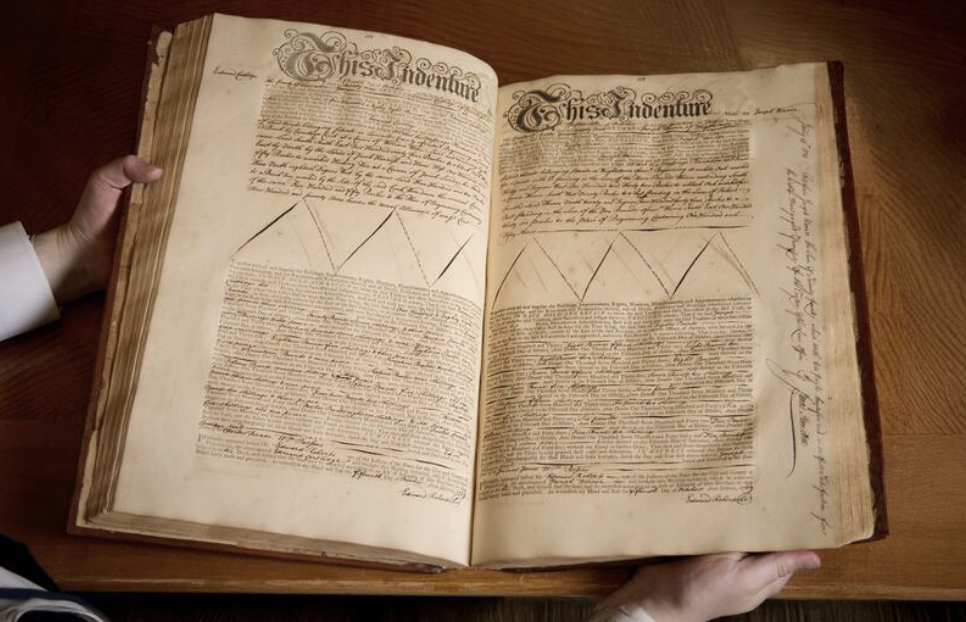
“The Jay T. Snider Collection of Benjamin Franklin” also includes a first edition of Benjamin Franklin’s Experiments and Observations on Electricity, 347 of Franklin’s promissory notes for the Pennsylvania Hospital, and the mortgage register that Franklin made during his first government printing job in 1729, among others.

The 1738 letter to Ladd is one of Franklin’s earliest letters to survive, and the earliest to ever come to auction, per the auction house Sotheby’s which will be auctioning parts of Snider’s collection next month.

“It’s the earliest Franklin letter I’ve ever seen. There hasn’t been an earlier one in the market since I’ve been collecting,” said Snider, whose collection, Sotheby’s calls “the best assemblage of Frankliniana offered for sale at auction in over 120 years.”

“Franklin’s letters turn up with some regularity. But to find one from the 1730s is essentially impossible,” said Selby Kiffer, senior international specialist for books and manuscripts at Sotheby’s.
A childhood passion to an adult collection

Like many kids growing up in the late 1950s, Snider was enamored with stories of cowboys and Native Americans, a passion that carried over into adulthood.

After graduating from the Wharton School in 1979, he began to collect books about American’s Western expansion. He started with Astoria by Washington Irving, which detailed Germany-born, American businessman John Jacob Astor’s failed attempt to establish a fur trading empire in the Pacific Northwest.

He read through dense bibliographies and bought more books on the subject, eventually finding an interest in the nation’s formation.

“Philadelphia is critical to that [history],” Snider said. “Philadelphia was central to our revolution and also the history before that. And then of course, I’m from Philadelphia.”

He soon narrowed his collection’s focus to Philadelphia, and eventually Franklin, after meeting Martin P. Snyder, who was a life-long Philadelphian who collected rarities such as the first edition of William Birch’s Views of Philadelphia, and other 19th century maps, engravings, and lithography.

Snider purchased the late collector’s materials in 2004 and auctioned several artifacts from it in a 2005 Christie’s auction, but held back Franklin’s items.

“That really became the greatest passion I’ve had in this,” he said.

His collection, Snider said, has included items he purchased for $10, and others — like George Washington’s letter to Benjamin Franklin, introducing him to the French military officer, Marquis de Lafayette — that Sotheby’s sold for over $1 million earlier this year.

“And I love them both equally,” Snider said.
‘Not a checklist collection’

The Library Company exhibition will mark the first time this material will be displayed for public view in Philadelphia. It will then travel to New York for an exhibition at Sotheby’s between June 20-24 before the auction.

Kiffer said Snider’s isn’t a “checklist collection,” but traces Franklin’s story as a book and almanac publisher to his life as a civic leader and scientist, postmaster, and diplomat.

Given Franklin’s connection to Philadelphia, Kiffer said it was important to bring the exhibition to the city before the New York auction.

“Philadelphia was the only possibility,” Kiffer said. “[Franklin] is in the city’s DNA, and to have the sale and exhibition limited to New York City, Franklin and Philadelphia deserve more.”
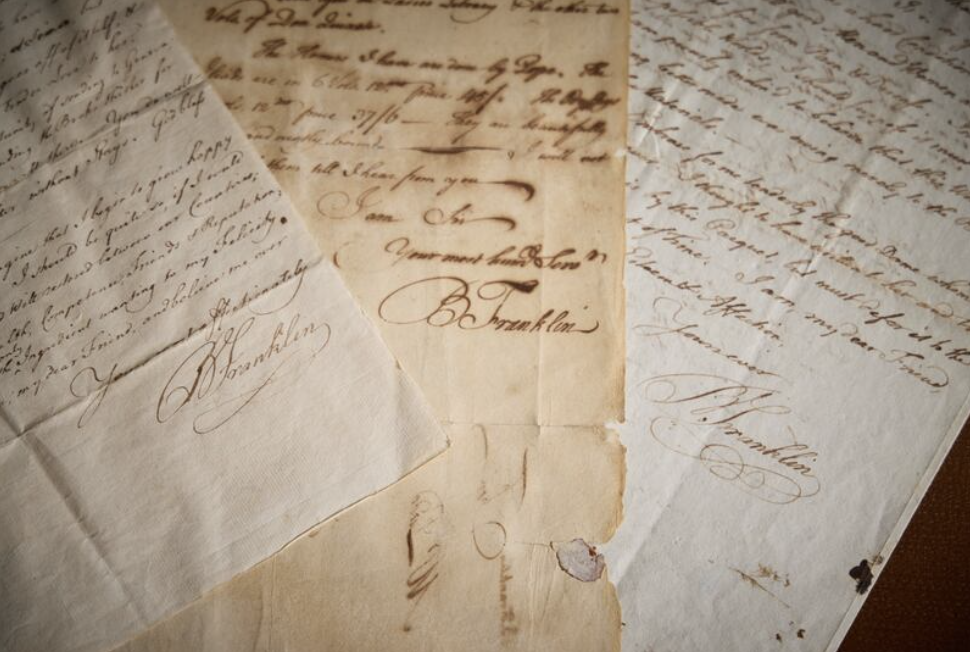
While the ultimate goal is to attract buyers for the collection, projected to total anywhere between $3 to 4.5 million, Snider said he hopes the highlights from his collection rekindle visitors’ interest in American history, and show them a side of Franklin that isn’t widely known.

“It’s always been my feeling that too many things end up on shelves somewhere, or in drawers. Somewhere that no one ever gets to see again. I’m hoping people just enjoy connecting with Philadelphia.”

“Highlights of the The Jay T. Snider Collection of Benjamin Franklin” is on view from May 5-7 at the Library Company of Philadelphia, 1314 Locust St. sothebys.com

– The Philadelphia Inquirer

Bryn Mawr College’s first Black graduate had to walk a mile to get to class. A new monument honors her journey.

D.C. artist Nekisha Durrett first took the “Black at Bryn Mawr” walking tour at Bryn Mawr College in February 2023. It was there that she learned about Enid Cook who, like her, graduated from Dunbar High School in D.C., considered one of the first academically elite public high schools for Black students in the country.

Cook went on to become the college‘s first Black graduate in 1931. She studied chemistry and biology.

Despite the wishes of former college president M. Carey Thomas and other faculty who rejected the idea of admitting Black students, Cook was permitted to enroll in the women’s college in 1927.

On her admission to the college, Thomas and her successor Marion Park barred the future microbiologist from living on campus, forcing Cook to walk roughly one mile to and from class.

“I do not myself feel it would be wise to admit a colored student into residence at Bryn Mawr at the present moment … I should perhaps add that Miss Cook’s passing the entire series of examinations at one time so successfully as to put her ahead of a long waiting list would seem to me in the case of any applicant very unlikely,” Park wrote in a letter to the Quaker activist Paul H. Douglas, who was advocating for Cook’s admission to Bryn Mawr.

On April 24, on that same campus, Durrett’s Don’t Forget to Remember (Me), was unveiled to a crowd of students, faculty, and residents, who marveled at both the size and detail of the public art work.

The monument, a “woven” pathway of custom clay bricks, forms a “square knot,” symbolizing an unbreakable connection and commitment to honor all of Bryn Mawr’s history.

Don’t Forget honors Cook and the Black servants and groundskeepers who maintained the campus during the early 1900s. It spans a 5,800-square-foot area, roughly the same length as Cook’s commute to Bryn Mawr.

“This campus was literally built on the backs of Black men and women, and that labor has been unrecognized as it always is,” Durrett said. “It was unrecognized and uncelebrated until Black students wanted to take on the responsibility of bringing their contributions to light.”

Rather than a single, elevated monument “frozen in time,” Durrett, a Cooper Union alumna, said she wanted something more dynamic and timely.

Among the pathway’s roughly 10,000 pavers are those engraved with the names of 248 Black workers and staff members whose contributions were hidden or “erased” by the college.

Each brick is glazed with soil from Perry House, a Black cultural center that was established after student protests in 1972, demanding a more inclusive curriculum and staff, and a culture house.

“The times that we‘re going through right now, we‘re witnessing the blatant attempt to erase and twist history,” Durrett said. “This has always been happening, which is job security for me because these stories are going to be uncovered.”

The monument is situated in the Cloisters of the Old Library, an enclosed space where the ashes of Thomas were scattered after her death. The library was once named after Thomas.

Bryn Mawr Africana Studies and Museum Anthropology professor Monique Scott said the space is a “haunting” location for many Black students.

“Students let us know that the Cloisters was a space where they didn’t feel welcome, and felt kind of heavy for them,” Scott said. “And with [Durrett’s] artwork, we‘re hoping that will shift that energy. It‘s about making Black and brown students feel very welcome here and in this space.”

Thomas, who died in 1935, rejected Black students and potential workers from entering the college, fearing their presence would tarnish its reputation. And for those who made it to campus, she attempted to limit their visibility.

Below the Cloisters are service tunnels, where live-in domestic servants and other personal staff worked.

Given the college‘s complicated history, Scott said students, faculty, and staff have conjured ways to uncover Bryn Mawr’s “untold stories” through the Art Remediating Campus Histories (ARCH) Project.

Following a student-led strike in 2020, Scott said, students, faculty, and staff established oral history projects, walking tours, and accessibility initiatives to unravel the hidden or misrepresented elements of Bryn Mawr’s history.

Among students’ demands was the installation of a public artwork that represented inclusivity. Durrett’s proposal was picked out of 110 applications.

Her previous works include “And The Ancestors Say…," located in D.C.’s Duke Ellington School of the Arts; “We See You” at New York’s Times Square; and “Magnolia,” which memorializes Black women who were murdered by law enforcement.

“From the beginning, it was so profound, amazing, emotional, and powerful. It was so many things,” Scott said.

Don’t Forget was built in partnership with Philly’s Monument Lab, a nonprofit public art, history, and design studio. Durrett was assisted by a group of student researchers, who dug into the school’s archives to find the names and origins of the school’s Black students and laborers.

From the dust-covered documents to charred-edged time cards from the 1900s to the ’30s, they discovered former porters, waitresses, and groundskeepers who had worked on campus. Some were from the Philly region, and others had ventured from as far as Virginia to study and work at the university.

Given Durrett’s “profound brilliance” and willingness to work so closely with Bryn Mawr students and department leaders, Monument Lab director Paul Farber said the monument came out just as he envisioned.

“A monument doesn’t just have to tell us about our past. But it can be done in a way that’s expansive and inviting,” Farber said. “Leave it to an artist like [Durrett] to respond in the most thoughtful and critical ways, and open up history anew in expansive terms.”

While Durrett understands one monument won’t rid the world of racism or discrimination, she‘s hopeful the path inspires future students, faculty, staff, and alums to continue honoring the Bryn Mawr’s full history and remember the names embossed on the clay bricks.

– The Philadelphia Inquirer

Yo Philly, we did it! The Visitor Center announces the city’s first Rocky festival

Nearly 50 years after the release of Rocky, Sylvester Stallone’s iconic Rocky Balboa remains an integral part of Philly lore. And this December, tourists and longtime fans will get to celebrate the first-ever RockyFest.

Following the success of last year’s Rocky Day, which drew thousands of spectators and fans dressed as their favorite boxer, the Philadelphia Visitor Center on Tuesday announced the first RockyFest. The center made the announcement atop the very Philadelphia Museum of Art steps made famous by Stallone in the 1976 Academy Award-winning film.

Visitor Center president and CEO Kathryn Ott Lovell said the weeklong celebration, which runs Dec. 3-8, will feature a series of free and ticketed events, including a 90-minute bus tour. The Rocky Bus Tour will take fans to Mighty Mick’s Gym, the Italian Market, and Adrian Balboa’s fictional grave site at Laurel Hill Cemetery, among other filming locations.

“We’re just excited to give people the opportunity to celebrate Rocky,” Lovell said. “Visitors want to run the steps and get a picture in front of the statue, but this is giving people a much more comprehensive experience.”

The festival aims to expand the fan experience that is already served by the Rocky Shop, located at the bottom of the Philadelphia Museum of Art steps, and Rocky Day, which Stallone attended along with his family and friend, actor Chevy Chase.

During his visit last year, Stallone called residents of Philly the true heroes.

“I want to thank you from the bottom of my heart — and Rocky’s, too, because we’re very close — to all of you who, believe it or not, are the real-life Rockys, because you live your life on your own terms, you try to do the best you can, and you keep punching,” he said.

Through partnerships with Visit Philadelphia, the Philadelphia Film Society, Philly PHLASH, and other organizations, RockyFest will help recreate Rocky and Adrian’s date nights at the University of Pennsylvania’s Class of 1923 Ice Rink and the Philadelphia Zoo. There’ll also be a Rocky marathon at the Philadelphia Film Center.

The Kennel Club of Philadelphia will host the “Southpaws at the Docks: Pugs and Mugs Yappy Hour” at the Cherry St. Pier on Dec. 5 to celebrate the bond between Rocky and his bullmastiff, Butkus. And historian Paul Farber, director of Monument Lab and host of The Statue podcast, will lead a discussion about the significance of the Rocky statue on Dec. 6.

“We’re excited about this year’s lineup of events and look forward to welcoming all who journey here to celebrate this cultural icon,” Visit Philadelphia president and CEO Angela Val said in a statement.

RockyFest guests will be offered free hotel parking and vouchers to the Rocky Shop, Val added.

Jennifer Nagle, vice president of special projects at the Philadelphia Convention and Visitors Bureau, is confident the festival will draw Philly natives in addition to out-of-towners. “I’m from South Philly myself, and there’s nothing more South Philly than what we just put together with this RockyFest, Nagle said. “It’s long overdue.”

For more information and tickets to the inaugural festival, visit phlvisitorcenter.com/rockyfest.

– The Philadelphia Inquirer

A stolen musket from the Revolutionary War returns to Philly

An 18th-century musket that’s linked to the Revolutionary War was stolen in 1968 from Valley Forge Park, leading to years of investigation. When the cherry wood and brass-made firearm, once a part of the Valley Forge Historical Society Museum collection, went missing, it left many historians and investigators in limbo for decades.

But with help from Upper Merion Township detectives and the FBI’s Art Crime Team, the prized relic was returned to the Museum of the American Revolution on Monday.

The .78-caliber musket was displayed on a blue cloth-covered table, just under the dramatic painting, Siege of Yorktown in Virginia. Museum president and CEO Scott Stephenson held the antique in his hands, noting how the details etched in the gun’s 45-inch barrel and engraved butt plate noted its historic origins.

“There were no machines cranking these parts out,” Stephenson said. “This is literally hammer in hand, steel, iron, brass, and wood carefully pinning these pieces together.”

The retrieval of the 250-year-old firearm was a battle on its own. Until recent months, there was no trace of the musket for 56 years.

In 2009, Kevin Steele of the Montgomery County District Attorney’s Office reopened a cold case on the theft of antique firearms from the Valley Forge Historical Society Museum and several law enforcement agencies joined the effort to retrieve them. Among these firearms was the New England musket.

On the local level, Upper Merion Township Detectives Brendan Dougherty and Andrew Rathfon were tasked with retrieving the musket, as well as other Revolutionary War antiquities. Between 2016-2022, they were joined by the FBI Art Crime Team, the U.S. Attorney’s Office, and others on the investigation.

The collective effort resulted in the arrest of two people and the recovery of 50-60 historic items that were returned to 25 different museums along the East Coast. But dozens of artifacts were still missing, including the treasured musket.

In March, Massachusetts-based arms appraiser Joel Bohy spotted an early 1770s firearm during an antique gun show in Baltimore, which ended up being the one stolen from Valley Forge Park.

Bohy knew it was Rhode Island-made. The engraved butt plate signals its New England origins. But he didn’t know the significance of the artifact until he saw a press release from Upper Merion Township detectives.

“When I first saw the gun at the show, I was pretty excited about it because it’s a really rare gun,” Bohy said. “It was even more exciting when three weeks later, Upper Merion Township police sent me a press release with the missing things retrieved from the cases they worked on before. As as soon as I saw [the musket], I clicked on the images and went, ‘Oh my God, I saw this gun weeks ago.’”

Bohy reached out to Dougherty and Rathfon, who he had worked with on cases before. The next day, the FBI team interviewed Bohy, and the two parties were able to track down the musket and deliver it to the insurance solutions company, Chubb.

Chubb paid the insurance claim for the missing relic back in 1969, which meant that it was now its official owner. Since the Museum of the American Revolution acquired the collection of the Valley Forge Historical Society back in 2003, the organization decided to gift the musket to the museum.

“We’ve obviously devoted many years to this investigation and we’re still going. But it’s special because it was stolen from our home,” Dougherty said. “And to know after 56 years it’s home is nice because it’s such a local historic item.”

With the firearm now in the hands of Stephenson and the museum’s curators just days before July Fourth, Chubb executive Maria Thackston said it’s a “poetic” story of repatriation.

“We’re thrilled to give it back to them, allow them to continue to study it, and make it available for the public to enjoy it,” she said. “It’s our privilege.”

While there are no current plans to exhibit the rare firearm, the museum will continue to study the artifact until plans for display unfold at a later date.

Staff writer Raymond Ragland contributed to this article.

– The Philadelphia Inquirer