Bryn Mawr College’s first Black graduate had to walk a mile to get to class. A new monument honors her journey.

D.C. artist Nekisha Durrett first took the “Black at Bryn Mawr” walking tour at Bryn Mawr College in February 2023. It was there that she learned about Enid Cook who, like her, graduated from Dunbar High School in D.C., considered one of the first academically elite public high schools for Black students in the country.

Cook went on to become the college‘s first Black graduate in 1931. She studied chemistry and biology.

Despite the wishes of former college president M. Carey Thomas and other faculty who rejected the idea of admitting Black students, Cook was permitted to enroll in the women’s college in 1927.

On her admission to the college, Thomas and her successor Marion Park barred the future microbiologist from living on campus, forcing Cook to walk roughly one mile to and from class.

“I do not myself feel it would be wise to admit a colored student into residence at Bryn Mawr at the present moment … I should perhaps add that Miss Cook’s passing the entire series of examinations at one time so successfully as to put her ahead of a long waiting list would seem to me in the case of any applicant very unlikely,” Park wrote in a letter to the Quaker activist Paul H. Douglas, who was advocating for Cook’s admission to Bryn Mawr.

On April 24, on that same campus, Durrett’s Don’t Forget to Remember (Me), was unveiled to a crowd of students, faculty, and residents, who marveled at both the size and detail of the public art work.

The monument, a “woven” pathway of custom clay bricks, forms a “square knot,” symbolizing an unbreakable connection and commitment to honor all of Bryn Mawr’s history.

Don’t Forget honors Cook and the Black servants and groundskeepers who maintained the campus during the early 1900s. It spans a 5,800-square-foot area, roughly the same length as Cook’s commute to Bryn Mawr.

“This campus was literally built on the backs of Black men and women, and that labor has been unrecognized as it always is,” Durrett said. “It was unrecognized and uncelebrated until Black students wanted to take on the responsibility of bringing their contributions to light.”

Rather than a single, elevated monument “frozen in time,” Durrett, a Cooper Union alumna, said she wanted something more dynamic and timely.

Among the pathway’s roughly 10,000 pavers are those engraved with the names of 248 Black workers and staff members whose contributions were hidden or “erased” by the college.

Each brick is glazed with soil from Perry House, a Black cultural center that was established after student protests in 1972, demanding a more inclusive curriculum and staff, and a culture house.

“The times that we‘re going through right now, we‘re witnessing the blatant attempt to erase and twist history,” Durrett said. “This has always been happening, which is job security for me because these stories are going to be uncovered.”

The monument is situated in the Cloisters of the Old Library, an enclosed space where the ashes of Thomas were scattered after her death. The library was once named after Thomas.

Bryn Mawr Africana Studies and Museum Anthropology professor Monique Scott said the space is a “haunting” location for many Black students.

“Students let us know that the Cloisters was a space where they didn’t feel welcome, and felt kind of heavy for them,” Scott said. “And with [Durrett’s] artwork, we‘re hoping that will shift that energy. It‘s about making Black and brown students feel very welcome here and in this space.”

Thomas, who died in 1935, rejected Black students and potential workers from entering the college, fearing their presence would tarnish its reputation. And for those who made it to campus, she attempted to limit their visibility.

Below the Cloisters are service tunnels, where live-in domestic servants and other personal staff worked.

Given the college‘s complicated history, Scott said students, faculty, and staff have conjured ways to uncover Bryn Mawr’s “untold stories” through the Art Remediating Campus Histories (ARCH) Project.

Following a student-led strike in 2020, Scott said, students, faculty, and staff established oral history projects, walking tours, and accessibility initiatives to unravel the hidden or misrepresented elements of Bryn Mawr’s history.

Among students’ demands was the installation of a public artwork that represented inclusivity. Durrett’s proposal was picked out of 110 applications.

Her previous works include “And The Ancestors Say…," located in D.C.’s Duke Ellington School of the Arts; “We See You” at New York’s Times Square; and “Magnolia,” which memorializes Black women who were murdered by law enforcement.

“From the beginning, it was so profound, amazing, emotional, and powerful. It was so many things,” Scott said.

Don’t Forget was built in partnership with Philly’s Monument Lab, a nonprofit public art, history, and design studio. Durrett was assisted by a group of student researchers, who dug into the school’s archives to find the names and origins of the school’s Black students and laborers.

From the dust-covered documents to charred-edged time cards from the 1900s to the ’30s, they discovered former porters, waitresses, and groundskeepers who had worked on campus. Some were from the Philly region, and others had ventured from as far as Virginia to study and work at the university.

Given Durrett’s “profound brilliance” and willingness to work so closely with Bryn Mawr students and department leaders, Monument Lab director Paul Farber said the monument came out just as he envisioned.

“A monument doesn’t just have to tell us about our past. But it can be done in a way that’s expansive and inviting,” Farber said. “Leave it to an artist like [Durrett] to respond in the most thoughtful and critical ways, and open up history anew in expansive terms.”

While Durrett understands one monument won’t rid the world of racism or discrimination, she‘s hopeful the path inspires future students, faculty, staff, and alums to continue honoring the Bryn Mawr’s full history and remember the names embossed on the clay bricks.
– The Philadelphia Inquirer

Kendrick Lamar, SZA go full speed at the Linc for the ‘Grand National Tour’

The victory lap continues for Kendrick Lamar. The Compton rap star has journeyed a path few have blazed in hip-hop history.

He sparred with global phenom Drake and came out with a slew of No. 1 hits, five Grammy wins in 2025, and a record-setting Super Bowl halftime performance that will be dissected by hip-hop scholars for years to come.

But Lamar’s behemoth, “Not Like Us,” is only a glimpse into his true musical powers.

Aside from his 22 Grammys and a Pulitzer, the 37-year-old artist has drawn tens of thousands of concertgoers for an already record-breaking stadium tour.

Lamar and R&B supernova SZA generated $9 million for the opening concert of their "Grand National Tour” last month in Minneapolis, making it the highest grossing hip-hop show in music history.

The tour’s momentum remained immaculate at Lincoln Financial Field for Lamar and SZA’s stop in Philly on Monday night.

As DJ Mustard played a a 30-minute set by DJ Mustard, who played classics like “Swag Surfin’” by Fast Life Yungstaz and “We Are Young” by fun., thousands of fans slowly trickled into the stadium.

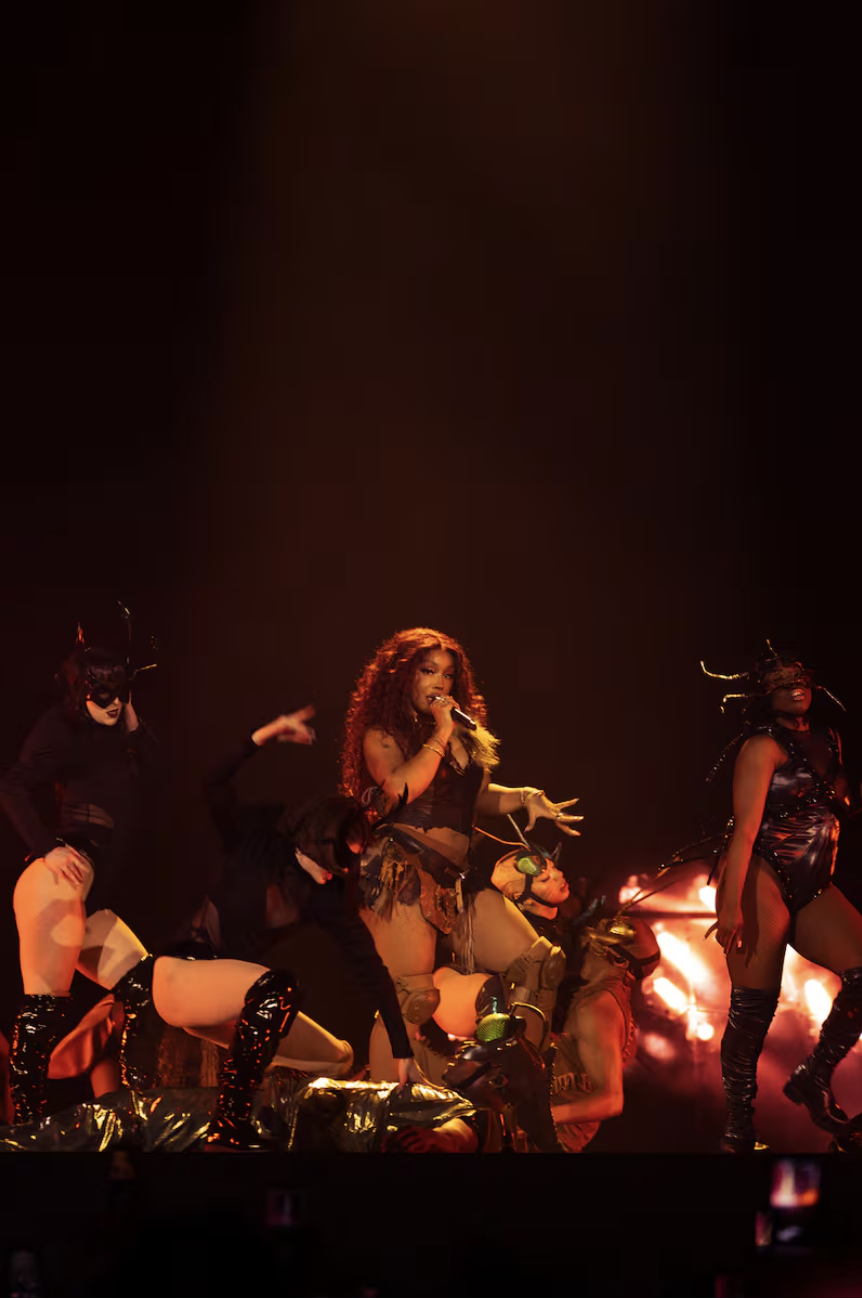
As the stadium lights flickered, Lamar rose onto the stage. He kicked off the show inside his now-trademarked Buick GNX, rapping the GNX album opener “wacced out murals,” embraced in smoke.

The show featured short skits of Lamar arguing with a lawyer-like disposition, mocking Drake’s recent attempts to take legal action following last year’s grudge match.

Even SZA, born Solána Rowe, gets in on the action. She’s seen correcting the off-camera lawyer’s pronunciation of her stage name in one video, then countering accusations that she has sought dysfunctional relationships for creative purposes.

That fiery intro set the tone for the show, which was adorned with hits from his platinum-selling GNX and SZA’s repackaged deluxe album, Lana.

Once Lamar closed out the first of eight acts with “tv off,” SZA rose to the stage with the same GNX, but perched on top of its moss-covered hood. While Lamar’s “squabble up” and “m.A.A.d city” reflected his rugged Compton roots, SZA basked in sultry tunes like “Love Galore” and “Broken Clocks” as a labyrinth of vines, praying mantises, butterflies, and other bugs flashed across the background screen.

The five-time Grammy winner was in full bloom, showcasing both her roaring vocals and sleek dance routines. While there were moments that seemed off pitch, she recovered as smoothly as her outfit changes.

Decked in knee pads and low-rise safari shorts, the “Scorcese Baby Daddy” singer serenaded the crowd with dazzling slow jams like “Kitchen” and hard-hitting tracks like “Low.” She took her bug fascination to new heights during “Garden (Say It Like Dat),” hopping on a giant mechanical ant she affectionately named “Anthony.”

Lamar’s performance remained sharp, calculated, and grounded. He attacked songs like “Like That” and the showstopper “Not Like Us” with unnerving intensity, while balancing the cunning bars with party records like “peekaboo” and SZA-assisted duets like “All the Stars.”

While the artistic contrasts between Lamar and SZA could alienate crowds, the pair found the perfect equilibrium throughout the nearly three-hour concert.

Lamar’s lyrical performance was impressive throughout the show, but moments like the Playboi Carti cover “Good Credit” and the sequencing of “Count Me Out” did stifle a bit of the momentum. But with over 50 songs shared between the two artists, most performed in full, there was bound to be a break in the action.

As the stadium tour journeys across North America and Europe, their Philly stop proved to be a balancing act with an Olympic-level landing. The concert was a melding of two performers, who are as electric together as they are on their own stages.

– The Philadelphia Inquirer

Dawn Staley, proudly ‘made in North Philly,’ wants everybody to know where she is from

No matter where Dawn Staley has gone in her basketball journey, she has taken Philadelphia with her as a companion, a teacher, and an inspiration.

In 1992, she was dropped from the U.S. National Women’s Basketball Team that won a bronze in the Barcelona Olympics because, she said to ESPN in 2021, of her lack of international experience and 5-foot-6 stature. Four years later, the undersized point guard led the team to its first gold medal in eight years.

After racking up five WNBA All-Star selections and two more gold medals, the North Philadelphia born-and-raised Staley was inducted into the Women’s Basketball of Fame in 2012.

In 2000, after initially rejecting the idea, she began coaching the Temple women’s basketball team, and soon transformed the program into a formidable one.

In 2008, she took over at the University of South Carolina, where her brash, old-school coaching style has led to three NCAA titles.

In her head, though, she is the same quiet, thumb-sucking kid, the scrappy guard from North Philadelphia’s Raymond Rosen housing projects, who has continued to honor her neighborhood, Staley said to The Inquirer over Zoom last week.

That love for Philly shines through in her memoir, Uncommon Favor: Basketball, North Philly, My Mother, and the Life Lessons I Learned From All Three.

“I’ve always respected where I grew up. I always carry my upbringing with me,” Staley said. “I’m unbothered by most things that are very challenging to others. It doesn’t matter, as long as it gets done. That’s what growing up in the projects does for you. And if you utilize the lessons, it will help you navigate through life.”

Released on Tuesday, the 239-page book takes readers to her childhood home on what has now been named Dawn Staley Lane, and reveals the dark moments that accompanied her personal and professional breakthroughs and losses.

Staley grew up in North Philly’s Strawberry Mansion, at 25th and Diamond Streets. This, she says in her book, shaped her into the fierce leader she’s become.

“My upbringing had taught me toughness, resilience, and that I could survive,” she writes.

She said she “saw women on TV playing basketball twice a year growing up. They probably played more than that, but I wasn’t in the house long enough … I saw national championships and I saw the Olympics and was like, ‘Oh, that’s what I want to do. That’s it.’”

Staley credits her unrelenting competitiveness, discipline, and gritty attitude to her no-nonsense mother, Estelle Staley, her four opinionated siblings, and her days playing pickup games at Moylan Recreation Center.

The recreation center, now named in honor of late Philly legend Hank Gathers Jr., is where Staley discovered her love of basketball. She was obsessed with the sport from the moment her first jump shot pierced the nylon net. And when boys passed her up for games, Gathers encouraged them to give her a chance.

Staley, on the other hand, refused to share her basketball unless she was among the first 10 players picked.

In her memoir, Staley details those formative moments, from Dobbins Technical High School to the Olympics. She also includes her true crime obsession.

Staley addresses the depression and mental fatigue she faced after winning the gold in 1996, the stockpile of injuries that shortened her pro career, her apprehensions to coaching, and the media bias she felt was directed at her South Carolina team during the 2023 NCAA tournament run.

“The book was relatively easy,” she said. “I’m an open book anyway. I don’t really hide anything. I just don’t really remember stuff. But the book made me remember stuff, so what I remembered, I’m going to share.”

Staley wasn’t inspired to write a book until a 2022 interview with Power 105.1 FM‘s The Breakfast Club, when radio host and author Charlemagne tha God asked her if she wanted to write one. She brushed it off, much like that initial coaching offer from Temple athletic director Dave O’Brien. But after a third national title run at South Carolina, she was ready to put her story to paper.

“A lot of people were asking me to do a book for such a long time,” she said. “It just didn’t seem like the right time to do it when they were asking … And then, when we had that undefeated season last year, it really sparked me to say, ‘This is really the time.’”

Her mother, Staley said, “was a disciplinarian.”

“And being the youngest child and not really having a say in your household because you have older siblings that are very opinionated, there were no freebies,” she said. “I got nothing easy. Nobody said, ‘Here you go.’ Everybody said, ‘Hey, we’re not going to give you anything. We’re going to challenge you, and we’re going to do it for the greater good of you.’”

Although she didn’t really understand that as a young person, “I think it forces you to create thick skin, toughen your armor, and it gives you pride to overcome the hurdles that’s thrown your way.”

Thus, the name Uncommon Favor.

Though she now lives in Columbia, S.C. Staley never veers too far from North Philly. She wears Eagles jerseys while coaching and her phone screen saver reads, “Made in North Philly.”

“I just think people really appreciate who I am, what I’ve become, and the fact that I never shy away from telling people where I’m from — no matter where I am, what country I’m in, or where I live. Everybody knows."

The city has embraced her right back.

In the coming weeks, Mural Arts will unveil the design of a new Dawn Staley mural on 28th and Diamond Streets, commemorating the hoops legend nearly 30 years after Nike revealed Staley’s first mural on Eighth and Market in 1996.

While she loves the public dedications, Staley hopes that Uncommon Favor, and her continued pursuits, inspires young Philadelphians roaming the same outdoor courts, recreation centers, and Chinese food spots as she did as a wide-eyed kid.

She also wants Philly to see the book and her story as a shared one, not just her own.

“It’s about us,” she said. “It’s not only my journey, but our journey. And I just think it’s going to be relatable to everybody that understands our hood.”

– The Philadelphia Inquirer

Key Glock On Channeling 2Pac With 'Glockaveli' & How The New Album Marks A "Rebranding"

After delivering a series of trunk-rattling hits and Billboard Top 20 projects, Key Glock stepped away from music in 2024 for personal and creative realignment. Upon his return this year, the Memphis rapper had inked a deal with Republic Records. While it was perhaps an uncharacteristic move for the independent star, it fulfilled an important promise.

Born Markeyvius Cathey, Key Glock followed in the footsteps of his cousin and mentor Young Dolph. And one week before the late rapper was fatally shot in their hometown in 2021, Dolph urged Glock to sign a major label deal if anything ever happened to him. In the years since, Glock has continued to praise Dolph in his music and carry on the independent label the "Major" rapper co-founded, Paper Route Empire — and with his new venture, he's able to honor Dolph's legacy and take his own career to the next level. 

The partnership deal with Republic allows the "Let's Go" rapper to maintain his long-standing relationship with PRE while granting him a wider musical audience. As he declared to Billboard upon announcing the deal, "I feel like I exceeded my goals as an independent artist… In this next chapter, I'm planning on getting platinum albums and more plaques."

Glock formally kicked off his major label era on May 2 with Glockaveli, his fourth studio album. Inspired by 2Pac's Makaveli persona, the project channels the same trap-infused sound and motivational anthems that have become parables to his artistry — from the soulful "Watch Da Throne" to the booming, DJ Paul-produced "3AM in ToKEYo."

Like Machiavellian themes laced throughout 2Pac's posthumous classic, Glockaveli hints that Glock is determined to make a bigger mainstream splash, no matter how much work is required. And with a new album, a 20-city tour and another planned project on the horizon, "South Memphis' finest" is already full speed ahead.

Below, Glock discusses the "rebranding" that led to Glockaveli, why he channeled 2Pac with his latest album, and how he plans to top himself with his new musical venture.

How was it piecing together your first mainstream album? I heard you had family and friends vote on which songs deserved to be on the final track list.

It was definitely [hard]. I grabbed like five groups of 10, and I just took votes out of all the 50 songs. It went from 50 songs to 30 songs, to 20 and 18 songs. Once I did that, by the time I was done, I had five or six different track lists. 

I didn't just go with the s— that I liked. I didn't want to be biased. I'd rather have other people's feedback. They're fans, but they're not my fans. They're my people. They're going to tell me what's right and what's wrong, music related or not. 

The album sounds like an elevated version of the sound you've already established. Did you work with any new producers or collaborators for the album?

No new producers. Everybody is from day one. [I worked with] Tay Keith, King Wonka and Mannie iL. Everybody else you heard from this album is who you probably heard from my first or second mixtape. 

I couldn't help but notice the 2Pac and Makaveli connection. What inspired the album title and sound?

It came from 2020 or early 2021. Me and Young Dolph planned after my Yellow Tape series, I was going to do the Glockaveli stuff anyway. A lot of people don't even know I already had the chain pre-made and everything. But stuff happens. After a while, I wasn't focused on it any more. I didn't care for music anymore. 

But last year, when I took the time away from music, and got my mindset right and my personal life set back the right way, I was recording. I never stopped recording. And it was all these different types of songs and music. It just sounded like a way stronger Glock than any other version of Glock.

You talked about this album symbolizing new beginnings. In what way? Is it personally, musically, or a mixture of both?

Both. It's a rebranding. That's how I look at it. 

There's no features on the album. Why such a bold move for your major label debut?

It's a self-confidence thing. I have strong faith and belief in myself, and I just like proving people wrong. I don't mind being the underdog sometimes. 

I'm glad I'm like that because it motivates me to always try to do something better than the last thing I've done. I never get content or satisfied with whatever I just did. I'm trying to top that now. 

You signed a partnership deal with Republic Records back in March. Was that a strategic move to help you take further steps in your music career?

Of course, it will help. But if I didn't have the work ethic and drive that I have — Republic could do the most, but it starts with me. I can't be 50 percent, and [the label] is 100 percent. We both have to be on the same page, and that's where we are.

With everything you have going on, do you feel like you're the face of Memphis? Or even the South?

I never look at stuff like that. I never even aimed to be looked at like that. I just be me, bro. I let people take it how they want. 

Outside of music, you've talked about starting an acting career. What's an ideal role for you?

I'm still waiting for somebody to call me or come get me. I'm slowly showing it myself in my own music videos. And eventually, I'll shoot my own s—, too. Once I get addicted to writing and shooting my own movies, it's over.  

I write most of my [music video] treatments now. Not 100 percent, but most of it is my idea. Every video you've seen, seven times out of 10 it's my idea. 

You've also teased that you'll be dropping another album for your fans this year. Can you reveal any previews of the project?

[The fans] are going to be satisfied. Well, not even satisfied. They're still going to be hungry. It's like you can't get enough of Glock, basically.  

Any surprises fans can expect on the Glockaveli Tour that kicks off May 21?

I can tell you to expect the unexpected. My shows are lit. I'm a rock star. 

– Grammy.com

The Impact Of Jay-Z's 'Reasonable Doubt': How The GRAMMY Hall Of Fame Album Introduced An Icon

It's hard to believe that no one wanted to sign Jay-Z in the mid-'90s.

Before he became one of rap's most decorated and celebrated moguls, the Brooklyn-bred emcee, born Shawn Carter, faced so much rejection from record labels that he was forced to release his first album independently. Little did the naysayers know, that project marked the beginning of perhaps rap's most prosperous career.

Arriving June 25, 1996, Reasonable Doubt introduced Jay-Z as a rapper who wasn't afraid to tell a gritty tale, and who would do so with a captivating and calculated delivery. The album's 14 tracks offer stories of cut-throat street hustling, near-fatal bouts with opposition and the lavish lifestyle acquired from a life of crime — narratives that were true to his background. But that also hinted that Hova had a hunger and wisdom that would take him far.

Reasonable Doubt's now-iconic black-and-white cover further leans into the album's mafioso themes, with then-26-year-old Jay in a suit and brimmed cap, cigar in hand. The cover "was really more like establishing him as this timeless character from Brooklyn. Styled out, sharp and clean," photographer Jonathan Mannion explained to Revolt.

On May 16, the album will be honored with an induction into the GRAMMY Hall of Fame, alongside impactful works by Santana, Luther Vandross, Emmylou Harris, Fela Kuti & Afrika 70, and Cat Stevens. The inducted recordings will be celebrated at an exclusive gala in Los Angeles.

While 1998's Vol. 2… Hard Knock Life is Jay's most commercially successful album, and platinum projects like Blueprint and 4:44 are among his most personal records, Reasonable Doubt was the musical spadework that made all his ambitions possible. The project — which sold roughly 420,000 units by the end of 1996 —  laid the foundation for the legendary emcee, whose contributions inspired generations of artists.

Jay-Z has often talked about his love for Reasonable Doubt, asserting that it's his favorite album in a 2013 interview with "The Breakfast Club": "That's the joint it took my whole life to make."

But the journey to his first album didn't come easy —  yet that's exactly what made Reasonable Doubt so special.

Jay-Z's early collaborations with fellow Brooklyn emcees and mentors Jaz-O and Big Daddy Kane flashed his tongue-twisting rhymes and fast-twitch sound, but records like 1989's "Hawaiian Sophie" failed to convince execs he was anything more than a sidekick to a bigger name. In true hustler form, Hov decided to take matters into his own hands.

"I had to put [Reasonable Doubt] out myself, nobody would sign me," Jay-Z said in a 2001 interview with MTV. "I went to every single record label and they were like, 'This guy is terrible.' He's nothing."

Recorded between 1994-1995 at the former D&D Studios in Manhattan and released independently via Jay-Z's own Roc-A-Fella Records, Reasonable Doubt was elevated by contributions from DJ Clark Kent, Irv Gotti, DJ Premier, Ski, Knobody, and other contributors. Featuring dialogue from Scarface and Carlito's Way, the album leaned into stories that seemed to be torn from the pages of life in the Marcy Projects of Brooklyn.

Part of Jay-Z's genius is in the diversity of offerings on Reasonable Doubt. Tracks like "Politics as Usual" offered a 360 view of the dark and unforgiving drug underworld; "Dead Presidents II" became a generation-spanning motivational anthem; "22 Two's" was a lyrical exercise executed in flawless fashion; and "Can't Knock The Hustle" was a radio-friendly serving.

"Reasonable Doubt showed a mentality of the bosses versus the runners," rapper Tone Hooker said in 2016's Reasonable Doubt documentary, RD 20. "In the '90s, everybody wanted to be the best rapper. Now, everybody wants to be the best hustler."

Similar to Nas' 1994 classic Illmatic, Reasonable Doubt reshaped the genre. Jay introduced a new generation of hip-hop fans to luxury rap. Rather than rapping about his superior flow as was common at the time, Jay talked about hustling your way to exclusivity — like taking boat rides to foreign land while sipping Moet.

Along with rhymes of caviar scoops and margarita sips on "Cashmere Thoughts," the closer "Regrets" reflects on the life-altering costs of these choices — from imprisonment to paranoia and death. Songs like "Can I Live" and "Coming Of Age" flashed his razor-sharp lyrics and street wisdom, while songs like "Ain't No N—" revealed his commercial appeal. The project was further elevated by guest appearances from Mary J. Blige, Foxy Brown, Jaz-O, and The Notorious B.I.G., the latter of which became all the more impactful following Biggie's death in 1997.

The album proved to be the introduction Jay and Roc-A-Fella Records needed. "Had I gone to a label, I don't think I would have been able to fully explore what was really happening," Jay said in a 2023 interview with Gayle King.

Frustrated by record label rejections, Jay, Damon Dash, and Kareem "Biggs" Burke used the funds from their singles-only deal with Payday Records (which spawned Jay's "In My Lifetime" and "I Can't Get With That") to establish an imprint of their own. Roc-A-Fella was born from the trio's ability to "rock" or outmatch a fellow emcee on the mic, and their drive for riches like real-life businessman John D. Rockefeller. The label would eventually birth or accelerate the careers of Kanye West, Beanie Sigel, N.O.R.E, Cam'ron, and others.

After landing a distribution deal with Priority Records, which gave Roc-A-Fella the resources they needed to make a notable splash, Jay was the sole artist and musical backbone of the newly-formed company. And with his growing talent, and the support of top-end producers, Jay was prepared to put himself and the label on the map.

Reasonable Doubt launched Jay-Z to stardom. He went from selling CDs of his single "In My Life" from the trunk of his white Lexus at near-empty college campuses to becoming the most dominant force in hip-hop throughout the late 1990s and 2000s. While it didn't land on the top of the Billboard charts, or garner much buzz on the day of release, it established Roc-A-Fella Records as a formidable hip-hop music label and Hov as a premiere face of the genre.

After the success of Reasonable Doubt, Jay-Z notched bonafide No. 1 hits like "Empire State of Mind," 14 chart-topping albums, and 25 GRAMMY wins and a staggering 89 nominations — making him the most celebrated rapper in Recording Academy history. While it's hard to imagine any other artists achieving Jay-Z's level of success, his first body of work certainly provided breadcrumbs. The path he blazed as an artist and billionaire-mogul was sparked with the release of Reasonable Doubt.

Nine BYOBs to try on the Main Line

BYOBs are as essential to Philadelphia-area food culture as cheesesteaks, hoagies, water ice, and soft pretzels.

With Pennsylvania’s notoriously strict liquor laws and expensive licensing fees, many restaurants in the Philadelphia region opt to go the BYOB route — helping fuel a vibrant dining scene where diners bring their own bottles to some of the area’s top spots.

Here are some Main Line BYOBs worth uncorking something special for.

Fraschetta BYOB

This intimate Bryn Mawr BYOB serves refined Italian fare in a cozy, elegant setting. Now owned by restaurateur Phuong Nguyen, Fraschetta continues to deliver satisfying housemade pastas and rich entrées, including creamy mushroom pappardelle and slow-braised wild boar in tomato sauce, finished with cocoa powder and Pecorino Romano.

📍816 W Lancaster Ave., Bryn Mawr, Pa. 19010, 📞 610-525-1007, 🌐 fraschetta.net

Dua Restaurant

In a sea of Italian spots, Bryn Mawr’s Dua Restaurant stands out for its traditional Mediterranean fare and cozy elegance. Chef Bledar Istrefi offers savory appetizers like burek and mussels pepata, and finely crafted bites like the pistachio crusted branzino and the mouthwatering pomegranate braised short rib over Israeli couscous.

📍 1000 W Lancaster Ave., Bryn Mawr, Pa. 19010 📞 484-380-2053, 🌐 duarest.com

Burrata Havertown

A sibling to its popular South Philly location, owners Dejvi Furxhi and Albi Furxhiu brought the charm of their Italian BYOB to the suburbs. Positioned on the bustling street of Eagle Road, Havertown’s Burrata location is adorned with Italian landscape portraits and cozy decor. The welcoming environment is complemented by delicious appetizers, pastas, and entrées, with items like truffle cream gnocchi and barramundi in garlic white wine sauce.

📍 26 E Eagle Rd., Havertown, Pa. 19083 📞 610-808-9933, 🌐 burratahavertown.com

The Choice Restaurant

Looking for a romantic night out? This 50-seat BYOB serves up Euro-fusion dishes with Ukrainian, French, and Asian touches. The restaurant, owned by Iryna Hyvel and her husband Volodymyr “Vlad” Hyvel, offers entrées like branzino with crispy potato balls, mushroom ragout, and striped bass ceviche.

📍 845 Lancaster Ave, Bryn Mawr, Pa. 19010 📞 484-383-3230, 🌐 thechoice-restaurant.com

Villa Artigiano Ristorante BYOB

This family-owned Ardmore restaurant boasts a menu of multiregional Italian favorites. Patrons can start with a small charcuterie board or other small plates before digging into signature dishes like gnocchi artigiano in fresh tomato basil sauce or pollo limone topped with crabmeat and a white wine sauce.

📍53 W Lancaster Ave., Ardmore, Pa. 19003, 📞 484-414-4997, 🌐 villaartigiano.com

Bam Bam Kitchen

From fried rib-eye and pork kimchi mandoo combos, to Korean fried chicken wings, and seafood pancakes, this Ardmore BYOB is booming with rich Asian flavor. Diners can enjoy Korean drink options like banana milk and the sac sac grape and orange flavors, or enjoy their own bottle while relishing over Bam Bam Kitchen’s succulent dishes.

📍 31 E. Lancaster Ave., Ardmore, Pa. 19003, 📞 484-844-7827, 🌐order.bambamkitchen.com

Tiramisu Cucina Romana

This Chester County gem blends the BYOB model with a full cocktail bar, offering the best of both worlds. Tiramisu specializes in Roman-Jewish cuisine with refined flavors. Menu highlights include red snapper with pine nuts, raisins and balsamic vinegar, or lobster ravioli with lump crab and cognac sauce.

📍 720 Lancaster Ave., Berwyn, Pa. 19312 📞 610-906-3299, 🌐 tiramisuberwyn.com

Ryan Christopher’s

This family-friendly Narberth favorite is helmed by chef Michael Klaumenzer, who cooks and oversees a menu packed with crowd-pleasers. Crafted from locally sourced ingredients, the Narberth eatery’s dishes include an award-winning French onion soup and entrées like grilled New Zealand lamb chops, sesame-seared salmon, and a chicken and shrimp cacciatore.

📍 245 Woodbine Ave., Narberth, Pa. 19072 📞 610-664-9282, 🌐 ryanchristophersbyob.com

Veekoo

Tony and Shelly Li’s stylish BYOBs, which expanded to the Main Line after opening in Royersford in 2003, continue to deliver savory Chinese, Japanese, and Thai favorites. Offerings include sushi rolls and signature plates like the Hong Kong-style soft shell crab and General Tso’s Chilean sea bass served with steamed jasmine rice or brown rice.

📍 761 W. Lancaster Ave., Bryn Mawr, Pa. 19010, and 564 Lancaster Ave., Berwyn, Pa., 📞 610-615-5118 and 484-318-7655, 🌐 veekoorestaurants.com

– The Philadelphia Inquirer

Japan’s king of carrot cake is a baker from York, Pa.

In December 1984, York, Pa., native Kyle Sexton gathered his belongings and left his life and career as a photo finisher in New York City behind.

The then-27-year-old boarded his first plane ever with little apart from $300, a small collection of books, and his love for Japanese food, language, and customs. He knew, even then, he wouldn’t look back. But he didn’t know he’d wind up becoming one of Tokyo’s most celebrated American-style bakers.

“My only goal was to live [in Tokyo]. I didn’t think about what I was going to do for work, or any of that … When I moved, I was just happy to be here,” Sexton said.

For more than three decades, Sexton, 67, has woken up at 6 a.m. to make the four baked goods that he sells at his Tokyo bakery, Kyle’s Good Finds: cheesecake, banana bread, brownies, and his famous carrot cake.

The four items — and a slew of other seasonal goods like zucchini bread, applesauce spice cake, and cherry pie — are at the heart of the Black-owned and family-operated bakery in the retro Nakano City neighborhood.

Since opening the bakery on March 8, 1992, Sexton’s pastries have been a hit with Japanese critics and international tourists alike. His carrot cake, though, has remained the star of the menu. “I only bake as much as I want to bake, and I work at my own pace. But people come here for the carrot cake, and that’s what I make the most,” he said.

When it comes to the recipe, Sexton is somewhat of a traditionalist. He uses the same core ingredients listed in dozens of recipe books: flour, sugar, eggs, freshly grated carrots, spices.

“When the Japanese press interviews me, they ask me the same question: ‘How do you make your carrot cake?’ And I always tell them, ‘It’s no different,’” Sexton said. “The only difference is I grind my own spices, and I suppose it’s a stronger taste. The cinnamon is larger than the cinnamon that you will find in a supermarket,” he said.

Once baked, the cake is topped with lemon-flavored cream cheese frosting — a simple, yet mouthwatering addition that makes the trip to Nakano that much sweeter. Thanks to a handful of culinary awards and a surge of social media buzz, Sexton’s bakery is now a must-stop for travelers who make the pilgrimage to the international food city.

The William Penn Senior High School grad has often ventured back to York over the years to attend family reunions. His fondest memories of home include spending time with his 45 first cousins, a number that has now expanded to 53. He didn’t spend much time in Philly growing up, but visited often when his daughter Safia attended UPenn.

Long before Sexton opened the doors to Kyle’s Good Finds, he worked as a photo finisher across New York, Pennsylvania, and Rhode Island. It wasn’t until he moved to New York that his interest in Japanese culture became an “obsession.”

After trying his first sushi in 1978, he was hooked. He began studying the language and Japanese customs, and soon formed a small circle of friends in New York, who later connected Sexton to friends they had back home in Japan.

Like many Americans who venture abroad, he first worked as an English teacher at a Japanese middle school. He turned to baking as a means to unwind after a workday.

A mix of cookbooks and several rounds of trial and error later, he perfected his carrot cake recipe and started bringing the spiced treat to his friends’ parties. They convinced him to make it a business.

After Sexton taught for seven years, three of his friends gifted him $10,000 each, and a fourth found the building that would later house Kyle’s Good Finds. Sexton and his wife, Shimizu Hikage, have run the bakery since.

“I never thought it was anything special,” Sexton said. “They seem to think it’s something special, but I didn’t know what all the hoopla was about. Before I was on the internet, I was always in the Japanese press.”

Sexton married Hikage in 1986 and they have four children: Kyle II, Elena, Xavier, and Safia. Xavier Sexton joined the business three years ago. The 23-year-old assists Sexton, who intends to pass the business to his youngest child.

But a retirement doesn’t seem too appealing to the longtime baker. “It’s just what I love to do,” Sexton said. “The shop is my sanctuary.”

– The Philadelphia Inquirer

A tree that bears 40 different fruits takes root in the Temple campus

Artist Sam Van Aken grew up on his family’s farm in Douglassville, Pa.

As a result, his favored medium to create art is a process called tree grafting. It involves taking a scion, or a desired piece of one plant, and combining it with the rootstock of another. The fusion creates a single plant that either sprouts the same fruit or shares elements of the both the trees.

He was introduced to tree grafting as a kid on the farm, spending years nurturing fruit trees from seed to full bloom.

He explored other mediums for his art, but kept returning to grafting. “It always stuck in my head,” Van Aken said. “I thought it was miraculous that you could take a part of one living thing, cut it, insert it, and stick it on to another living thing. It was absolutely fascinating to me.”

Only he didn’t stop at two combinations. Van Aken, an associate professor in Syracuse University’s art department created Tree of 40 Fruit, a live tree that sprouts 40 different stone fruits, thanks to grafting.

“I always felt like I worked in partnership with the tree, but it’s also very much a partnership with the people where the trees are,” Van Aken said.

The first Tree of 40 Fruit was planted in the Syracuse campus in 2011, and there are 25 more of them in locations throughout the country including in Maine, Indiana, New York, and California. The Tree’s latest installation was planted on Temple University’s Tyler School of Art and Architecture campus on March 14.

The Temple Tree will burst out in crimson and white blooms this spring. And by late summer, stone fruits such as peaches, plums, apricots, nectarines, and cherries are likely to sprout from its branches. All the varieties, the artist said, will be specific to the kinds that grow best in Philadelphia weather.

“One hundred years ago we were growing fruit for taste. But now we grow it for how long it will last while it’s shipping, or if it will look good at a grocery store. Taste and nutritional value are like fourth or fifth priority,” Van Aken said.

Along with beautifying the Tyler School courtyard, the live sculpture will be a means of agricultural preservation, as it will grow stone fruit varieties that aren’t commercially produced or widely available. Students will be allowed to pick the fruits and eat them.

The agricultural artist often dives deep into the provenance, or the origins, of specific fruit varieties. Sometimes, it takes him back by 2,000 years.

One story involves the Lenape People who were native to the Philadelphia area. An English settler stumbled on an apple tree they had planted and wanted to buy it. “It didn’t register in their philosophy because you can’t own a tree anymore than you can own air,” Van Aken said.

The cost of reserach, labor, and maintenance of such trees “can be prohibitive for individuals,” Van Aken said. So he primarily aims to place them in public settings. “Placing the trees in a public context also pays tribute to the Lenapy philosophy that no one can own a tree only be gifted from its abundance.”

To ensure Temple’s fruit tree thrives in the Pennsylvania sun, Van Aken found a bulletin from the Pennsylvania Department of Agriculture that was released in the late 19th century. The report listed fruit varieties that were recommended for the Philadelphia area, and those are the ones he used to graft the sculpture.

Climate change, he said, “has become an overwhelming concern.” But it’s not necessarily one that hasn’t been paid heed to in the past. In Gettysburg, the site of the famous Peach Orchard battle, the Sherfy family was monitoring cold hardiness in peaches in the 1870′s “with the idea that long peach blossoms were better for colder climates than short blossomed types.”

Van Aken’s trees usually spend their first three to five years in a nursery, after which the artist carves out a plan to graft them and plant them in soil. Thereon, he visits them four or five years.

“It’s weird,” he said, “but it totally changes your perception of time. I’m like, ‘Oh, that’s a year away?’ and it feels like it’s tomorrow.”

The Tree is part of Tyler’s 8th Annual Jack Wolgin Visiting Artist program, which brings influential artists and thinkers to the campus for a free public lecture and to lead hands-on workshops with Tyler students.

“Sam’s work is absolutely ideal to bring our students together across different to see how those [different] disciplines can be synthesized in the creation of a tree that’s also a sculpture, and is also an embodiment of cultural histories,” Tyler School dean Susan Cahan said. She hoped he would bring students of differing disciplines together for a campus-wide project.

For his project, Van Aken worked with Tyler students to plant an apple tree at Tyler’s campus site in Ambler, Pa. This tree, he said, is composed entirely of apple varieties and will ultimately grow 40 different types of apples originating or historically grown in Southeastern Pennsylvania.

Van Aken, who believes an intimate engagement with nature to be essential, is excited to see how the Temple community members respond to the trees in full bloom.

“Seeing a seed grow into a plant,” he said, “is all the magic you need in the world.”

– The Philadelphia Inquirer