The chipped pieces of Isaiah Zagar’s fallen mosaic are trinkets of Philadelphia’s history

Isaiah Zagar’s famed mosaic, Skin of the Bride, has seen its last days.

For more than 25 years, the 7,000-square-foot mural wrapped around the former Painted Bride Art Center. But on Thursday, Philadelphia’s Magic Gardens’ restoration team finally chiseled away the remaining tiles and gathered usable pieces with hopes of creating a memorial honoring Zagar and the original mosaic.

After hearing that tiles would be available for people to pick up at the mosaic site, Fishtown resident Jenna Countie knew she had to make a trip to Old City.

“As soon as I saw the announcement … my brain immediately was like, ‘Alright, I need to get my hands on some of them,’” she said. “I didn’t know what I was going to do with them; I just wanted to keep them somewhere.”

Countie remembered seeing Zagar’s work along the streets of South Philly in her youth, but it wasn’t until she wrote a research paper on him in college that she fully realized his artistic genius. As the years passed, she continued to marvel at Zagar’s work and dedication to his craft. Once news about Skin of the Bride’s destruction made its rounds, it was a “massive blow” to her. “It symbolizes how the city doesn’t prioritize art,” she said. “It’s really a sad, sad moment.”

Countie intends to turn Zagar’s tiles into a picture frame, but if they’re hard to assemble, she will put them in a shadow box with a picture of the mural. Then she will attach a plaque with Zagar’s name and include a little description of the mosaic so she can see an inkling of Philly history every time she passes by the box, just as she did walking the streets of Old City.

“They’re not just tiles, it’s really a piece of art and history because it’s been here so long,” Countie said. “[Zagar] is 84 years old. He’s probably not going to be making more art like this, so this [is] cool and personal to have — even just a few pieces of it.”

PMG events and marketing manager Allison Boyle said the organization is moved by the support of the greater community and the reverence residents like Countie and others have for Zagar and his work .

“We know Zagar’s work is a part of the fabric of Philadelphia and helps to make this city such a special and unique place to live and visit,” Boyle wrote in a statement. “It’s our hope that all those who have been touched or angered by this story will contact their city representative and ask them to recognize the importance of Zagar’s art to Philadelphia, and join us in fighting to save future murals from destruction.”

Zagar worked 12- to 15-hour days for nine years to create Skin of the Bride, one of the largest public murals of his storied career. Developer and architect Shimi Zakin wanted to preserve the full mural and build apartments above, but neighbors sued to stop the city from granting him the zoning exceptions he said he needed.

Considering the history of the site and her experience getting to know Zagar over the years, Tracy Buchholz said she couldn’t help but grab some tiles to place in her office.

“I met [Zagar] nine years ago, and I watched and photographed him creating mosaics across the city,” said Buchholz, who works for the company that supports PMG’s public relation efforts. “He doesn’t just slap these things against a wall. They come alive piece by piece, resulting in something beautiful.”

Holding onto tiles from the mosaic is important for her “because I understand what went into it. [Zagar had] so much passion and love for the Painted Bride and for the community.”

“His work is meant to be shared, discussed, and appreciated. Walking past any of his work makes me smile on a bad day and get creative on a good day,” she said.

Countie is hopeful the city will rally together to preserve Zagar’s remaining work. His art makes people appreciate Philadelphia’s “imperfections,” she said, and it’s important the fight to protect his work continues.

– The Philadelphia Inquirer

At night, he’s laying down verses. By day, rapper Anthony ‘Dappa’ Samuels runs a day care in West Philly

Electrifying performances, late-night studio sessions, and endless tour stops: The lifestyle is second nature to Philly rapper Anthony “Dappa” Samuels, whose connections and lyrical prowess have landed him on stages with some of the biggest names in the industry.

Equipped with punchy lyrics and a charisma-fueled appeal, the 30-year-old has performed with the likes of Fabolous, Machine Gun Kelly, Action Bronson, and Ty Dolla $ign. He’s collaborated with Westside Boogie, Stalley, Benny the Butcher, and other notable hip-hop stars.

But that’s only half his story.

Between the late nights in the studio and the days traveling from one tour stop to the next, Samuels happily embraces his role as “Mr. Anthony,” the owner of West Philly’s Young With Options Academic Center.

After quitting a job in accounting back in 2017, Samuels was encouraged by one of his mentors to pursue his love for child care and open the learning center. That year, he began operating out of a rowhouse at 53rd and Market Streets. “My overall vision was to have a creative arts program or creative art school,” he said. “That’s been a passion of mine for a long time, and we’ve been able to incorporate it here.”

The day care’s multicolor marquee hangs outside a powder blue rowhouse adorned with painted clouds. The space is a wonderland for young kids with bright eyes, endless energy, and an insatiable appetite for learning.

As Samuels walks through the day-care doors, kids look up from their cots with smiles as bright as the center’s crayon-colored walls. “Hey, Mr. Anthony,” they yell out in cheer.

Samuels and assistant director Dinnelle Jordan help organize poetry, music, and acting classes in the multi-floor space. Last month, they started a dance studio on the top floor, where they teach majorette, hip-hop, ballet, and other dance and exercise courses.

Most of the children hail from low-income families from West Philly.

Janelle Walls has been bringing her 7-year-old daughter to Young With Options since she was 1. Walls continues to send her child because of Samuels’ influence and willingness to support her family, even when she couldn’t afford the fees.

“One word I use when speaking about [Samuels] is ‘alignment,’” she said. “He isn’t at the school preaching positive behavior to the kids and then going into the studio and pushing a different message. Everything about him and what he does is consistent with the Young With Options brand. To me, it’s a message to kids that you can be yourself and still be successful.”

In the five years she’s worked with Samuels, Jordan said he’s been a consistent light of positivity. While other rappers dive into fast food chains and clothing lines on the side, his venture into child education speaks to his love for the youth, she said. “The fact [that] he helps other families go to work while looking after their children was a brilliant idea,” Jordan said. “It just goes to show how much he cares about his community.”

As a kid growing up in the Strawberry Mansion section of North Philly, Samuels said he seldom saw Black men with legitimate businesses, especially those revolving around childcare. “I love being able to be there and be hands-on,” he said. “I take a lot of pride in that, and it actually helps me with music and in life. I know I have to be that mentor and can’t do anything illegal, snap out, or make bad decisions. I have to stay solid.”

Samuels said being a day-care owner has had an impact on his music. He’s made a conscious effort to veer away from lyrics heavily revolving around street life. He knows his students are listening to his music, and their parents are keeping a watchful eye.

“I’ve seen and been through a lot,” he said. “I’m from the same environment that the kids in my day-care are from. I was one of those little kids, too. That’s what I love about being here. A lot of these kids, especially the little boys here, look like me and act like I did at one point in time.”

Samuels performed at the 2023 Roots Picnic Music Festival and acted alongside Danielle Macdonald in the film Patti Cake$. He was a stand-in for Michael B. Jordan in 2015′s Creed.

Legendary Philly artist Freeway said Samuels’ rap skills alone were enough to connect the two artists. But after hearing about Young With Options and the rapper’s other endeavors, he knew Samuels was cut from a different cloth.

“He’s always trying to go to the next level and push the envelope,” the “What We Do” artist said. “I feel like he’s going to have a long career and branch off into movies and different things outside of music every once in a while.”

Samuels said he wants to continue expanding as an artist and entertainer. But in that pursuit, he plans to open more academic centers so more children have a place to hone their creative arts skills.

“It’s all about me making a difference,” Samuels said. “I’m really big on the people, so I’m working to get bigger and have more day cares in the future.”

– The Philadelphia Inquirer

Who is ‘irregular’? Meet the artist behind the tag showing up all over the city.

On the face of eroded barricades, rotting alleyway dumpsters, dark under-passes and window-sized wood panels, the word “irregular” has become an increasingly regular sight for Philadelphians — and a mark of artist Sean Hassett’s growing presence.

Hassett, who goes by the moniker “Irregular” or “Irregular Sean,” has spray painted and penned his graffiti tag across the outskirts of West Philly to Chinatown, Spring Gardens, Brewerytown to the beating heart of Center City. Yet, his identity and motive are largely cloaked in mystery.

“I have no backing and there’s no system that I’m part of that’s helping generate what I’m putting out,” Irregular said to The Inquirer.

“I’m trying to show people that you don’t have to take the normal route, you can do it on your own.”

While he was drawn to the word “irregular” as a kid growing up in Darby, he didn’t put his talents to the canvas until he was released from George W. Hill Correctional Facility after a one-year stint in 2013.

While incarcerated, Irregular befriended an inmate who used to draw images on the letters he wrote to his loved ones in exchange for soup cans. Before the man was released, he gave Irregular all of the stencils and art tools he used to craft his work. That moment, he said, opened the door for his own artistic pursuits.

“Coming home with that record and no college degree, (it) pushed me to devote myself to my craft,” Irregular said.

Over the years, Irregular started creating acrylic paintings and mosaic-style works made from fragmented mirror pieces.

In 2020, the now-33-year-old artist began spraying his graffiti tag across Philly. He was partly inspired by the protests following George Floyd’s murder and the work of Germantown artist Nomad and Ghuls creator Lami Tolla. and he says his style and approach is influenced by Banksy and Basquiat.

Though he documents his art on Instagram, Irregular does not post pictures of himself on social media. (He did not agree to be photographed by The Inquirer.) He says he usually only leaves home for daily necessities and to sell and make his street art.

“I’m very withdrawn, and I’ve been very solo in what I’ve done over the years,” he said. “I’ve stuck to myself, and I don’t get into politics or institutions of the art scene... I try to contain my energy as much as I can. I think what I’m doing has some power to it, and I’m not trying to withhold it.”

When he peeks his head outside his home studio, he’s usually decked in paint-spotted garments, riding his bike with a spray paint can and white-out pen stashed inside a mid-sized pouch in pursuit of a new location for his work. In a matter of minutes, he coats the nine letters of “irregular,” and ducks off slyly without drawing attention.

“I just move with common traffic,” he said. “I like to say I move with the wind.”

He still sells his work in Rittenhouse Square, but tries to stay in the background and doesn’t approach onlookers until he sees a “magic moment” happen.

“I always wanted to create things that sell themselves on the street,” he said. “I don’t say, ‘Hey, look at this,’ or have a sign telling people to buy my work. I just stand a couple feet away, lean up against a pole and observe.”

Along with graffiti and mirrored artwork, Irregular sells mystery boxes, deep profile canvas and wooden-framed paintings on his website, with pieces ranging between $100 to $2,000.

It’s impossible to know how many tags he’s placed in the city. He stopped counting years ago but still feels a rush of leaving his mark. It’s like psychotherapy, he said, motivating him to satiate his appetite for more artistry and self-expression.

He views his work as a source of reflection, with the mirror pieces and word “irregular” serving as a symbol of self-identity and a magnet that draws a connection between him and the viewer. But rather than being packaged as a “street artist,” he prefers no title at all. “You can’t put a spotlight on a star. I’m just doing the work. Irregular is a statement, (and) the work emits a light of its own.”

Some Philadelphians view his tags as playful breadcrumbs. Some see it at as a link to a thought-provoking series, and others — especially on social media — see it as vandalism. “Artfully committing vandalism is still vandalism,” a Twitter user said.

I take objection to the term “artist”. He’s a criminal. Artfully committing vandalism is still vandalism.

— JohnsCow (@johns_cow) April 10, 2023

I dunno. Ask the “artist” to tag your front door.

— TappahannockName (@Allfortime0503) April 10, 2023

Resident Peter Gambino, however, welcomes this art.

“Philly has such a big and diverse art scene, so we might as well have a few mystery people working in that space,” said Gambino who first spotted Irregular’s tags six months ago. “[His work is] like little easter eggs placed along the infrastructure of our city.”

Other onlookers aren’t too fond of Irregular’s work . “I hate their tags,” says Philly resident Alex Fredericks. “(They’re) too long and aggressively style-less.”

Despite the mixed responses from passers-by, Irregular has become a sought-after talent in Philly’s art scene. He created two projects with Mural Arts Philadelphia. The first was a temporary mural for last year’s Wawa Welcome America; his work Mural Magic is irregular was featured at the 2023 Flower Show.

He was also tapped by Hyatt Centric Center City to be a part of the hotel’s monthly Maker Series back in January. Elizabeth Fricke, director of sales and marketing at HCCC, said Irregular’s approach to street art made him a natural fit for the series that spotlights the work of local artists.

Photo blogger Conrad Benner, who worked with Irregular on the Mural Arts projects, called Hassett an innovator. “He’s at this point in his career where all the doors are open to him, and he’s jumping through them,” he said. “That’s to say, he’s driven and taking advantage of this lane he’s made for himself.”

An “irregular” tag along 11th St. by Spring Garden in Philadelphia.Heather Khalifa / Staff Photographer

As more opportunities come along, Irregular said he will continue to etch his path as an independent artist, and break down barriers that may be in his or other artists’ way.

There’s no set direction in mind, he said. For now, he plans to sell more of his artwork and hopes to expand his brand globally.

“I’m not a starving artist, I’m a hungry artist, and myself and others know there’s much more potential past these walls,” he said. “I’m continually pushing myself, trusting my evolution and allowing everything to come my way. I want to stay on my trajectory and see Irregular grow 10 times bigger.”

– The Philadelphia Inquirer

Breaking barriers and opening doors: Philly artists are finding new spaces to showcase their creations

Few spaces are as essential to Philly arts as the city’s history-rich museums and art galleries. The institutions house some of the most prized artifacts and antiquities in the country, and serve as a domain for unknown artists to become international fixtures.

But for Lauren Fiasconaro and other Philly-based creatives, the barrier to entry is often too steep, forcing many artists to turn to local cafés, restaurants, bars, and other alternative spaces to showcase their artwork.

“This is definitely something that’s been cropping up more and more,” said Fiasconaro, 30, who’s currently displaying her cyanotype photography at Northern Liberties’ Mammoth Coffee. “More than half of my ideas came from seeing artwork in places that I wasn’t expecting, and there’s some amazing work in places and venues you wouldn’t expect.”

Philly sculptor Jonathan Santoro, 39, said local artists have taken matters into their own hands.

“Groups of artists are growing tired of white cube galleries and rejecting the status quo while being intentionally anti-commercial,” he said. “More artists are taking the reins and displaying their artwork how they want.”

Rather than wait for spots to open at established art institutions, artist Sue Moerder began hosting small showcases in hair salons, restaurants, bars, and even pet shops under the group philacitywithart. She started the 500-member Facebook page to forge more opportunities for local artists to display and sell their work without having to jump through hoops to get into galleries and museums.

Moerder, who makes sculptures from animal skulls, said the city is flooded with local talent, but the exclusivity of certain spaces has led many artists to seek other ways to sell their work and make ends meet.

“Galleries are great, but they’re very hard to get into,” Moerder, 62, said. “I think one of the harsh realities of being an artist in Philadelphia is that many people can’t survive solely doing their art. Most have to work to support it, which is a shame because there are too many talented artists. And when you’re exhausted and you’re mentally drained, it’s hard to create. It’s frustrating.”

Recognizing the shortage of accessible art spaces, Gleaner’s Cafe owner Stephen Hencheck fills the shop’s walls with the work of local artists as a way to spotlight the city’s talent and build the confidence of newer creatives hesitant to display their designs.

With the cafe’s name partially inspired by Jean-François Millet’s painting The Gleaners, Hencheck said the decision to add these works was an important one. Not only has the move drawn more eyes to local artwork, it’s helped struggling artists fully profit from their creations, rather than fight for higher commission splits in more traditional spaces.

Hencheck allows creatives to fully profit from their work, while more notable galleries have commission splits that teeter between 30% and 50%, he said.

“We just try to keep a starving artist from starving so we can look at their work,” Hencheck, 44, said.

“If your business is your community, you should make it your business to support that community. That doesn’t apply to everyone, and it doesn’t have to. If creativity and culture are what you believe your base is and what makes the neighborhood your business is in, why wouldn’t you try to support that?”

Through partnerships with nearby galleries, the Fitler Club is combining the influence and resources of established spaces to fuel its own alternative venue.

The urban social club has Philly-made pieces throughout its center, a move Visual Arts Director Tricia Maloney said has connected the club’s members to the city’s creative forces, and given more local artists a platform to spread their wings.

“Our hope is that there may be a lower barrier to entry to engage with the art in a place like the Fitler Club,” Maloney, 41, said. “It’s not a gallery — we tried to take that intimidation factor out of the equation, even to the extent that I coordinate the program and I don’t have an arts background. It’s really about relationship building.”

Fitler Club cofounder Michael Forman said the addition of alternative art spaces doesn’t diminish the importance of established art institutions in Philly. It’s an added way to support local creatives and place a brighter spotlight on the work they produce.

Along with the Gleaner’s Cafe and Fitler Club, Fiasconaro said venues and organizations like Persimmon Coffee, Underground Concepts, and Feminist Flea are opening doors for artists in the LGBTQ and Asian American and Pacific Islander communities, as well as others that have been marginalized by their race, ethnicity, sexuality, and identity.

Having these spaces, Fiasconaro said, is key to a more inclusive and well-rounded arts scene.

“Historically, gallery spaces are and can be very inaccessible for a lot of people,” she said. “I have definitely encountered that as well. But I’m seeing more inclusivity in this trend of alternative spaces, which is amazing. It’s been a long time coming.”

Fiasconaro is hopeful more opportunities for artists of all creeds will open up in museums and galleries. And as Philly creatives continue to carve out nontraditional platforms, the artists and businesses receive the support they deserve.

– The Philadelphia Inquirer

Local artist, educators praise ‘Abbott Elementary’s Mural Arts episode

ABC’s Abbott Elementary spotlights the transformative powers of the Philly arts in a new episode featuring Mural Arts Philadelphia.

On Wednesday’s episode, titled “Mural Arts,” the school’s history teacher Jacob Hill, played by Chris Perfetti, secures a visit from a representative of Mural Arts who is looking to work with students on a painting that reflects the legacy of the school.

For some Philadelphians, the episode felt like the icing on the cake of a show they already feel represents their communities so well.

Read More

No fade on prices: Why Philly barbers are charging $100 and up for haircuts

Kenneth Carruth IV, the North Philly native known as The4thKen on social media, has made waves (literally) with his haircut tutorials and videos. The 20-year-old barber has amassed more than 1.8 million likes on TikTok, with his biggest video reaching over 2 million views. But it’s not always his clean lines and tight fades that are attracting attention.

In one video, Carruth showed off a mid-fade and noted, “My client paid me $80 for this haircut.” Other videos list prices well above $100. While some viewers were in favor of the price tag, others called the haircut a “scam” and wrote how their barber could do the same job for $15.

Before the COVID-19 pandemic, Carruth also charged $15 per head. But with more demand, and the rising cost of running a business, he had to raise his rates.

“I feel like pre-pandemic, barbers were undervalued,” Carruth said. “Now, barbers are starting to realize their worth and see that it’s not just about the cut. You’re providing an experience.”

And he isn’t alone.

According to the Bureau of Labor Statistics, haircut prices rose 6.8% in November 2022 from the same time a year before, which is the largest annual increase since the fact-finding agency started tracking the category. Men — who are used to paying with a single bill for their cuts — are noticing.

In the past, local barbers engaged in price wars with neighboring shops to have an edge on clientele. If one shop offered cuts for $20, another would offer them for $15. But the pandemic crippled small-business owners, said Damon Dorsey, 61, president of the American Barber Association. Barbers and other service workers were among the hardest hit.

To stay afloat, many chose to raise their rates.

Southwest Philly barber Nicky Prosseda, 40, said the seismic blow of the pandemic also inspired barbers to sharpen their business practices.

From the mid-20th century to recent years, Prosseda said, barbers enjoyed the benefits of cash-in-hand transactions and tax-free loopholes. But as the industry evolved, the slow rise in haircut prices didn’t match the hikes in beauty product prices, booth rentals, and Venmo and CashApp fees. And for many, it made barbering unlivable as a primary income source.

Prosseda, who charges $75 a cut, is the director of Philly’s Modern Male Barber Academy. “I truly believe that there’s this kind of pain for the sins of our forefather barbers and the past owners,” he said. “They didn’t teach us the best things in the industry, so you pass it down.”

Based on data collected in May 2021, the Bureau of Labor Statistics estimated that most barber salaries range between $22,430 and $53,260. Prosseda said that may be barbers’ reported income, but a lot have been making $50,000 to $100,000 for years. And with even more resources at their disposal, he estimates they will start to rack in upward of $150,000 per year going forward.

Along with better business practices, Dorsey said, barbers are now able to leverage their social media presence to draw in more clients willing to pay top dollar. Apps like Booksy and StyleSeat help barbers manage customer information and schedule haircuts. Barbers like Carruth have used them to expand their brands beyond their corner or neighborhood.

By building his social media brand, Carruth was able to open his own barber studio in Kensington. After turning his social media followers into loyal clients, he saved enough money to get a business license and land the small commercial space in August 2021.

“I know a lot of barbers that are great at cutting hair, but they suck at running a business,” Carruth said. “And with that, you can’t charge what you want because you’re just going purely off skill.”

While most of his clients understand his raised prices, West Philly barber Jalen Thompson, 23, said he’s had customers leave to look for lower rates. Thompson, who charges $45 to $75 for haircuts and more than $120 for house calls, is comfortable with that risk.

“We stopped being hustlers and turned into CEOs,” he said. “I became a barber because I love cutting hair, but I also knew how much money there was to be made in this industry. ... There’s an opportunity to retire early and really enjoy life and take on other business ventures.” Prosseda agrees that it’s allowed him and others to live a better, more balanced life.

“A barber’s career is not one of mental easiness or physical, so you have to raise the prices for the barber to have a work-life balance where you can put your kid on the bus, and go be the coach to your son’s football team, or whatever it is. You have to raise the prices in order for that to happen.”

The fruits of the industry, Carruth said, are enjoyed by barbers who learn how to adapt. Along with cutting different hair textures and embracing products like semi-permanent dye, man weaves, and other enhancements, it’s important to provide other services like hair washes, snacks, TV, and WiFi.

“There’s a lot of older barbers that are stuck in their ways that refuse to change, and unfortunately, they’re more than likely gonna get left behind,” he said.

Overbrook resident Ian Watson, who’s been a client of Carruth’s for nearly a year, said customers are willing to pay for the right experience.

“Depending on the quality of the cuts and the level of professionalism, people will pay to avoid the stereotypical barber,” Watson said. “I say it’s worth it.”

– The Philadelphia Inquirer

Jack and Jill of America has been shaping the lives of Black children for 85 years. It was started by moms in Philly

In January of 1938, concert pianist Marion Stubbs Thomas invited 20 of her friends to her home in South Philadelphia to discuss starting a social club. The idea came from her friend Louise Truitt Jackson Dench, who hoped the joy and kinship of Christmas could be felt year-round.

With Dench’s vision in mind, Thomas created the Jack and Jill of America, a service organization of mothers dedicated to empowering Black children and families, ensuring they have the knowledge and resources to grow into young leaders. And after decades of advocacy and community work, the mother members and children of the group joined hands Saturday to celebrate 85 years of history.

Read More

Mrs. Johnson's Bakery, beloved historic Austin doughnut shop, is back

With more than seven of decades of history, Mrs. Johnson's Bakery has long been a favorite among Austinites and University of Texas students, whose late-night cravings for doughnuts drove them to the North Austin shop's drive-thru window. Last year, fans were worried the iconic shop was closed for good.

The Airport Boulevard bakery was shut down for a year, but its closure led a change in leadership and some remodeling. Local restaurateurs Tyson and Graciela "Cherry" Blankemeyer are the new owners of Mrs. Johnson's, and they reopened the bakery's doors in November with a new look and the same classic offerings.

Read More

Iconic Austin blues club Antone's launches livestreaming platform

If you've ever dreamt of a concert in your backyard, the day is here. Antone's Nightclub is premiering a new livestreaming platform to teleport fans far and wide to the iconic blues venue.

Antone's will begin offering fans the "intimacy of live club shows in a virtual format through HD streaming," according to a news release. The Dumpstaphunk’s Phunksgiving shows on Friday and Saturday will be the first to premiere on the service, with both in-person and virtual tickets available through the venue's website.

Read More

Here's a list of seasonal Austin beers for a hops-step into the holiday season

We’re ready for some seasonal dishes, hideous sweaters, Christmas carols and the bloom of new family memories. ‘Tis the season to be jolly, right?

If you’re looking for a brew that has some pumpkin spice and cinnamon, or gingerbread and oat flavors, consider your wish fulfilled. Here are a few Austin bars and breweries offering holiday-themed beers. Looking to find one in the grocery store? Check with the breweries for retail availability.

Read More

Community Vegan makes veganism accessible for all through familiar, savory bites

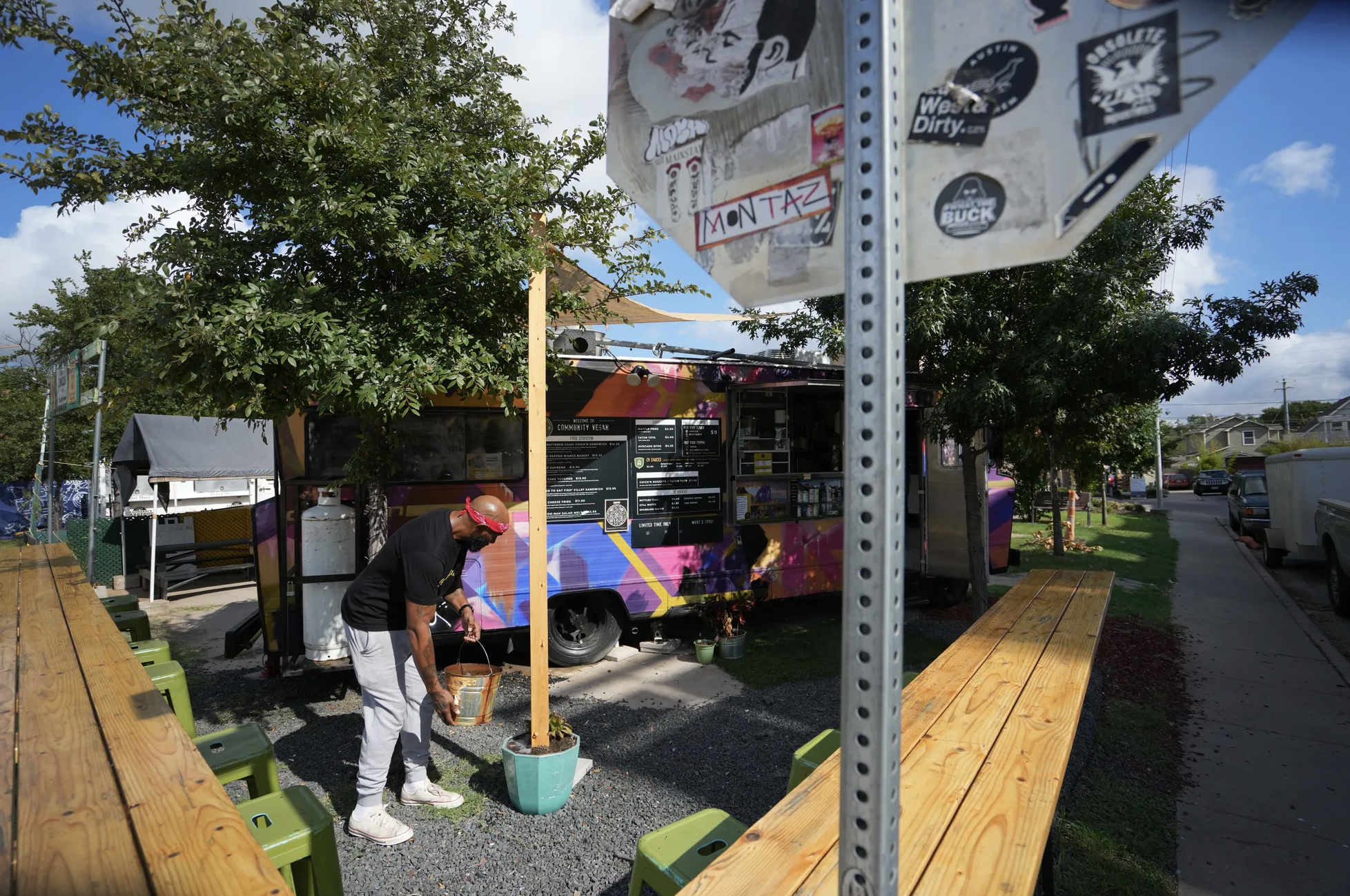
On the corner of East 11th and Lydia streets, the sweet aroma of Community Vegan’s savory bites draws onlookers and customers to the bustling food truck.

The micro-eatery has become a popular food spot in the East Austin Cultural District with dishes such as oyster mushroom wing baskets, beer-battered cauliflower chicken sandwiches, avocado bites and the truck's signature Vegan Lickin' Good Buckets.

Nearly every meal is crafted by co-owners and vegan cooks Marlon Rison and Ericka Dotson, who shape the restaurant’s flavorful dishes to satisfy cravings for nachos, chocolate milkshakes, southern fried chicken pieces and other popular items.

“It’s all about flavor, right? I know we’re bringing that to the block,” Rison said.

As the Community Vegan name spreads through the city's dining scene, Rison's face grows more familiar, too. Inspired by the logos of KFC, Wendys and other food chains, his radiant smile is at the center of the food truck's sign and its branded products. But beyond the logo, Rison's magnetic energy is the heart and soul of the East Austin operation that opened in September 2021. 

Along with its brunch and main menu items, Community Vegan also offers raw, wildcrafted sea moss packages from Dotson's company, Lott’s Herbs & Remedies; Dotson is a certified herbalist. Sea moss is a species of red algae that grows on coastlines across North America, the British Isles and continental Europe. Advocates say when it's consumed in supplement form, it can help improve heart and gut health and strengthen the immune system.

After seeing an advertisement for Community Vegan, North Austin resident Jai'Sun Alexander stopped by the food trailer in March and since has become a loyal customer because of the eatery's variety and Rison's personal touch.

"(Rison) does a really amazing job at engaging with all of his customers, whether they're first-timers, regulars or whoever," Alexander said. "He makes sure everybody's enjoying themselves or enjoying the food and enjoying the atmosphere. He does a really great job at making great food and making an even greater experience out of it."

Success is still a surprise for Rison. 

“We didn’t expect to create a product and service that could grow into this,” he said. “Like yo, let’s pay these bills and have some fun and be responsible. But fortunately, we’ve been able to do more than that.”

Despite the focus on vegan and herbal options, Rison said they are not trying to convert non-vegans to a meat-free lifestyle with Community Vegan. Only about a third of their customers are vegan, Rison said, and the goal is to broaden the minds of patrons by introducing a veggie-based substitute for the foods they already enjoy, including menu items such as Crab Cake Totchos, "I Used To Eat Fish" Filet Sandwich and Chilli Cheeze Fries.

"By no means are we ‘diet food’ and we don't even put it out there," Rison said. "For us, what we want to do is expose as many people as possible to vegetables, and if that means making it comfortable, we'll make it easier to digest."

Community Vegan co-owners wants to inspire others

Before opening Community Vegan, Rison was a radio host in Dallas and weighed upwards of 360 pounds. As a former powerlifter, he ate chicken, fish and turkey constantly throughout the week and consumed 350-400 grams of protein daily. He quit eating beef in 2004 and pork over 30 years ago, and he decided to make a complete switch to veganism after watching the documentary “What The Health” on Netflix in 2017. 

The film, which focuses on the role of food in health, inspired Rison to take his health into his own hands. He altered his diet – cutting out all meats and processed foods – and dropped 140 pounds in the process. 

Under the “Plantbased G” name, Rison started to share his health journey at speaking engagements and posted vegan recipes and cooking demos on his Instagram page. After seeing his audience grow on social media, Dotson encouraged Rison to write a digital cookbook filled with his top recipes.

In 2020, Rison released “The Quarantine 15,” an e-book filled with 15 (plus one bonus) vegan recipes curated by the Victoria-native.

Rison said he was driven to share his passion for plant-based foods and to encourage other people of color to pursue healthier diets, especially people susceptible to high cholesterol, heart disease and other serious health issues.

“We’ve got some of the worst health out of any of the groups that are out there, and it’s because of what we eat and we’re trying to change that tradition in terms of what we eat and how we eat it,” Rison said. “We want to make sure we give (patrons) options that are veggie-based and healthier for you, and hopefully, that will kind of change the way they approach food.”

Months after the release of the ebook, Dotson and Rison started thinking about opening their own restaurant.

Rethinking his life's path during the pandemic

While Rison enjoyed a career in radio, he said time spent in lockdown made him re-evaluate his life’s purpose. Instead of working for a corporate brand, he wanted to pursue something that added to his family’s legacy, and establishing a restaurant was at the top of his list. 

“For me, I said I have to be more responsible for taking care of myself, my family and my loved ones,” Rison said. “(Dotson) was still hitting me with the idea of the food truck thing, and then I said to myself, you know what, that might be the move for me to take control of my future, my destiny and build something that I can pass down to my kids and grandkids.”

Rison didn’t know whether it would be a traditional brick and mortar space or food trailer, and the only commercial dining experience he had before Community Vegan was as a cook at Popeyes at age 16. Dotson, a native Austinite, saw the potential in a mobile vegan restaurant in the central Texas city. 

The couple scoured the web and saw a listing on Craigslist for a 1973 Winnebago Chieftain in San Angelo. They drove three hours out to the seller, who was willing to lower the price of the rugged 27-foot-long RV once he heard their plans to open a restaurant.

They towed the RV to Austin and spent 10 months and thousands of dollars to gut the worn trailer and replace decades-old appliances. Once the kitchen and other items were installed, Rison and Dotson commissioned local artist Andrew Horner, known as APSE, of the ColorCartelto give the food truck its signature coat and began taking their first orders for food.

To find a home for Community Vegan, Rison and Dotson also reached out to Stuart King, president of King-Tears Mortuary on East 12th Street, who referred them to Austin Revitalization Authority President and CEO Gregory Smith. He directed the two co-owners to the Lydia food truck park.

"We knew we could thrive in the East Austin Cultural District while securing the presence of a Black business on the block," Rison said.

Sharing East Austin’s history, reclaiming the district’s influence

Dotson, the great-granddaughter of Ira Lott and Viola Madison Lott, who built a thriving lumber and housing business in the area, said there’s no better corner for the food truck.

Growing up in East Austin and Round Rock, Dotson said it was an area she used to speed past, as crime was an all too familiar occurrence during the 1970s and 1980s. But she said East Austin also was a community filled with Black and Latino-owned businesses and cultural happenings that reflect the area’s rich history. 

Over the decades, the character of East Austin has transformed dramatically as high dollar residential and commercial real estate companies razed old buildings, priced out longtime residents and crippled the traditionally Black community's past influence.

With Community Vegan’s placement, Dotson said she wants to reclaim the district’s cultural roots and remind folks of the area’s origins. 

“With us being planted here, we can share the story about what was here,” Dotson said. “At one time, it was a happy time. My mom would talk about the time there was a theater down here, and they would all take the bus down and go shopping and all sorts of things. But it’s turned into something very different. So, it’s time to turn over the lead, but with us included. It’s important our faces are here.”

Plans to open second food truck, vegan grocery store

After a year in business with the food truck, Dotson and Rison said the next step is to expand. The duo is working on putting together a second food truck in the fall that is drivable and can directly serve patrons in all corners of the city.

As far as big picture goals, Rison said he's thinking about building a Community Vegan grocery store somewhere in the East Austin Cultural District. That way, more people of color will have access to vegan ingredients and herbal supplies. 

Rison's hope is that Community Vegan becomes a national brand. But right now, he said his focus is to continue advocating for healthier lifestyles and continue putting smiles on the faces of the customers and community members who support the business. 

“We got to represent the block and say thank you,” Rison said. “This is our opportunity to say thank you every day. With every meal, we show our appreciation.”

— Austin American-Statesman

A passion forged: Founder of Austin Warrior Arts shares love for martial arts

At 9 years old, Da'Mon Stith knew his life's purpose. He was going to be a ninja, and there wasn't an invading kick, sword or blade powerful enough to stop him. 

When Stith was 8, his father gave him a toy sword with a bright red ruby on its hilt and a streak of jewels that led to the plastic white blade. It was about as sharp as a cafeteria spork, but once he got his hands on the flimsy dagger, no other toy in his collection mattered and his young, swirling mind was fixated on the world of martial arts. 

What was once a young boy's dream has grown into a lifelong passion, and Stith has explored every corner of it through his practice, his teachings and his own armory. He discovered his true identity in the process.

Growing up with Bruce Lee and Taimak as idols

Before then, Stith idolized martial arts legends and movie stars like Bruce Lee, whose high-flying kicks, rapid strikes and cosmic-level charisma drew the young padawan in. He imitated Lee's moves and tried his best to embody his effortless swag. 

Stith's obsession with martial arts culture grew once he started studying karate at age 9. But with his passion came confusion and, for a time, a sense of self-loathing and displacement. As he was going deeper into East Asian art forms, he was unknowingly pulling away from a culture of his own. 

Without any notable Black martial artists in movies or on TV screens during the era, Stith said he clung to the Asian actors of classic action films and shows of the 1970s and '80s.

"I would tell my mom and other people I was Asian, and I don't look any part of Asian," Stith said. "It was different, but things happen in pieces and in stages. When I found my inner-self, it was like holding my breath for a long time and finally being able to breathe."

It wasn't until Stith saw 1985's "The Last Dragon," which starred Taimak as Leroy Green (or Bruce Leroy), that the 11-year-old Austin native saw a martial arts hero that looked like him and shared his affinity for the combative arts. 

Taimak's Bruce Leroy character became a figure of inspiration for Stith, who started studying karate more intensely when his family moved to Okinawa, Japan, for his stepfather's job on a military base. Okinawa — the birthplace of karate — is also where Stith first recognized African history as his second passion, a discovery that later led to a 25-year career of teaching and practicing African martial arts. 

Through the teachings of his eighth-grade teacher Ms. Gross, Stith learned about the kings and queens of ancient Egypt and the leaders of African empires who ruled the continent and conquered neighboring lands. 

Stith discovered his love for capoeira, African warrior tradition

Stith was struck by his teacher's history lessons, and he started researching warrior traditions rooted in Africa and throughout the diaspora. His curiosity grew after he was introduced to capoeira, an Afro-Brazilian martial art that was created by enslaved Africans in the South American country in the early 16th century. 

Stith, who was studying Jeet Kune Do at the time, began studying capoeira after watching the 1993 film "Only the Strong."

As with "The Last Dragon," Stith was enraptured by the sweeping movements and high-flying kicks in the movie. But more anything, he was drawn to the art form's ties to Western and Central African culture.

"People who looked like me were doing a martial art that I felt I had a kinship to," Stith said. "It wasn't based in Asia or Europe, it was an art form that was very Black and African in its presentation and it filled that void for me.

"I didn't understand the art. I just heard the music and saw the movement and it connected with me."

After moving back to Austin at age 17, he became a capoeirista and began studying the movements of Detroit-based martial artist Kilindi Iyi. He saw an advertisement for $80 worth of Iyi's videos in Black Belt Magazine and watched his instructional tapes for hours on end.

From there, Stith adopted Iyi's deceptive kicks, Zulu and Egyptian stick fighting techniques and sweeping takedowns from historical African martial arts and incorporated them into his form of capoeira. 

Stith said the art form opened up his stiff frame, allowing him to enter a state of free flow he never experienced in other disciplines. But capoeira also debunked the thought that African people willingly gave up their bodies, their names and their cultures during the Trans-Atlantic slave trade.

He began practicing and teaching his own style of the historic art form

As he dove further into African history and martial arts, Stith recognized how many Black men and women fought to obtain their freedom and retain their heritage, often times using the combat skills they learned as warriors of battle. 

"What we're told is they brought us over, we were slaves and lost everything, but capoeira shows that we resisted what was happening to us by taking up arms and passing on our DNA and culture," he said."We tried to retain what we had in this motherland to the new land, which would become the breeding ground for new martial arts found in the diaspora."

By 1997, Stith was teaching to students capoeira da rua, or capoeira of the streets, which is a more practical form of the Afro-Brazilian style that he and his training partners developed in Austin. 

Stith started teaching alongside other martial artists at various sites around town and on the University of Texas campus, including the Anna Hiss Gymnasium and an undisclosed space they nicknamed "The Boiler Room" that a faculty member opened up for his group.

He taught students of all ages and backgrounds the footwork, bladed weaponry, counter and defensive strikes of capoeira. And ever since then, Stith has dedicated his life to teaching the art form. 

"I felt I had a purpose and a destination I was heading toward," he said. "I'm the best when I'm doing teaching and sharing my practice. Seeing them grow, being a part of their lives and giving them a piece of their culture makes me feel good." 

Stith began making the weapons he spent years wielding

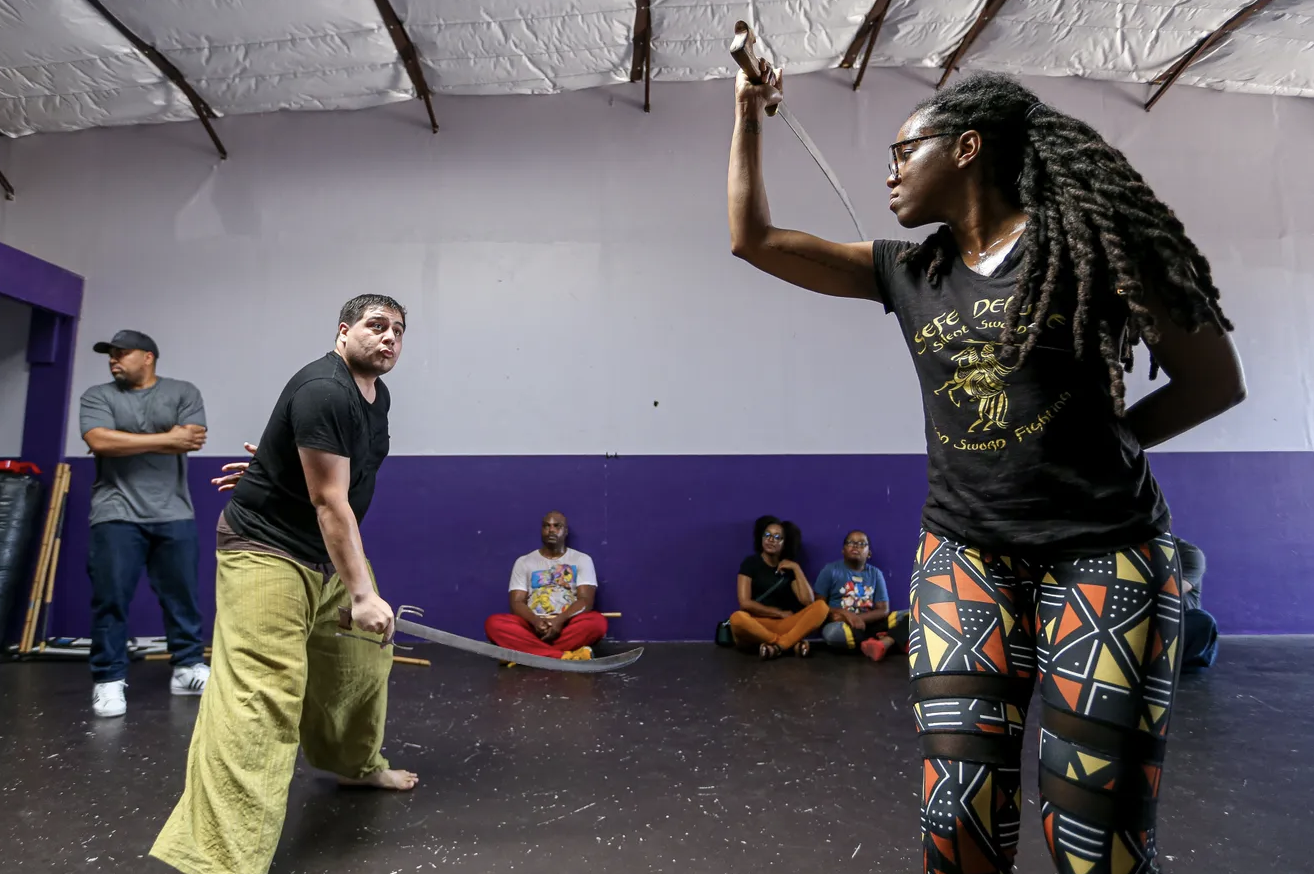
In 2012, Stith formed the Guild of the Silent Sword, which includes his group of students and experienced capoeiristas. Even before then, he and fellow capoeira practitioner Jeffrey DaShade Johnson started making African weapons under the Street Forge Armory name. 

At first, the duo wanted other companies to make their weapons, but when they saw how costly it would be, they started crafting them on their own.

Stith and Johnson make sickle swords, short and long takoubas, filipino swords, nimcha sabre and other items under the armory brand inside of Co.lab, a creative space that's free for residents of color. They have shipped custom pieces across the country and as far as Australia and Germany, with items priced between $30-65. 

"I love using swords, and now we have the ability to create and make these instruments that can be used for destruction but also require skill, math and science," Stith said. "It's a good feeling to have a skill nobody can take from you. As long as I have access to material and tools, I can provide for my family and there's something very empowering about that."

While the brand has been official for some time, Johnson said Street Forge Armory really got its start when he and Stith were kids.

When Johnson was 9 years old, he also idolized the martial arts icons of the time and began making his own swords from hacksaw, duct tape, hammers and a screwdriver as a chisel. In Japan, Stith created his own weapons by hammering down old golf clubs and shaving them down into make-shift katana swords. 

The two Austinites didn't know each other then, but their passions would bring them together in 1999. Johnson trained under Stith and years later he decided to go into business with him, hoping to enlighten others with the skills that come with capoeira and the confidence that sprouts from the knowledge. 

"What we're finding is people want to be more healthy and more confident in themselves, but when they go to a mixed martial arts gym, they don't see people like them, or the people that look like them don't identify or think like them," Johnson said. "We're trying to make it accessible to everybody in the community."

While Johnson was aware of the martial arts rooted in Africa and the diaspora, he said there are few people as well-versed on the history and are able to pass it on to students as seamlessly as Stith. 

'It's honestly been a healing space for me'

Four days a week, Stith teaches hand-to-hand combat and stick and sword training to students as young as 8 at his Austin Warrior Arts studio at 9705 Burnet Road. On Saturdays, the groups meet at Mueller Park to trade friendly blows with Ancient Egyptian, Ethiopian and North African weapons. 

Student Natalie Joy, whose been working under Stith for a year, said she's found community in a city she's long felt isolated, especially in the martial arts world. 

"It's honestly been a healing space for me," Joy said. "I've always loved martial arts, but I always felt in those spaces kind of 'othered.' But in this space, I feel very included and very accepted. It is healing to do something that my ancestors did way back, and another way I can connect with them and that's very important and impactful for me."

Beyond learning the combative stances, student Erika Crespo said Stith has lifted her confidence and opened her heart at times when she's needed it most. 

"Coming to these classes has helped me learn how to get close to somebody and trust them," Crespo said. "When you come from a trauma history or you're anti-social, you don't get close to people. But in this case, I had to learn how to go with the flow and trust that I don't react too much out of fear or anxiety. I'm really doing something that's making me feel whole and it's been a hard but really beautiful journey."

In continuing his practices and weapon-making, Stith's dreams as a ninja have taken shape in other ways. While he's far from an agent of espionage, he's dedicated his life to education and craftsmanship, and he's looking to amplify everything with the opening of his own studio.

Having taught at local schools, community center, daycares, fitness centers and other spaces for 25 years, Stith said having a place fully dedicated has been his ultimate goal, and he's been living it for the past three months. 

Stith said he has the studio, but they need help keeping the doors open until they can build up their student base, so he and the Austin Warrior Arts team started a GoFundMe  to help pay for the space's rent. 

So far, the group has reached $9,115 of the $12,000 goal from current and former students of Stith and community members, which Stith said is a testament to the support and importance of African martial arts and history. 

"It's like mind-blowing to be honest," Stith said. "I can't describe what it feels like having this space and knowing it's dedicated solely to this is really humbling."

– Austin 360

From small galleries to primetime TV, Dawn Okoro is shining under international spotlight

As a "tall, thin and quiet bookworm" with a love for fashion and culture magazines in Lubbock, artist Dawn Okoro said she always felt like a black sheep in the small, northwestern Texas city. 

While others her age played on playgrounds, she spent hours flipping through the pages of Vogue, Essence, Jet and Ebony magazines.

Her artistry blossomed as she studied the covers and spreads of the iconic publications, with the images of models like Naomi Campbell and Tyra Banks broadening her scope and sparking her creative talents.

"For me, my window to the world was in magazines," Okoro said. "My grandma would get them and my mom had a subscription to Jet Magazine and Ebony Magazine, and every month there would be a couple of pages dedicated to fashion. They featured Black fashion designers and some of the Black models and I would just think, 'Wow.'"

With each weekly or monthly issue, Okoro was inspired to replicate the images captured by editorial photographer Richard Avedon and other creative minds of the time. 

In elementary school, she began making drawings of the clothing designs from the magazines, sometimes filling the skin with a mahogany shade where it did not previously exist. And by the time Okoro, 42, was in high school, she took her fashion-centric style to the canvas. 

But Okoro said her family didn't believe a career as a full-time artist was sustainable. 

"Where I grew up, people heard of (Pablo Picasso) or whatever, but my family was kind of like, 'That's a nice hobby, but you need to go be a doctor or a lawyer or engineer,'" Okoro said.

To appease her family, Okoro pursued other avenues. 

She graduated from the University of Texas at Austin with a degree in psychology and a minor in fashion design. She later earned a law degree from Texas Southern University, but despite the opportunities that bloomed from her academic success, her creative passions were always on her mind.

After graduating from TSU, Okoro uprooted her life in Austin to start anew in New York with the hopes of making it as an artist in the Big Apple. 

Okoro began meeting with different artists and curators, but after a year, she and her then-boyfriend — now-husband — were forced to move back to Central Texas due to family and financial strains that worsened with the Great Recession in the late 2000s. 

With no interest in practicing law and to please her family, Okoro put her artistic pursuits on hold and decided to start a career in journalism.

"In my heart, I knew I wanted to do art, but there was still that drive to feel like I'm actually doing something with my life in a way that my family would understand," she said. 

'I thought there would be less struggle and anxiety'

While working at Spectrum News Austin, Okoro said, she wouldn't pick up a paintbrush for months or even years at a time. 

"It was a process," Okoro said. "When I moved back to Texas from New York, I just decided to give up on art. I liked making work, but I think I had a vision of what an artist was. I thought there would be less struggle and anxiety. But it's impossible not to see art in your life. You really can't avoid it; it's everywhere."

Okoro eventually found time to create new art series and finished paintings she hadn't touched in years. 

Her creative revival came at a time of emptiness.

After experiencing the death of loved ones, Okoro recognized the fragility of life and decided to turn to a paintbrush and canvas again. 

"It felt like something was missing," Okoro said. "After maturing, seeing life and experiencing the death of people close to me, it kind of felt like life really is short and I need to start living and I started small from there." 

In 2018, Okoro showcased her "Punk Noir" exhibit at the George Washington Carver Museum, a show that featured towering canvas paintings inspired by local artists and influencers in and around Austin that exuded a "punk spirit," Okoro said. 

The exhibit also included music from Austin-based band BLXPLTN to coincide with the artist's vision. And with the exhibition's success, Okoro drew the attention of local and international gallerists. 

Among her many admirers was Phillip Niemeyer, owner of Northern and Southern Gallery, who marveled at Okoro's eclectic style. 

"When I first saw Okoro, I thought she was amazing from the get-go, and everything she's doing now is just reinforcing that," he said. "I love the way she's constantly exploring her work. She doesn't stay in one place."

Mauve Doyle, the artistic director at Maddox Gallery in London, said she was drawn to Okoro's transparency and creative mind. 

"I like her confidence and her ability to engage with people, take chances and trust in the process of things," Doyle said. "Her future is really bright, and her work is uplifting."

Doyle said Okoro's background in fashion bleeds into her artwork, with many of her subjects painted in deeply enriched colors and positioned in ways that mirror the covers of editorial magazines.

Where to see Dawn Okoro's work

The relatively withdrawn artist has come into her own.

Since 2017, the Houston-born artist has held residencies and exhibitions in Seattle, Miami, New York and London, and she recently collaborated with PepsiCo to have her artwork placed on the brand's Lifewtr bottles. Her work also has been featured in Season 2 of NBC's "Law & Order: Organized Crime." 

"When I watched the episode where Jennifer Beals said my name and showed my painting, I squealed a little," she said. "I’m happy to see some of my goals begin to come to fruition. There is so much more that I can do with art. I’m just getting started."

Okoro has continued to expand her artistic reach since becoming a full-time artist in August 2021, with works such as "VantaBlack," "Kool-Aid Drawings," and "Crown and Glory."

Along with international exhibitions and TV show appearances, her contributions to the arts also have been recognized by Austin organizations.

In February, CapMetro placed portraits from Okoro's "Kool-Aid Drawings" project on city buses, and a wooden bust of the artist was placed inside the Carver Museum for the center's "Peace to the Queen" exhibit of work by artist Jamel Shabazz. 

Given her success as an artist, Okoro said her mother and other family members have applauded her chosen path and accomplishments.

"I think they're proud of me," she said. "I think now that I have more opportunities that are more tangible to see, they understand it better now. I think they're happy to see me happy and doing what I love to do."

After her career pivots and periods of artistic inactivity, Okoro said she's now fully embraced her artistry and individuality. 

"It's taken me years to come to that conclusion, and there are still some times as an adult when those feelings creep in again. But I think just doing my art has helped me a lot, and getting my art out there lets me know it's OK just to be who I am," she said. 

Okoro said her goal is to inspire other artists to accept their differences as their superpowers and to add beauty to the world. 

– Austin American-Statesman

Keep your eyes peeled: The art of Banksy is coming to a secret Austin location this summer

The work of anonymous street artist Banksy will be on display for a new immersive art exhibition, Banksyland, at a still-secret downtown Austin location.

More than 80 of the England-based artists' "original and studio pieces, salvaged street artworks and never-before-seen installations" will be at the center of a 20-city international touring exhibit running July 22-24, according to the Banksyland website.

The location won't be revealed to ticketholders until two weeks before the exhibit's opening. At this point, the only clue is an Austin ZIP code, 78712, listed on the event website, which may point to a venue on the University of Texas campus. Keep your eyes peeled, Austin. 

The exhibit, produced by the international experimental arts collective One Thousand Ways, is also taking place June 24-July 4 in Dallas and Aug. 12-14 in Houston. The Statesman contacted One Thousand Ways several times for more information and has not received a response. 

Tickets are $22-$59. Children 6 and under are free and no ticket is required. 

Entry is available for multiple one-hour time slots starting at noon during the three-day exhibition. Visitors are required to arrive 15 minutes before their scheduled entry time. 

For tickets, go to banksyland.com.  

– Austin 360

5 things we learned from Nobel Peace Prize winner Maria Ressa's SXSW keynote

While veteran journalist and Rappler CEO Maria Ressa was bound by a virtual screen during her South by Southwest keynote, her presence was felt inside the Austin Convention Center.

The Nobel Peace Prize winner dug into the spread of misinformation and how it's been weaponized by the world's political powers to threaten democracy.

Read More