50 years after a deadly refinery fire, Philly firefighters honor those who were lost

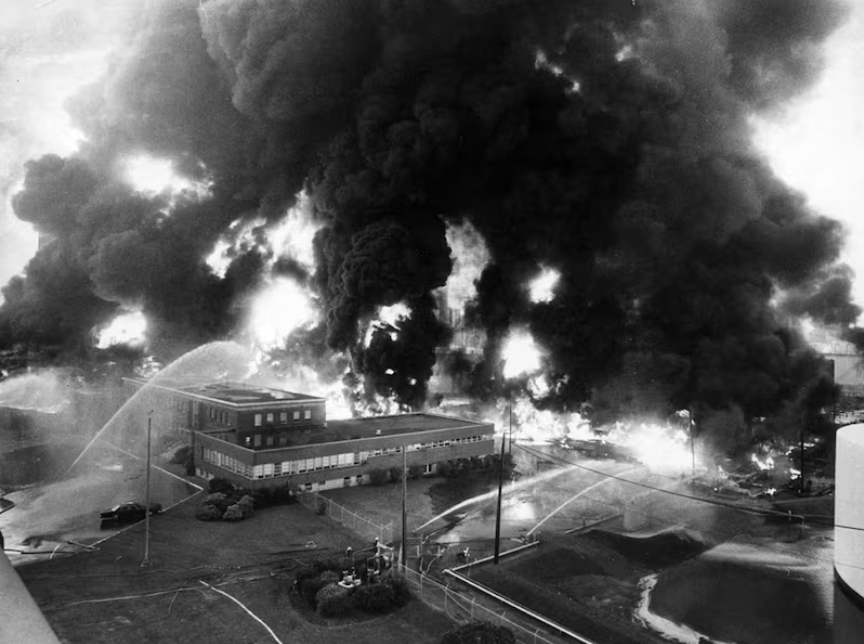
Fifty years after dark black smoke from unrelenting flames clouded the sky over South Philadelphia, more than 100 people gathered Sunday in solemn remembrance of the city’s deadly Gulf Oil refinery fire.

The 11-alarm blaze on Aug. 17, 1975, forced the deployment of 600 firefighters to the Gulf Oil complex at Penrose and Lanier Avenues.

The intense flames and smoke, caused by the ignition of hydrocarbon vapors, resulted in the deaths of eight Philadelphia firefighters and serious injuries to 14 others.
To commemorate the devastation and honor the sacrifice of the men who bravely gave their lives, the Philadelphia Fire Department Historical Corp. held a tribute at Fireman’s Hall Museum on Sunday.

“It‘s rewarding that we’re doing this,“ museum curator Brian Anderson said. “We let the families know that even though they lost their family members, their sacrifice wasn’t in vain. It was with purpose.”

In the audience Sunday were firefighters and the families of those killed and injured in the refinery blaze.
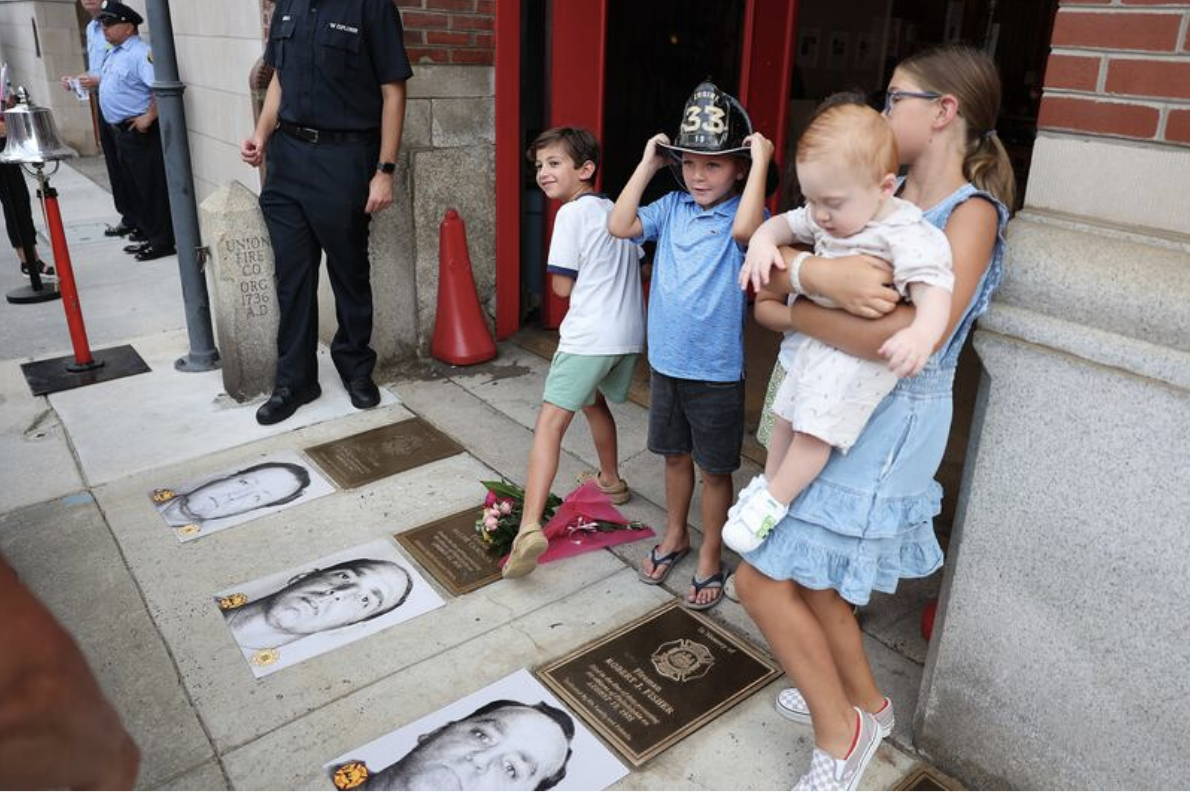
Attendees placed roses on the engraved plaques of the late firemen: John Andrews, Ralph Campana, Robert J. Fisher, Hugh McIntyre, Roger Parker, Joseph Wiley, James Pouliot, and Carroll Brenek.

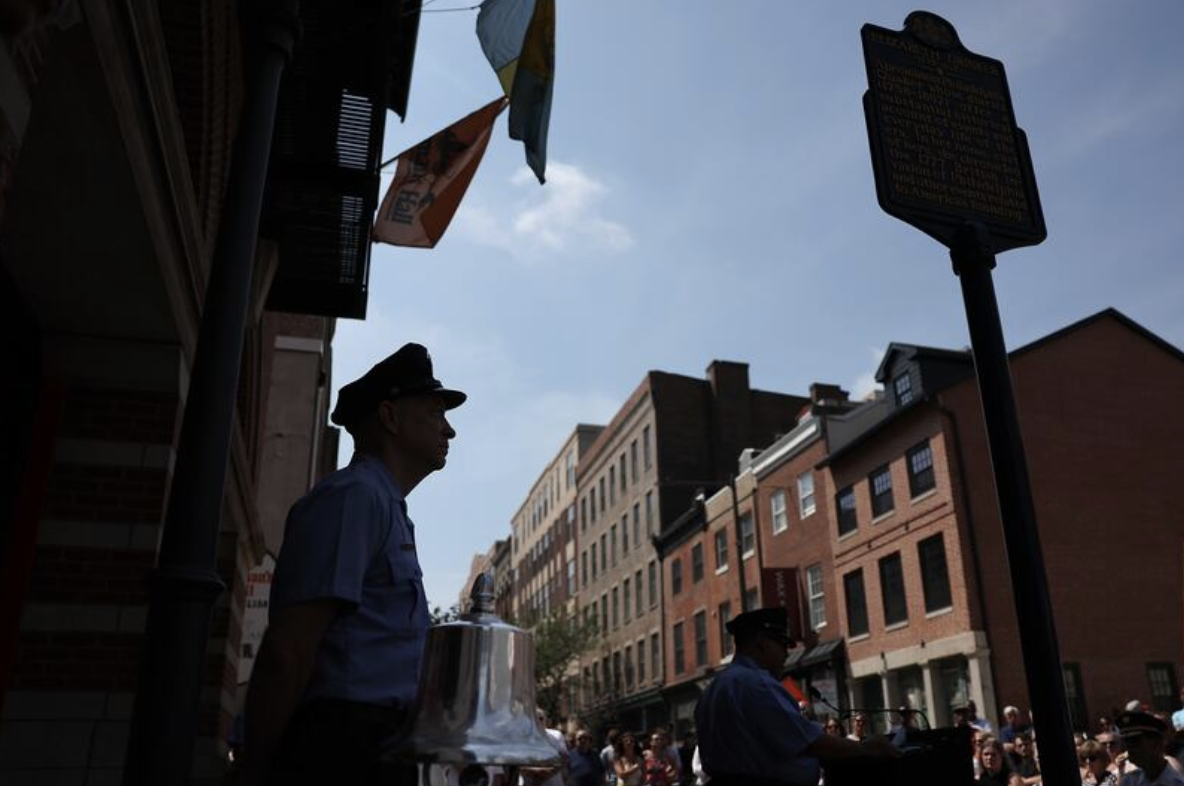
Many bowed their heads, closed their eyes, and stood in stillness as Anderson and PFD Historical Corp. president Eugene Janda took to the podium to illuminate their sacrifices.

Others shed tears hearing testimonies by friends and family about lost loved ones.
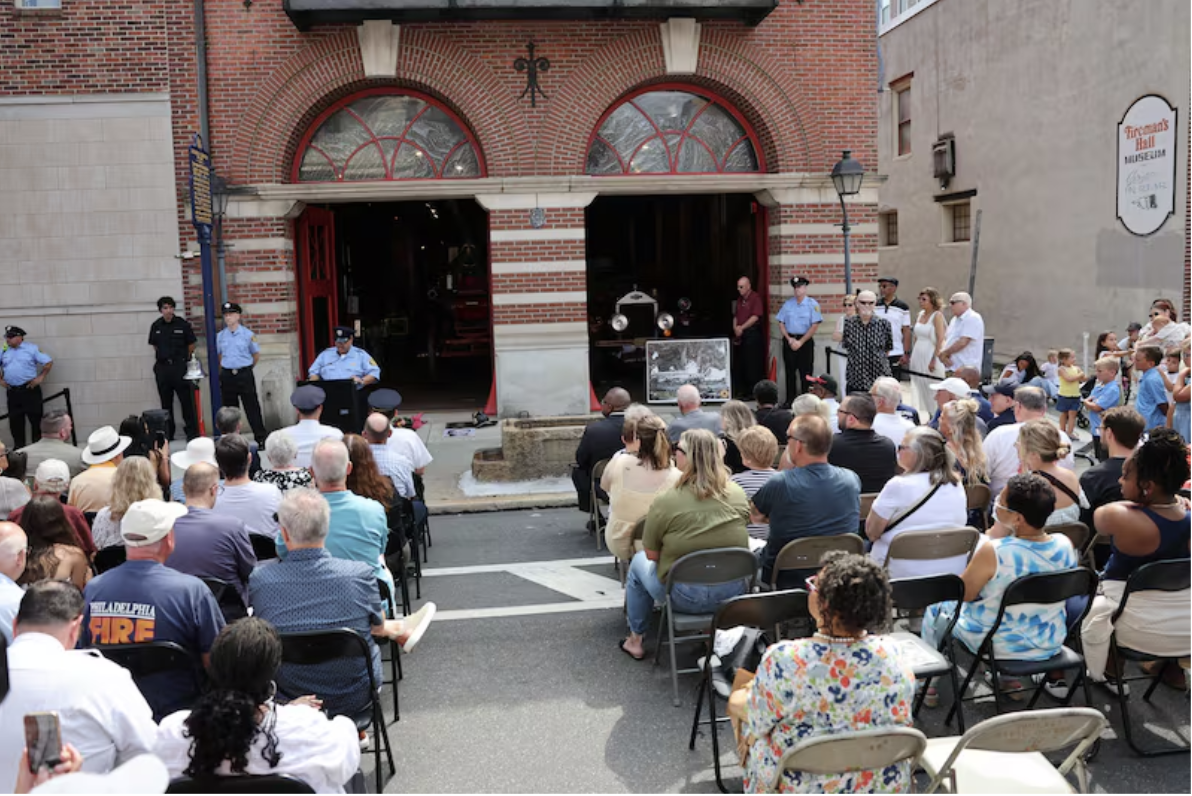
Nearby, vehicles from Philadelphia Second Alarmers, Engine 20, and other emergency responders lined the block of Second Street in Old City.

Over the years, Robert Fisher, the son and namesake of one of the firefighters who died from battling the refinery fire, said he had wanted nothing more from Philadelphia Fire Department and Fireman’s Hall than to memorialize the 50-year milestone of the tragic event that took his father.

“Everything was special,” Fisher said of Sunday’s ceremony. “Standing back and seeing people observe, honor, respect, and reflect on everything was very important. Hopefully, the legacy lives on.”
Along with honoring his father’s legacy, Fisher said reconnecting with the families and now-retired firefighters linked to the tragedy brought much-needed community.

“When you see each other, you know what each other’s going through,” he said. “You don’t have to talk about it. You’re just happy that you’re seeing someone. We don’t reflect backwards, we reflect forward.”

Given the support that poured forth from all in attendance, Anderson has no doubt that the sacrifices made by the firemen that day 50 years ago will live on.

“You can tell by the attendance of today’s event, these members will never be forgotten,” he said. “They’ll be forever memorialized here at the museum, too.”

– The Philadelphia Inquirer

Bryn Mawr College’s first Black graduate had to walk a mile to get to class. A new monument honors her journey.

D.C. artist Nekisha Durrett first took the “Black at Bryn Mawr” walking tour at Bryn Mawr College in February 2023. It was there that she learned about Enid Cook who, like her, graduated from Dunbar High School in D.C., considered one of the first academically elite public high schools for Black students in the country.

Cook went on to become the college‘s first Black graduate in 1931. She studied chemistry and biology.

Despite the wishes of former college president M. Carey Thomas and other faculty who rejected the idea of admitting Black students, Cook was permitted to enroll in the women’s college in 1927.

On her admission to the college, Thomas and her successor Marion Park barred the future microbiologist from living on campus, forcing Cook to walk roughly one mile to and from class.

“I do not myself feel it would be wise to admit a colored student into residence at Bryn Mawr at the present moment … I should perhaps add that Miss Cook’s passing the entire series of examinations at one time so successfully as to put her ahead of a long waiting list would seem to me in the case of any applicant very unlikely,” Park wrote in a letter to the Quaker activist Paul H. Douglas, who was advocating for Cook’s admission to Bryn Mawr.

On April 24, on that same campus, Durrett’s Don’t Forget to Remember (Me), was unveiled to a crowd of students, faculty, and residents, who marveled at both the size and detail of the public art work.

The monument, a “woven” pathway of custom clay bricks, forms a “square knot,” symbolizing an unbreakable connection and commitment to honor all of Bryn Mawr’s history.

Don’t Forget honors Cook and the Black servants and groundskeepers who maintained the campus during the early 1900s. It spans a 5,800-square-foot area, roughly the same length as Cook’s commute to Bryn Mawr.

“This campus was literally built on the backs of Black men and women, and that labor has been unrecognized as it always is,” Durrett said. “It was unrecognized and uncelebrated until Black students wanted to take on the responsibility of bringing their contributions to light.”

Rather than a single, elevated monument “frozen in time,” Durrett, a Cooper Union alumna, said she wanted something more dynamic and timely.

Among the pathway’s roughly 10,000 pavers are those engraved with the names of 248 Black workers and staff members whose contributions were hidden or “erased” by the college.

Each brick is glazed with soil from Perry House, a Black cultural center that was established after student protests in 1972, demanding a more inclusive curriculum and staff, and a culture house.

“The times that we‘re going through right now, we‘re witnessing the blatant attempt to erase and twist history,” Durrett said. “This has always been happening, which is job security for me because these stories are going to be uncovered.”

The monument is situated in the Cloisters of the Old Library, an enclosed space where the ashes of Thomas were scattered after her death. The library was once named after Thomas.

Bryn Mawr Africana Studies and Museum Anthropology professor Monique Scott said the space is a “haunting” location for many Black students.

“Students let us know that the Cloisters was a space where they didn’t feel welcome, and felt kind of heavy for them,” Scott said. “And with [Durrett’s] artwork, we‘re hoping that will shift that energy. It‘s about making Black and brown students feel very welcome here and in this space.”

Thomas, who died in 1935, rejected Black students and potential workers from entering the college, fearing their presence would tarnish its reputation. And for those who made it to campus, she attempted to limit their visibility.

Below the Cloisters are service tunnels, where live-in domestic servants and other personal staff worked.

Given the college‘s complicated history, Scott said students, faculty, and staff have conjured ways to uncover Bryn Mawr’s “untold stories” through the Art Remediating Campus Histories (ARCH) Project.

Following a student-led strike in 2020, Scott said, students, faculty, and staff established oral history projects, walking tours, and accessibility initiatives to unravel the hidden or misrepresented elements of Bryn Mawr’s history.

Among students’ demands was the installation of a public artwork that represented inclusivity. Durrett’s proposal was picked out of 110 applications.

Her previous works include “And The Ancestors Say…," located in D.C.’s Duke Ellington School of the Arts; “We See You” at New York’s Times Square; and “Magnolia,” which memorializes Black women who were murdered by law enforcement.

“From the beginning, it was so profound, amazing, emotional, and powerful. It was so many things,” Scott said.

Don’t Forget was built in partnership with Philly’s Monument Lab, a nonprofit public art, history, and design studio. Durrett was assisted by a group of student researchers, who dug into the school’s archives to find the names and origins of the school’s Black students and laborers.

From the dust-covered documents to charred-edged time cards from the 1900s to the ’30s, they discovered former porters, waitresses, and groundskeepers who had worked on campus. Some were from the Philly region, and others had ventured from as far as Virginia to study and work at the university.

Given Durrett’s “profound brilliance” and willingness to work so closely with Bryn Mawr students and department leaders, Monument Lab director Paul Farber said the monument came out just as he envisioned.

“A monument doesn’t just have to tell us about our past. But it can be done in a way that’s expansive and inviting,” Farber said. “Leave it to an artist like [Durrett] to respond in the most thoughtful and critical ways, and open up history anew in expansive terms.”

While Durrett understands one monument won’t rid the world of racism or discrimination, she‘s hopeful the path inspires future students, faculty, staff, and alums to continue honoring the Bryn Mawr’s full history and remember the names embossed on the clay bricks.

– The Philadelphia Inquirer

Nine BYOBs to try on the Main Line

BYOBs are as essential to Philadelphia-area food culture as cheesesteaks, hoagies, water ice, and soft pretzels.

With Pennsylvania’s notoriously strict liquor laws and expensive licensing fees, many restaurants in the Philadelphia region opt to go the BYOB route — helping fuel a vibrant dining scene where diners bring their own bottles to some of the area’s top spots.

Here are some Main Line BYOBs worth uncorking something special for.

Fraschetta BYOB

This intimate Bryn Mawr BYOB serves refined Italian fare in a cozy, elegant setting. Now owned by restaurateur Phuong Nguyen, Fraschetta continues to deliver satisfying housemade pastas and rich entrées, including creamy mushroom pappardelle and slow-braised wild boar in tomato sauce, finished with cocoa powder and Pecorino Romano.

📍816 W Lancaster Ave., Bryn Mawr, Pa. 19010, 📞 610-525-1007, 🌐 fraschetta.net

Dua Restaurant

In a sea of Italian spots, Bryn Mawr’s Dua Restaurant stands out for its traditional Mediterranean fare and cozy elegance. Chef Bledar Istrefi offers savory appetizers like burek and mussels pepata, and finely crafted bites like the pistachio crusted branzino and the mouthwatering pomegranate braised short rib over Israeli couscous.

📍 1000 W Lancaster Ave., Bryn Mawr, Pa. 19010 📞 484-380-2053, 🌐 duarest.com

Burrata Havertown

A sibling to its popular South Philly location, owners Dejvi Furxhi and Albi Furxhiu brought the charm of their Italian BYOB to the suburbs. Positioned on the bustling street of Eagle Road, Havertown’s Burrata location is adorned with Italian landscape portraits and cozy decor. The welcoming environment is complemented by delicious appetizers, pastas, and entrées, with items like truffle cream gnocchi and barramundi in garlic white wine sauce.

📍 26 E Eagle Rd., Havertown, Pa. 19083 📞 610-808-9933, 🌐 burratahavertown.com

The Choice Restaurant

Looking for a romantic night out? This 50-seat BYOB serves up Euro-fusion dishes with Ukrainian, French, and Asian touches. The restaurant, owned by Iryna Hyvel and her husband Volodymyr “Vlad” Hyvel, offers entrées like branzino with crispy potato balls, mushroom ragout, and striped bass ceviche.

📍 845 Lancaster Ave, Bryn Mawr, Pa. 19010 📞 484-383-3230, 🌐 thechoice-restaurant.com

Villa Artigiano Ristorante BYOB

This family-owned Ardmore restaurant boasts a menu of multiregional Italian favorites. Patrons can start with a small charcuterie board or other small plates before digging into signature dishes like gnocchi artigiano in fresh tomato basil sauce or pollo limone topped with crabmeat and a white wine sauce.

📍53 W Lancaster Ave., Ardmore, Pa. 19003, 📞 484-414-4997, 🌐 villaartigiano.com

Bam Bam Kitchen

From fried rib-eye and pork kimchi mandoo combos, to Korean fried chicken wings, and seafood pancakes, this Ardmore BYOB is booming with rich Asian flavor. Diners can enjoy Korean drink options like banana milk and the sac sac grape and orange flavors, or enjoy their own bottle while relishing over Bam Bam Kitchen’s succulent dishes.

📍 31 E. Lancaster Ave., Ardmore, Pa. 19003, 📞 484-844-7827, 🌐order.bambamkitchen.com

Tiramisu Cucina Romana

This Chester County gem blends the BYOB model with a full cocktail bar, offering the best of both worlds. Tiramisu specializes in Roman-Jewish cuisine with refined flavors. Menu highlights include red snapper with pine nuts, raisins and balsamic vinegar, or lobster ravioli with lump crab and cognac sauce.

📍 720 Lancaster Ave., Berwyn, Pa. 19312 📞 610-906-3299, 🌐 tiramisuberwyn.com

Ryan Christopher’s

This family-friendly Narberth favorite is helmed by chef Michael Klaumenzer, who cooks and oversees a menu packed with crowd-pleasers. Crafted from locally sourced ingredients, the Narberth eatery’s dishes include an award-winning French onion soup and entrées like grilled New Zealand lamb chops, sesame-seared salmon, and a chicken and shrimp cacciatore.

📍 245 Woodbine Ave., Narberth, Pa. 19072 📞 610-664-9282, 🌐 ryanchristophersbyob.com

Veekoo

Tony and Shelly Li’s stylish BYOBs, which expanded to the Main Line after opening in Royersford in 2003, continue to deliver savory Chinese, Japanese, and Thai favorites. Offerings include sushi rolls and signature plates like the Hong Kong-style soft shell crab and General Tso’s Chilean sea bass served with steamed jasmine rice or brown rice.

📍 761 W. Lancaster Ave., Bryn Mawr, Pa. 19010, and 564 Lancaster Ave., Berwyn, Pa., 📞 610-615-5118 and 484-318-7655, 🌐 veekoorestaurants.com

– The Philadelphia Inquirer

Freezing temps have brought back the backyard ice rink

Philly winters have been streaky in recent years, but homeowners and hockey enthusiasts are making the most of the recent deep freeze to build backyard ice skating rinks.

While many families favor the dependable conditions of an indoor rink, Fox Chase resident David Bara prefers the slow, chilling burn of a homemade skating consortium.

Since 2016, Bara has rolled up his coat sleeves to build a 22-by-48-foot rink for his family and golden retriever Ellie to enjoy. “I’m an absolute fanatic,” Bara said. “There aren’t many people in Philly who are crazy enough to do what I do. It’s definitely something more reserved for Canadians and other people up north.”

For nine straight winters, Bara has built a miniature hockey rink using plywood and a white plastic liner (a black one draws too much sunlight), while navigating the unpredictable forces of Mother Nature. “Half of the passion I have is the challenge of being able to do one where we live,” Bara said. “It’s not easy. It’s me and Mother Nature. If Mother Nature doesn’t cooperate, then there is no rink.”

After building the wooden exterior, he puts down the plastic liner and gradually fills it with water over three days. The shapeless plane slowly transforms into a sleek, 10-inch-high surface, which he wraps with beam-supported banners covered in local business ads.

Bara said his outdoor rink (ODR) wasn’t always as well-executed. His first one was made from a torn blow-up pool, with a thin surface just wide enough to fit his son and one other hockey player. But the haphazard experiment inspired him to take the art of ODR-making to the next level.

What started as a one-off project for Bara has turned into an obsession. “I’m out there building ice four or five times a night. I set my alarm for midnight, 2 o’clock, and 4 o’clock in the morning because it’s better to do it when there’s no sun.

I call it passion; some people call it insanity.”

It’s even become a part of family tradition. Bara hosts a broomball tournament every year for his daughter’s birthday, and his shed-turned-warming room is a late-night hang for Philadelphia Flyers fans. It’s equipped with a TV, a fully stocked bar, cozy insulation, and LED-lit walls covered in Flyers memorabilia.

Flourtown content creator Logan Randazzo said her DIY rink, too, has become a winter tradition. The Canada native and amateur figure skater grew up practicing two-foot turns and forward swizzles on her family’s rink. And for the past three Christmases, Randazzo and her husband have joyfully shared those “core memories” with their five children on the back patio of their historic mansion.


“It’s been fun as a parent to see that through my children’s eyes,” Randazzo said. “I used to spend all day out there with my brothers, so it’s really fun to see them [out there]. I hope it’s the kind of stories they can talk about when they grow up.”

While indoor rinks are great for skating year-round, Randazzo said nothing compares to the feeling of outdoor skating, especially when it’s accessible a few feet from a backdoor. “It’s nothing against indoor rinks, but the convenience of a mother of five to just step outside the door is absolutely priceless.”

Since posting an Instagram video of her 20-by-40-foot rink, Randazzo, who’s amassed more than 250,000 followers on the platform, said other Philly-area residents have contacted her to ask how they can make one of their own.

While ODRs are more common among Canadian and Midwestern households, Long Valley, N.J., resident John Greco said it’s become a growing trend on the East Coast since the COVID-19 pandemic.

The former hockey player runs a backyard ice rink Facebook group with Bara. He said people have been seeking new ways to explore the outdoors, and with more DIY tips and resources readily available, Greco said it’s easier than ever to get started.

The biggest challenges for new rink builders are finding backyard space without a slope, or building rink boards without a gap. Differing levels could lead to uneven ice, and cracks in the exterior can lead to “blowouts,” a balloon-like pop that ends in a flooded yard.

“I’ve heard all the horror stories. I try to collect information for people because that was my battle at the beginning. And now there are resources for people to start,” said Greco.

Barring an occasional snow blitz, or a momentary string of ice-capped days, snow in Philadelphia has been alarmingly scarce the past 10 years.

Last winter, Philly registered the lowest snow cover in a decade since the National Weather Service began tracking it in the winter of 1940-41. And the meteorological winter of 2023-24 was ranked the 10th warmest in records dating back to 1872.

Bara said it takes roughly three straight days of freezing temperatures for ODRs to hold. But despite last year’s record-low snowfall, he was able to build his ice rink in less than 24 hours. “I was making new layers every hour,” he said.

While winters have been more difficult to predict, Bara said the past 10 years have been fairly consistent. Some months (and years) are cooler than others, but the lifelong Philadelphian said the recent weather has been close to what it was when he first started making his backyard rink.

After a decade building “natural backyard rinks,” Greco said this year was his first making it with a chiller system, easing some of the pressure that comes with the weather-dependent pass-time.

YardRink CEO Brian Packard, whose company specializes in National Hockey League-licensed ODR kits, said the ease of technology is also encouraging people to build their own iced arenas.

It’s a trend he hopes will reduce children’s phone screen time and spark added interest in street hockey. Its growth, Packard said, could be similar to the popularity of flag football, which makes its Olympic debut in 2028. “It’s about sticks in hands and smiles on faces,” Packard said. “We’re excited about the resurgence of backyard ice hockey. People are going bananas with it.”

Whether it’s an NHL-licensed rink or a frozen retention basin, Maple Glen resident Kristen Warner said the best thing about ODRs are the moments shared with neighbors, friends, and family.

Warner has had rinks flood, and some have required emergency resurfacing. But no matter the conditions, one element always remains the same – the joy.

“[It doesn’t] matter if you get one weekend of solid ice, or an entire winter,” she said, “it’s worth the time and effort for the memories that are made.”

– The Philadelphia Inquirer

Keke Palmer and Tierra Whack bonded over a secret pregnancy

Keke Palmer met Tierra Whack over a game of spades at Jackie Chan’s house in South Philly.

Trust me, the story gets even better.

They started arguing with Rihanna when Eddie Murphy showed up to diffuse the situation.

And if all this sounds too good to be true, that’s because, well, it is.

“All right, we play too much,” Palmer joked to the Fitler Club crowd. The newly published author stopped by on Thursday for an event presented by Harriett’s Bookshop and sponsored by the Fitler Club and The Inquirer. Whack interviewed Palmer about her book, Master of Me: The Secret to Controlling Your Narrative.

The real story? The actress, singer, and KeyTV founder met Whack at Alicia Keys’ house in 2023, bundled up in a puffer coat, which she took off to reveal a baby bump. She was months away from giving birth to her son, Leodis “Leo” Jackson.

Whack kept her lips sealed on the secret pregnancy, and the two multi-hyphenates have built a special bond over the past two years. “I love you girl,” Palmer said as she walked over to hug the North Philly native. “I love you, too,” Whack said.

“I’m here, no payment or nothing,” Whack said to the crowd in the Fitler Club ballroom. “This is my girl.”

Palmer’s memoir delves into her days as a child actor, and the lessons she’s learned on her journey to becoming an Emmy-winning entertainer, entrepreneur, and mom of one.

“Kids bring perspective,” she said. “I have to make sure this baby is good, and then I have the rest of the day. It’s helping me understand what’s really important.”

Palmer and Whack spoke of their love-hate relationship with musicals and their fondness for ’90s and early 2000s sitcoms like The Jamie Foxx Show and The Parkers. And like the rest of us, Palmer can’t get enough of the Apple TV+ thriller Severance. “It’s so good, I had to go back and re-watch season one,” she said.

By the end of the evening, Whack had seemingly found a name for her next project.Whack of All Trades.

“If that’s the next album, I need a feature,” Palmer said.

– The Philadelphia Inquirer

An in-the-works UArts documentary will show what led to the school’s collapse

Amid the thousands of emails that filled his inbox, former University of the Arts professor Kyle Crichton never expected to receive a message like the one delivered at 6:19 p.m. on May 31.

Crichton froze as the news broke — president Kerry Walk said the school was closing in a week. And on June 7, the historic arts college officially shuttered its doors, leaving hundreds of students and educators wondering how and why the university suddenly collapsed.

Administrators blamed declining enrollment and unexpected financial challenges as the source of the dismay, while some UArts employees and union members pointed to alleged mismanagement. The closure sparked days of protests and class-action lawsuits filed by dozens of ex-staffers.

‘I started filming it’

With uncertainty still looming,Crichton grabbed his camera and began capturing student-led protests on the steps of Dorrance Hamilton Hall on June 5. The award-winning filmmaker had another project on the books, but he decided to chronicle the story he was experiencing and watching unfold.

“As it happened, I started filming it,” said Crichton, who received a Mid-Atlantic Regional Emmy for his work on the 2023 documentary Angel Dose. “I was disappointed financially, but I was also disappointed I wasn’t going to be teaching these kids.”

In need of a cinematographer and co-director, Crichton tapped fellow UArts graduatesKatie Supplee and Michelle Rose Goodwin, who agreed to be a part of the project, still in early stages and currently titled “Reckless Education.”

Along with capturing the devastation of the June 7 announcement, the three filmmakers have interviewed UArts students, staff, and faculty about the lasting affects of the shut down over the past four months.

Goodwin, the co-director and producer of the film, is hopeful the documentary will fully capture the frustrations, anger, and heartbreak felt among the UArts community in the days and months after the unforeseen closure.

“The school dissolving in the fashion that it did shook a lot of people’s foundations, took a lot of control from their lives, and made a lot of people feel powerless,” Goodwin said. “And I think this documentary is a way to try to give them that power back.”

Why did UArts close so suddenly?

Goodwin said they aren’t shying away from the school’s missteps, which ultimately led to its dissolution and Chapter 7 bankruptcy filing. But a goal of the documentary is to figure out what happened.

To unveil the full wreckage of UArts, Crichton said it’s a “multi-pronged” approach that requires the voices of city officials.

Crichton, Supplee, and Goodwin are hoping to land interviews with city council members and attorney general Michelle Henry.

“Art is such a good vessel for spreading ideas, and I feel like that’s what we’re doing here,” Supplee said. “We don’t want to just impact the Philly arts scene with the film. We want to speak to the shuttering of educational institutions as a whole.”

Next steps for production

Supplee, whose fiancé worked at UArts before the university closed its doors, said the small production crew is now following “displaced UArts students who were forced to transfer schools to pursue their creative arts career.”

With filming in full swing, Crichton said the team is aiming for a 2026 release. The next step is to add more interview subjects, researchers, and filmmakers to bolster up the production, and score additional funding to piece the self-funded project together.

The three filmmakers are funding the independent venture while balancing their daily work as documentarians and content creators.

Crichton is confident they can produce the film “rag-tag style” for $100,000. And as they bring on more contributors, preferably UArts alums, he believes the nearly two-year process will be worth the wait.

“It feels like we have lightning in a bottle, and we want to continue pursuing it,” Crichton said. “Things will unfold, and we’ve come to the realization that it’s going to be a little bit of time, but we’re prepared for it.”

For more information, visit recklesseducationfilm.com.

– The Philadelphia Inquirer

Yo Philly, we did it! The Visitor Center announces the city’s first Rocky festival

Nearly 50 years after the release of Rocky, Sylvester Stallone’s iconic Rocky Balboa remains an integral part of Philly lore. And this December, tourists and longtime fans will get to celebrate the first-ever RockyFest.

Following the success of last year’s Rocky Day, which drew thousands of spectators and fans dressed as their favorite boxer, the Philadelphia Visitor Center on Tuesday announced the first RockyFest. The center made the announcement atop the very Philadelphia Museum of Art steps made famous by Stallone in the 1976 Academy Award-winning film.

Visitor Center president and CEO Kathryn Ott Lovell said the weeklong celebration, which runs Dec. 3-8, will feature a series of free and ticketed events, including a 90-minute bus tour. The Rocky Bus Tour will take fans to Mighty Mick’s Gym, the Italian Market, and Adrian Balboa’s fictional grave site at Laurel Hill Cemetery, among other filming locations.

“We’re just excited to give people the opportunity to celebrate Rocky,” Lovell said. “Visitors want to run the steps and get a picture in front of the statue, but this is giving people a much more comprehensive experience.”

The festival aims to expand the fan experience that is already served by the Rocky Shop, located at the bottom of the Philadelphia Museum of Art steps, and Rocky Day, which Stallone attended along with his family and friend, actor Chevy Chase.

During his visit last year, Stallone called residents of Philly the true heroes.

“I want to thank you from the bottom of my heart — and Rocky’s, too, because we’re very close — to all of you who, believe it or not, are the real-life Rockys, because you live your life on your own terms, you try to do the best you can, and you keep punching,” he said.

Through partnerships with Visit Philadelphia, the Philadelphia Film Society, Philly PHLASH, and other organizations, RockyFest will help recreate Rocky and Adrian’s date nights at the University of Pennsylvania’s Class of 1923 Ice Rink and the Philadelphia Zoo. There’ll also be a Rocky marathon at the Philadelphia Film Center.

The Kennel Club of Philadelphia will host the “Southpaws at the Docks: Pugs and Mugs Yappy Hour” at the Cherry St. Pier on Dec. 5 to celebrate the bond between Rocky and his bullmastiff, Butkus. And historian Paul Farber, director of Monument Lab and host of The Statue podcast, will lead a discussion about the significance of the Rocky statue on Dec. 6.

“We’re excited about this year’s lineup of events and look forward to welcoming all who journey here to celebrate this cultural icon,” Visit Philadelphia president and CEO Angela Val said in a statement.

RockyFest guests will be offered free hotel parking and vouchers to the Rocky Shop, Val added.

Jennifer Nagle, vice president of special projects at the Philadelphia Convention and Visitors Bureau, is confident the festival will draw Philly natives in addition to out-of-towners. “I’m from South Philly myself, and there’s nothing more South Philly than what we just put together with this RockyFest, Nagle said. “It’s long overdue.”

For more information and tickets to the inaugural festival, visit phlvisitorcenter.com/rockyfest.

– The Philadelphia Inquirer

The Philly photographer who spent decades photographing the beauty and majesty of Black cowboys

More than 30 years ago, Pulitzer Prize-winning photographer Ron Tarver began photographing Black cowboys, rodeo queens, and ranchers across the southern plains of east Texas, the low hills of Oklahoma, and the urban pathways of Philadelphia.

On assignment for National Geographic and The Philadelphia Inquirer, Tarver captured generations of cowboys and cowgirls working in their stables, strutting in small-town parades, or cooking breakfast inside their ranch-style homes. After failed attempts to thread the detailed portraits and textured landscapes into a book project, Tarver put away nearly 20,000 pictures in a storage container.

In the years since, Tarver published a book about the experiences of African American war veterans and became an associate art professor at Swarthmore College after a 30-plus-year career in photojournalism.

His new book The Long Ride Home: Black Cowboys in America finally releases on Saturday. A week later, Tarver will be doing a book signing, sponsored by the Print Center, at the 20 / 20 Photo Festival Photo Book Fair at Cherry Street Pier on Sept. 7. The book photos will also be on display at InLiquid Gallery as part of their Brotherly Lens: A Portrait of Philadelphia exhibition, which is also part of the 20 / 20 festival.

“This is one of those projects that wouldn’t leave me alone for the longest time,” said Tarver. “It’s always been on my mind because it’s such an important project to get out into the public.”

Black cowboy culture’s recent renaissance in pop culture may have started with the 2020 North Philadelphia-set western Concrete Cowboy, starring Idris Elba. Musicians from Lil Nas X to Beyoncé have also straddled horses and donned bolo ties for songs honoring the Old West.

For Tarver, the timing is perfect. “It’s out in the zeitgeist now,” he said. His book’s 110 images showcase the deep roots of the country’s Black cowboys and cowgirls.

Tarver’s The Long Ride Home isn’t the act of an outsider looking into Black cowboy culture. He lived it.

Tarver grew up in Fort Gibson, Okla., where he rode horses bareback, attended rodeo shows, and spent his summers working on local farms and his cousin’s ranch.

His grandfather, Thomas Wilson, was a working cowboy in the 1940s. His father, Richard, introduced Tarver to the world of documentary-style photography.

It wasn’t until Tarver, now an Elkins Park resident, moved to Philadelphia in 1983 that he realized how unacquainted people were with the Black West.

“The bottom line was people didn’t think there was such a thing as a Black cowboy. I got all kind of strange feedback [on the book] from people literally saying, ‘I don’t think there’s an audience for this. I don’t think there’s any kind of thing or entity as a Black cowboy.’ So, that’s why I put this thing in a box and just said, ‘Forget about it.’”

According to Smithsonian Magazine, one out of every four cowboys who were “trailblazing, sharpshooting, and horseback-riding” on the American frontier were Black. And with the release of The Long Ride Home, Tarver plans to paint a vivid picture of the culture’s history and grandeur.

Liz Spungen, executive director of the Print Center, said Tarver faced many roadblocks with the book’s release. But she’s thrilled to see the decades-long project come to life, and to have the capacity to showcase his work in a planned exhibition in fall 2026.

“I think there’s probably a more receptive audience for it now … people are now more eager, I hope, to understand the larger contributions of Black Americans in the West. We are more attuned to hearing these stories now, so I’m hoping it will receive a fabulous audience.”

With renewed interest in his Black Western project, Tarver was tasked with cutting down his 20,000-image collection to a book-size number. He focused on the years between 1992 and 1996, and zeroed in on photos of everything from the rodeo shows to the after-hour hangs.

“I wanted to show that this isn’t a fad,” Tarver said. “I wanted to show the broad spectrum of Black Western lifestyle, and its vibrance even as far back as then.”

Tarver narrowed it down to 250 photos, and then tapped longtime friend and former NatGeo magazine photo editor Elizabeth Krist to pare the project down even further.

Through the editing process, Krist was impressed by the stark contrast between Tarver’s detail-rich portraits and “visceral action shots.”

A founding member of the Visual Thinking Collective, Krist is hopeful the book opens people’s eyes to the lived culture of Black cowboys, both then and now. “It’s an ongoing culture. It’s not something you look back and think, ‘OK, that was the 1800 or 1900s.’ This is something that is still going on. I hope people really understand it on a deep level when they see his work.”

Once the final lineup of photos was selected, New Mexico-based designer David Skolkin stepped in. He was in awe of Tarver’s ability to meld his journalistic practices with his creative nuance.

The two men connected on long phone calls and Zoom meetings for months to finalize the layout and photo sequencing for The Long Ride Home. “It was like figuring out a puzzle,” Tarver said.

“The images felt very real to me. I could feel the people, sense their emotions, and could even sense how things smelled in the environment of the photographs. They had a texture that was very accessible to me,” Skolkin said of the final book.

As Tarver prepares for the book’s release, he’s reminded of the people he connected with throughout his career. Many of the children he photographed in the early 1990s have carried on their family’s legacy of farming and cowboy culture.

He hopes to develop another book that’s dedicated to the families he first photographed. He also wants his images to be placed in national museums and global showcases to continue sharing the story of the Black West for people to celebrate its largely undocumented glory.

“We all built this country,” Tarver said, “and to remind people that we were in this culture and have been for a long time is important. I hope this book carries out that idea, as well as the beauty and majesty of it.”