A wholesome rap battle promises cash — and takes a stand against gun violence

In the grueling battle against gun violence in Philadelphia, community leader and activist Sajda “Purple” Blackwell has served on the front lines.

At age 7, she lost her brother, Ronnie Easley, who died of a gunshot wound.

In January 2023, Sideic Robinson, the son of her husband, Thomas Blackwell VI, was fatally shot in Rochester, N.Y., while leaving his job at a local Burger King.

As the owner and operator of the online radio station PQRADIO1, Blackwell realized she had a role to play in perpetuating a trigger-happy culture. Her station played music that glorified street violence. And as death tolls rose, she swore only to promote “positive music on purpose.”

While she still plays urban contemporary artists like Lil Baby, Megan Thee Stallion, and Meek Mill, Blackwell doesn’t play or promote records that glorify gun violence.

Adding to her efforts at reprogramming the minds of local listeners, Blackwell also started the West Philly-based nonprofit Blackwell Culture Alliance Inc., which looks to “build stronger communities, neighborhoods, and economies through educating, donating, and volunteering.” It organizes food distribution drives and other outreach programs.

One such program is the open mic series How Dope Are You?, which Blackwell hopes will counteract some of the pervasive pop culture messages she finds so harmful. .

Since 2021, the monthly rap battle has encouraged local rappers to spread anti-gun violence messages through their music. The competition awards Philly rappers, poets, and spoken word artists with a $1,000 prize, but there are two rules: they can’t use curse words and have to firmly address the problem of gun violence.

“We became very intentional on promoting nonviolent music, and to challenge our young people to make the music they talk about, what they want to hear, and to make it hot. People have really begun to step up to the challenge,” Blackwell said.

Inside West Philly’s Holy Apostles & the Mediator Episcopal Church, the rap battle starts with gun violence survivors and their families locking arms in a “healing circle.” After Blackwell welcomes everyone, the attendees share their experiences.

“Whether we have 50 or 100 people, we’re creating a space for nonviolent music,” Blackwell said leading up to a recent showcase. “And if you can make a song about not killing anybody, then you can come get this ‘shmoney.’”

On May 22, South Philly artist Michael “Mike J” Johnson and nearly a dozen other creators exchanged stories and caring words before setting the stage ablaze.

“It just felt like a real encouraging space,” Johnson said. “Nobody was out for each other. The dynamic was genuine, wholesome, and very supportive.”

Johnson, who was inspired to rap after hearing Nas’ “I Gave You Power” at 8 years old, admits his music isn’t always the most uplifting. Days before the competition, he worked tirelessly to craft a song he felt was up to Blackwell’s standards.

He thought about the victims and perpetrators of gun violence, and how both their lives can seemingly end with the pulling of a trigger. He came up with the song “Let’s Rise Up,” which incited a seismic chant from the crowd in attendance.

“Bro, rise up. Sis, rise up,” the audience screamed. “Bro, rise up. Sis, rise up.”

By the end, Johnson and the other performers were awarded portions of the $1,000 prize. The program — and the camaraderie that was formed among the participants — made it feel more like a family gathering than a competition. There were no losers, Johnson said.
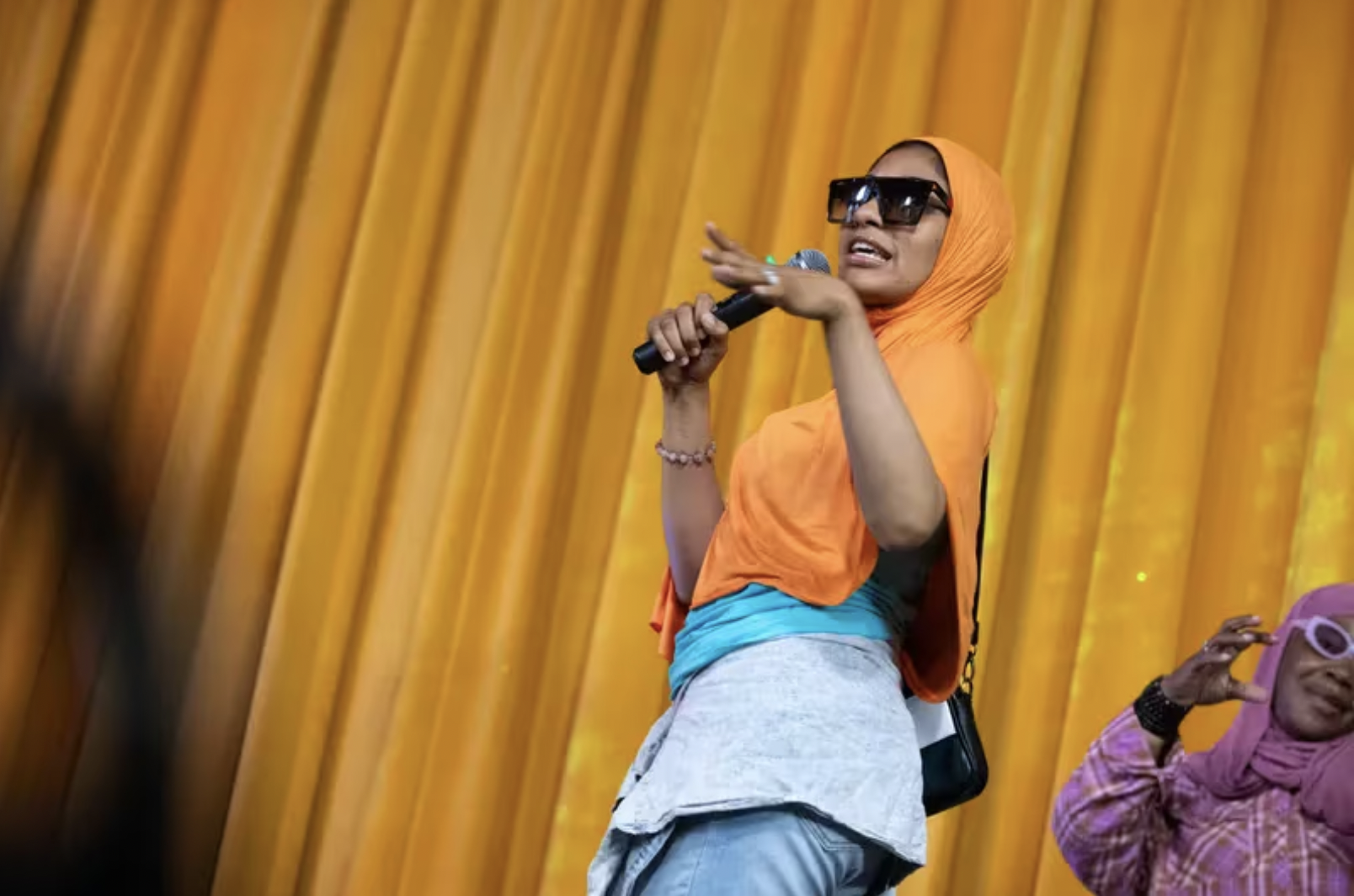
“It’s not just West [Philly],” said Reika Safiyya, a singer-songwriter, teacher, and sustainable clothing designer based in West Philly. “When you’re in Philly long enough, you can see the different dynamics. It’s a city full of art and talent, but the resources and support isn’t always there for people to thrive and live healthy lives. What Blackwell is doing is very necessary.”

Along with reducing gun violence, Blackwell said the open mic shows local artists that positive music can still fuel success. “It perpetuates the idea that the music is not corny, and that there are artists out there who can still survive in the rap game that’s not killing anybody,” she said.

What started as a five-person crowd three years ago has bloomed into a more recognizable open-mic series and family outing with catered food and a fresh lineup of local talent.

There’s been a notable drop in gun violence in recent years. According to the Office of the Controller, there was a 20% decrease in total homicides from 2022 to 2023. And Blackwell likes to think the Blackwell Cultural Alliance played a part in the decline.

Having cared for patients impacted by gun violence, Philly pediatrician and How Dope Are You? supporter Vivek Ashok said Blackwell has inspired him to take a more active approach to advocacy. For any program to be sustainable, he said, it requires a healthy investment from community members and elected officials.

“A lot of these community initiatives, specifically run by Black and brown folks, are not adequately funded,” he said. “I think highlighting the resilience and beauty of Philly youth is critical to understanding this group. And How Dope Are You? does that.”

As the program evolves, Blackwell’s goal is to foster more relationships with local organizations and brands. She hopes the city will fully get behind her campaign for nonviolent music. “We’re here to change people’s outlook on what music can be, and for the music industry to follow suit,” she said. “This effort is boundless. There’s no limit.”

– The Philadelphia Inquirer

Black-owned businesses are finding a home in Chestnut Hill

In Chestnut Hill, newly opened storefronts like Multiverse, NoName Gallery, Serenity Aesthetics & Wellness Medical Spa, and others have breathed new life into the historically affluent neighborhood known for 18th-century architecture, and a bustling commercial corridor. These businesses, owned by people of color, are servicing an evolving and increasingly diverse Chestnut Hill.

“We’ve had more than 24 businesses open in the last two years,” said Courtney O’Neill, executive director of the Chestnut Hill Business District. “The majority were African American owners, young couples, or women — and sometimes all the above.”

While 70% of Chestnut Hill residents are white, the neighborhood has seen a 7% increase in Black residents over the past decade, according to data from the U.S. Census Bureau. Black Philadelphians now make up 19% of the community, and there’s an increasing number of multicultural businesses attracting them to the Hill.

Fitness trainer Kim Harari, who moved to Chestnut Hill a year ago, said she relocated for a “homier” feel, and to find a deeper sense of community as a first-generation immigrant and queer resident.

For Harari, the growing diversity of Chestnut Hill is one of its best qualities. “If I could put a blueprint for what I wanted it to be, it’s here,” said Harari, a trainer at the Balance Chestnut Hill gym. “I never felt in place [in Center City], but [here] it’s diverse, queer-friendly, and a lot of Black-owned businesses. I love it.”

The speculative fiction bookstore Multiverse, which is owned by Sara Zia Ebrahimi-Hughes and Gralin Hughes, hosts monthly showcases for modular synthesizer artists. DanceFit studio owner Megan Kizer has led Beyoncé- and Lil John-inspired after-dark dance sessions. And NoName Gallery’s Jonene Lee has put on First Friday celebrations on the Hill.

Lee has welcomed graffiti artists, local musicians, and hip-hop DJs to her First Friday events, and said the presence of BIPOC-owned spaces and programs like hers has added much-need vibrance to the area. She feels more late-night, block party-style events is something the community has been wanting for some time.

“I’m happy that we’re bringing more color and culture here,” Lee said. “Even little old white women say they love what I’m doing, and that makes me happy.”

Lee says she knows no community is perfect. She’s dealt with “silent racism” all her life — the kind that’s felt through glaring eyes and disturbed faces rather than insults or derogatory statements. But she’s certain there’s real opportunity to grow in Chestnut Hill.

“It’s known for old money, and when you have old money, it’s white and it’s racist, I get that. But it’s not like that here. [Residents are] really open to art and culture, so I found a good spot.”

Tensions over change

While BIPOC business owners have been welcomed into Chestnut Hill in recent years, TC Unlimited Boutique owner Keia Chesson says that wasn’t always the case.

When she first opened her boutique eight years ago, Chesson was attracted to the “quaint” and walkable district, and the general ritziness of the area. At the time, there were only a few Black-owned storefronts in Chestnut Hill, and Chesson said moments of resistance from longtime residents occasionally surfaced.

“When Barack and Michelle Obama were in office, I highlighted purses and other items [with the Obamas’ faces on them] in my window, and some people didn’t like it,” said Chesson, who previously served on the board of directors for the Chestnut Hill Business Association. “Being a Black owner and supporting a Black president may not have been liked among some people [here], but for the most part, people embraced it.”

The increased diversity, O’Neill said, has brought a welcomed and organic change to the area, which has been largely “homogenous” for decades.

“It’s not just the business corridor, it’s just Chestnut Hill overall,” O’Neill said. “It’s an affluent neighborhood, but there’s a lot of affluent African Americans who have found their way here and made homes.”

Emerging unity

Beyond the rise in BIPOC-owned spaces, Will Brown of the Duke Barber Co. said there’s a real sense of unity that’s present throughout the commercial corridor. That’s why he’s kept his business in the area for 15 years, and why other entrepreneurs have gravitated there.

“We all go into each others’ businesses and support each other,” he said.

Brown said the growing diversity doesn’t mitigate the challenges businesses still face. Newly-established entrepreneurs can’t serve just one demographic to be successful — it has to be all of Chestnut Hill.

Owners like Gina Charles are up for the challenge.

Charles, the founder and medical director at Serenity Aesthetics & Wellness Medical Spa, moved her practice from Mt. Airy to Chestnut Hill in November. She wanted to find a ground-level location with greater visibility and easier access to its doors, and a space on the 8100 block of Germantown Avenue was a perfect match.

Charles is excited to see what the future holds, and for Chestnut Hill’s evolution to lead to more job opportunities, business collaborations, and networking events among all residents and patrons. “That’s a win for everyone,” Charles said.

– The Philadelphia Inquirer

‘There’s no edge like Philly’: Why the city’s most talented won’t leave their hometown

Philly’s “got major talent,” as entertainment mogul Charles “Charlie Mack” Alston says. “There are some remarkable people and talent that have come out of Philly, and the city has a surplus of it.”

But the demands of the industry often pull artists, musicians, and actors away from their beloved hometown, forcing them to pack their bags and migrate to cities like New York, L.A., Atlanta, and Miami.

But for Mack, who was Will Smith’s long-term bodyguard and personal assistant before becoming a notable Hollywood power broker, there’s only one place he calls home — and that’s Philly. And he is not alone.

Some entertainers born and bred in the region can’t seem to leave the city behind. We asked them why.

Responses have been lightly edited for clarity.

DJ Jazzy Jeff

DJ and hip-hop pioneer; West Philly native

Where do you live?

I’ve lived in Delaware for almost 20 years, but I never had a desire to move far away. It’s what I know. This is home.

Does the Philly area’s affordability play a factor?

It’s true – Philly isn’t as expensive as New York or L.A., and I know the city so I feel more comfortable here. I know how to navigate Philly; I don’t know how to navigate New York or L.A. In Philly, I know my surroundings.

Why do you think some Philly-born entertainers choose to leave the city?

Philly is a tough town. It prepares you to go off into the rest of the world because Philly doesn’t show love to those who don’t deserve it. Nothing comes easy, and it prepares you to go to places like New York and do a good job.

I think the people who move out of Philly never lose the love for Philly.

What does Philly’s future as an entertainment hub look like?

If you look at the history, [the Philly scene was lively] with Kenny Gamble and Leon Huff, then it left. That was the neo-soul movement and [then came] The Roots, it all goes in cycles. I tell a lot of inspiring musicians to just be ready when it comes back because it’s coming back.

Tierra Whack

Rapper; North Philly native

What’s inspired you to stay in Philly?

I love to travel, visit new places, and experience new things but nothing feels better than waking up in my hometown, with people that look and feel just like me.

Did you always see yourself staying in Philly?

I am Philly [and] Philly is me. I love my city and everything it has to offer. I want to put my city on the map. I’m not sure why other people leave, but I’m here to stay.

In a past interview, you talked about pouring back into the city. What does that look like for you?

My goal is to build a creative space here in Philly. Not only where I can go and be creative, but where others can, too. I love what’s happening in our city right now, [and] I want to be a positive light for everyone coming up after me.

Eugene ‘ManMan’ Roberts

Producer and musical director; South Philly native

Why do you think so many popular entertainers from Philly prefer to live in Philly?

A lot of people pull from Philly. Every major album, tour, and every band — someone from Philly is in the mix. And sometimes when we leave home and go to these other places, you’re filling them up with your energy, your presence, and your sound, but they can’t refill that cup. You got to go back home to get that vibe, inspiration, and aesthetic that makes home, home.

What’s stopped you from leaving the city?

We got rich history here. We have amazing producers, songwriters, and artists. We’re really good, and I never wanted to turn my back on the place that made me who I am. I’ll always be that no matter where I go.

Do you see Philly becoming a renewed musical hub?

Philly used to have Philly International, Sigma Sound, and all these other studios, and people came here to cut records. But when the world went digital, it took away needing studios. Until we build up an empire of entertainment with studios and rehearsal facilities, I don’t think any city can [become a musical hub].

L.A. is all that because that’s where all the celebrities live, and there’s good weather but I think the pandemic made it a level playing field for everybody.

Charlie Mack

Entertainment mogul and community leader; Southwest Philly native

Why do you think big-name entertainers from Philly choose to venture elsewhere?

Philadelphia is like a character, and people that used to come here admired it, but admired it from afar. If you don’t feel safe, you can’t relax and let your hair down. Right now, we’re in a place where we’re hemorrhaging and going through a very horrific transition, and I hope and pray that the kids here have an opportunity to experience Philly the same way I did.

I love my city, but the reality is people don’t feel safe. And home is supposed to be just that: a place you feel safe and welcome.

How can Philly go back to being what it used to be?

The natives of Philadelphia are in a space where they don’t love themselves. That’s the harsh reality, and it’s hard for someone to stay put when they’re not received or revered from their own people. Artists need validation and love, it’s a part of their makeup. Philly is real and harsh, it will hit you right in your face. Residents won’t give you fanfare if you’re not tapping into the things that make them move.

How can we better retain the talent that comes out of Philly?

I feel like the men of the city of Philadelphia have to restore safety. Women are stepping up in major ways, but men have to restore everything that is amazing about Philadelphia: the artistry, the streets, the sports, the politics, city government, and everything that it’s about.

Adam Blackstone

Multi-instrumentalist and songwriter; Trenton native

What does being close to Philly mean as an entertainer?

One thing is the culture of Philadelphia. There’s a go-getter and hustler’s spirit. For me, no other city has embraced the arts like Philly.

In Philadelphia, we just want to see each other win and we represent our city from all over the world, no matter where we’re from. That’s always a plus we have that maybe other cities don’t.

Are there certain Philly spots that give you inspiration?

When we go to any sports event, whether it’s the Philadelphia Eagles, Sixers, or Flyers, I feel a sense of oneness and a feeling that we’re all fighting for the same thing.

Don Cannon

DJ and record executive, West Philly native now living in Atlanta

Why does it seem like more Philly artists are staying in the city?

I feel like people just love the culture. I can walk through Society Hill and Parkside, and it just feels different than anywhere else in the world, from Brooklyn to Compton. It’s just a different feel, and I think that’s why people want to stay here. And sometimes you get away from home and think, “Man, it’s not the same,” and go back.

I know you relocated to Atlanta, but do you ever come back to Philly?

I left when I was 18, but I often go back to see what’s happening there, what’s the newest trends, and to get some edge. Sometimes you travel across the world, but there’s no edge like Philadelphia.


– The Philadelphia Inquirer

Philadelphia’s Black Cowboys honor a fallen, four-legged figure

Every time he marched across Fletcher Street stables, the strapping frame and cappuccino-colored mane of the American Quarter Horse drew the attention of Philadelphia’s Black cowboys and cowgirls.

His name was Streakin’ E Class. The quiet equine had a grandeur and presence that matched that of partner and former owner Eric “E” Miller, founder of the Philadelphia Urban Riding Academy.

Miller purchased his four-legged friend from the New Holland Horse Auction in 2017, nicknaming him “Chuck” in honor of a childhood best friend who passed.

On Sunday, Chuck died at age 29. His passing was felt across Philly’s horse-riding community, with several Instagram users commenting Monday on PURA’s announcement. “Rest well Big Chuck,” one user wrote. “I’m glad I gave you extra treats last night.”

“Everyone that visited the barn loved him because he was just so pretty, and he was just the man,” said PURA executive director Erin Brown, who goes by the moniker Concrete Cowgirl. “People adored him. He was just so beautiful and strong-looking, and even the other cowboys noticed he had this presence just like [Miller].”

Chuck was one of several horses Miller owned but wasthe first he bought after his release from prison in 2017. Miller’s interest in horses was rooted in his childhood. His father, who went by Butch, owned a stable in North Philadelphia.

In January 2019, Miller founded PURA, and the nonprofit became an outgrowth of the Fletcher Street barn, where Miller kept his horses and employed locals to care for them. His vision was to teach horsemanship to riders young and old and to preserve the history of Philly’s urban cowboys, bringing their stories to the general public.

His work led to the making of the Netflix film Concrete Cowboy, released in 2021, which starred actors Idris Elba, Caleb McLaughlin, and Jharrel Jerome. Brown said Miller was “the voice behind the movie and script.” But a month before filming began in North Philadelphia, Miller was shot and killed inside his Roxborough home.


Brown, who met Miller as a teenager at Fletcher Street, was determined to fulfill Miller’s vision for the movie and to care for Chuck. “I just knew [Miller] would haunt me if I didn’t,” she joked. “I knew how important it was to him.”

Brown said that Chuck was Miller’s “baby boy” and that he never missed an opportunity to brag about his dashing looks.

After Miller’s death, Brown took up the executive director role at PURA and ownership of Chuck. Recently, the horse’s health began to worsen. “It was best to let him go out like a G,” she said. “You could tell he was really tired.”

The long-time horse rider gifted braided pieces of Chuck’s mane to Miller’s four children. It’s a custom among cowboys and their fallen horses, and Brown felt it was the best way to honor Chuck’s legacy and the bond he and Miller shared. “I knew he was special to [Miller],” she said.


Miller’s daughter, Emani, said Chuck was like an older brother.

Chuck even joined Emani during her prom send-off last spring. The horse’s shoulders were adorned with images of him and her father, bringing the teenager to tears. “I couldn’t believe the amount of joy I felt,” Emani said. “It just made the presence of my father feel so real.”

Looking back at photos of her and Chuck, Emani said that she is saddened at Chuck’s death but that knowing he and Miller are now “reunited in heaven” has brought her a sense of solace.

“I know how much my dad loved his horse,” she said. “It felt so good to receive a piece of Chuck’s mane, and I was able to have a piece of him I will forever hold near [and dear] to my heart.”

Brown didn’t ride Chuck much but on commercial sets, he was the “grumpy old man” she entrusted for the job. He even appeared in Concrete Cowboy alongside Elba.


With support from Philadelphia and Councilmember Curtis Jones, PURA is set to open a new stable in Cobbs Creek next spring. The roughly $1.2 million project will convert an existing structure into a climate-controlled barn, Brown said, and Chuck was to be the first horse to walk through its doors.

Jones said the project will not only provide added resources for PURA, which currently boards its horses at the Dream Park in Logan Township, Gloucester County, but it will pass the “the baton” for future cowboys of color and protect the history of Philly’s urban cowboys.

“If this city were left to its own devices, it would totally erase the rights of cowboys out of its city limits,” he said. “Brown is not only fighting for the rights of the cowboy of color ... assuring there will be riders in upcoming generations.”

Brown said that a plaque honoring Milller and Chuck — and stories of them together — will be placed along the stable’s walls.

Meet the Philly artist who counts Shaq, Kevin Hart, and Brooke Shields among his fans

Long before the work of Justin Wadlington was placed in world-renowned gallery spaces, and he had Shaquille O’Neal, Brooke Shields, Kevin Hart, and other celebrities on his client list, the Philadelphia-bred artist learned to master another medium: the art of perseverance.

By 2009, Wadlington was worn by the grind of his 9-5 airline job, and it had been five years since he picked up a pencil and sketchpad. But a trip to Cancun reignited his artistic flame. Inside his job’s break room, he began sketching an image of a figure enjoying a beachfront, with a photograph of himself in the Mexican city as a guide.

His coworkers glanced at his work and were in awe of his abilities. That was enough for Wadlington to renew his pursuit of making it as an artist. “I made a promise to myself: get back into this and see what you can do with it. And ever since then, I kept trying to push the limits.”

As a kid, Wadlington submitted sketches of X-men characters to his school’s drawing competition. His high school teachers were some of the first to spot his artistic talents, and they placed his work in the building’s auditorium for a mini art show. “Back then, I knew I could draw, but I didn’t think it was special,” Wadlington said. “I just knew I could draw cartoons, but I never knew it was something beyond a hobby. I didn’t look at it as a passion, but it was.”

Growing up in Southwest Philly, survival was his main focus. His artistic pursuits fell to the background.

At 5, he accidentally ran into a piece of metal sticking out from a wall, and the devastating blow left him blind in his left eye. Wadlington’s mother struggled with mental illness and was later murdered in 2004. His father, a Vietnam War veteran, died by suicide when Wadlington was 2 years old. His grandmother raised him, but when she could no longer care for him, he was in and out of group homes until he was old enough to live on his own.

He enrolled in the Community College of Philadelphia in 2001 but dropped out after one semester. “Nobody was around as successful artists, so I felt like I had to get a job,” he said. “I looked around, but I knew Disney wasn’t going to hire me.” He worked up to two jobs a week to make ends meet, and over time, the desire to become a sought-after painter disappeared.

That moment in the American Airlines break room led him back to his creative path. Wadlington, inspired by England-based hyperrealist artist Kelvin Okafor, began sharing his detailed drawings of hip-hop artists and cultural figures on social media. Soon, he would put down the drawing stencil for a painting brush.

He was “self-conscious” about his left eye for a while, but the 40-year-old artist says it’s become one of his “strengths.”

“When I was younger, sometimes people would make fun of [my eye], and I used to feel some type of way about it,” he said. “But once I got older, started taking life into my own hands, and embracing the negativity, I began to show it more. I no longer hid it behind sunglasses.”

He took on the moniker Blind Eye Artist as a “reminder that I’m embracing something I was once ashamed of.”

As he refined his style on canvas — detailed images of pop culture icons, athletes, and artists against a Renaissance-style backdrop — Wadlington began gifting his work to high-profile entertainers, including Amber Rose, Joe Budden, and others. In 2017, one of his friends said they could get him in touch with Kevin Hart, so the artist worked on a portrait of the comedian for weeks, and was able to send him a large-scale painting.

Struck by the detail of Wadlington’s work, Hart posted the portrait on his Instagram. “Your talent in your craft is ridiculous man. I’m humbled by your gesture. ...This is the true definition of a #DopePic,” his caption read.

The post caught the attention of Shaquille O’Neal, who asked Wadlington to draw a portrait of him. In February 2018, the artist flew out to Los Angeles to hand the 7-foot NBA Hall of Famer the portrait, and another painting that paid tribute to the late Notorious B.I.G. Impressed by Wadlington’s talents, Shaq introduced him to New York-based art investor Glenn Fuhrman.

“I got the sense pretty quickly that he was a pretty special guy and definitely different and also a super talented artist,” Fuhrman said, “and that was really the beginning of a great relationship.” He and Wadlington quickly formed a mentor and mentee relationship.

With Fuhrman’s guidance, Wadlington began showcasing his abstract paintings in New York gallery spaces, schools, and museums, including the New York Academy of Art and the South Hampton Art Center in Long Island. His life and artistic journey soon struck Philly filmmakers Ashwin Chaudhary and Jonathon Korn of Juice Groove Films.

The two filmmakers wanted to make a short film around the Philly-based artist, but, Chaudhary said, the film quickly turned into a full-length feature. “He was larger than life when I first met him,” Chaudhary said. “Off the bat, his journey and how he got to where he is was just so compelling.”

The documentary, titled Blind Eye Artist, was primarily filmed between 2020 and 2022 and captured Wadlington’s roots in Southwest Philly. The film was released on Amazon Prime in October. “To witness the power of his art in transforming his life, it’s a story that will motivate anyone who wants to accomplish anything in a creative medium of any kind,” Korn said.

In the years he’s been in the art world, Fuhrman said many have fallen to their vices and life traumas. Wadlington, he said, could have easily fallen in the same trap. But because of his hard work and dedication to the craft, he’s never let it happen. “He’s got a great combination of talent, passion, and belief in himself that I think the sky’s the limit for him,” Fuhrman said. “I think he can go very, very far on this path that he’s taking.”

While he’s still carving his path, Wadlington said he wants to continue expanding as an artist and push the boundaries on all creative levels.

“I want to do impossible stuff, and I want people to see that they can do impossible stuff, too, regardless of where they come from or if they’re blind in one eye,” he said. “This is bigger than me, and I’d be doing people a disservice if I stopped going.”

– The Philadelphia Inquirer

The chipped pieces of Isaiah Zagar’s fallen mosaic are trinkets of Philadelphia’s history

Isaiah Zagar’s famed mosaic, Skin of the Bride, has seen its last days.

For more than 25 years, the 7,000-square-foot mural wrapped around the former Painted Bride Art Center. But on Thursday, Philadelphia’s Magic Gardens’ restoration team finally chiseled away the remaining tiles and gathered usable pieces with hopes of creating a memorial honoring Zagar and the original mosaic.

After hearing that tiles would be available for people to pick up at the mosaic site, Fishtown resident Jenna Countie knew she had to make a trip to Old City.

“As soon as I saw the announcement … my brain immediately was like, ‘Alright, I need to get my hands on some of them,’” she said. “I didn’t know what I was going to do with them; I just wanted to keep them somewhere.”

Countie remembered seeing Zagar’s work along the streets of South Philly in her youth, but it wasn’t until she wrote a research paper on him in college that she fully realized his artistic genius. As the years passed, she continued to marvel at Zagar’s work and dedication to his craft. Once news about Skin of the Bride’s destruction made its rounds, it was a “massive blow” to her. “It symbolizes how the city doesn’t prioritize art,” she said. “It’s really a sad, sad moment.”

Countie intends to turn Zagar’s tiles into a picture frame, but if they’re hard to assemble, she will put them in a shadow box with a picture of the mural. Then she will attach a plaque with Zagar’s name and include a little description of the mosaic so she can see an inkling of Philly history every time she passes by the box, just as she did walking the streets of Old City.

“They’re not just tiles, it’s really a piece of art and history because it’s been here so long,” Countie said. “[Zagar] is 84 years old. He’s probably not going to be making more art like this, so this [is] cool and personal to have — even just a few pieces of it.”

PMG events and marketing manager Allison Boyle said the organization is moved by the support of the greater community and the reverence residents like Countie and others have for Zagar and his work .

“We know Zagar’s work is a part of the fabric of Philadelphia and helps to make this city such a special and unique place to live and visit,” Boyle wrote in a statement. “It’s our hope that all those who have been touched or angered by this story will contact their city representative and ask them to recognize the importance of Zagar’s art to Philadelphia, and join us in fighting to save future murals from destruction.”

Zagar worked 12- to 15-hour days for nine years to create Skin of the Bride, one of the largest public murals of his storied career. Developer and architect Shimi Zakin wanted to preserve the full mural and build apartments above, but neighbors sued to stop the city from granting him the zoning exceptions he said he needed.

Considering the history of the site and her experience getting to know Zagar over the years, Tracy Buchholz said she couldn’t help but grab some tiles to place in her office.

“I met [Zagar] nine years ago, and I watched and photographed him creating mosaics across the city,” said Buchholz, who works for the company that supports PMG’s public relation efforts. “He doesn’t just slap these things against a wall. They come alive piece by piece, resulting in something beautiful.”

Holding onto tiles from the mosaic is important for her “because I understand what went into it. [Zagar had] so much passion and love for the Painted Bride and for the community.”

“His work is meant to be shared, discussed, and appreciated. Walking past any of his work makes me smile on a bad day and get creative on a good day,” she said.

Countie is hopeful the city will rally together to preserve Zagar’s remaining work. His art makes people appreciate Philadelphia’s “imperfections,” she said, and it’s important the fight to protect his work continues.

– The Philadelphia Inquirer

At night, he’s laying down verses. By day, rapper Anthony ‘Dappa’ Samuels runs a day care in West Philly

Electrifying performances, late-night studio sessions, and endless tour stops: The lifestyle is second nature to Philly rapper Anthony “Dappa” Samuels, whose connections and lyrical prowess have landed him on stages with some of the biggest names in the industry.

Equipped with charisma and punchy lyrics to match, the 30-year-old has performed with the likes of Fabolous, Machine Gun Kelly, Action Bronson, and Ty Dolla $ign. He’s collaborated with Westside Boogie, Stalley, Benny the Butcher, and other notable hip-hop stars.

But that’s only half his story.

Between the late nights in the studio and the days traveling from one tour stop to the next, Samuels happily embraces his role as “Mr. Anthony,” the owner of West Philly’s Young With Options Academic Center.

After quitting a job in accounting back in 2017, Samuels was encouraged by one of his mentors to pursue his love for child care and open the learning center. That year, he began operating out of a rowhouse at 53rd and Market Streets. “My overall vision was to have a creative arts program or creative art school,” he said. “That’s been a passion of mine for a long time, and we’ve been able to incorporate it here.”

The day care’s multicolor marquee hangs outside a powder blue rowhouse adorned with painted clouds. The space is a wonderland for young kids with bright eyes, endless energy, and an insatiable appetite for learning.

As Samuels walks through the day-care doors, kids look up from their cots with smiles as bright as the center’s crayon-colored walls. “Hey, Mr. Anthony,” they yell out in cheer.

Samuels and assistant director Dinnelle Jordan help organize poetry, music, and acting classes in the multi-floor space. Last month, they started a dance studio on the top floor, where they teach majorette, hip-hop, ballet, and other dance and exercise courses.

Most of the children hail from low-income families from West Philly.

Janelle Walls has been bringing her 7-year-old daughter to Young With Options since she was 1. Walls continues to send her child because of Samuels’ influence and willingness to support her family, even when she couldn’t afford the fees.

“One word I use when speaking about [Samuels] is ‘alignment,’” she said. “He isn’t at the school preaching positive behavior to the kids and then going into the studio and pushing a different message. Everything about him and what he does is consistent with the Young With Options brand. To me, it’s a message to kids that you can be yourself and still be successful.”

In the five years she’s worked with Samuels, Jordan said he’s been a consistent light of positivity. While other rappers dive into fast food chains and clothing lines on the side, his venture into child education speaks to his love for the youth, she said. “The fact [that] he helps other families go to work while looking after their children was a brilliant idea,” Jordan said. “It just goes to show how much he cares about his community.”

As a kid growing up in the Strawberry Mansion section of North Philly, Samuels said he seldom saw Black men with legitimate businesses, especially those revolving around childcare. “I love being able to be there and be hands-on,” he said. “I take a lot of pride in that, and it actually helps me with music and in life. I know I have to be that mentor and can’t do anything illegal, snap out, or make bad decisions. I have to stay solid.”

Samuels said being a day-care owner has had an impact on his music. He’s made a conscious effort to veer away from lyrics heavily revolving around street life. He knows his students are listening to his music, and their parents are keeping a watchful eye.

“I’ve seen and been through a lot,” he said. “I’m from the same environment that the kids in my day-care are from. I was one of those little kids, too. That’s what I love about being here. A lot of these kids, especially the little boys here, look like me and act like I did at one point in time.”

Samuels performed at the 2023 Roots Picnic Music Festival and acted alongside Danielle Macdonald in the film Patti Cake$. He was a stand-in for Michael B. Jordan in 2015′s Creed.

Legendary Philly artist Freeway said Samuels’ rap skills alone were enough to connect the two artists. But after hearing about Young With Options and the rapper’s other endeavors, he knew Samuels was cut from a different cloth.

“He’s always trying to go to the next level and push the envelope,” the “What We Do” artist said. “I feel like he’s going to have a long career and branch off into movies and different things outside of music every once in a while.”

Samuels said he wants to continue expanding as an artist and entertainer. But in that pursuit, he plans to open more academic centers so more children have a place to hone their creative arts skills.

“It’s all about me making a difference,” Samuels said. “I’m really big on the people, so I’m working to get bigger and have more day cares in the future.”

– The Philadelphia Inquirer

Who is ‘irregular’? Meet the artist behind the tag showing up all over the city.

On the face of eroded barricades, rotting alleyway dumpsters, dark under-passes and window-sized wood panels, the word “irregular” has become an increasingly regular sight for Philadelphians — and a mark of artist Sean Hassett’s growing presence.

Hassett, who goes by the moniker “Irregular” or “Irregular Sean,” has spray painted and penned his graffiti tag across the outskirts of West Philly to Chinatown, Spring Gardens, Brewerytown to the beating heart of Center City. Yet, his identity and motive are largely cloaked in mystery.

“I have no backing and there’s no system that I’m part of that’s helping generate what I’m putting out,” Irregular said to The Inquirer.

“I’m trying to show people that you don’t have to take the normal route, you can do it on your own.”

While he was drawn to the word “irregular” as a kid growing up in Darby, he didn’t put his talents to the canvas until he was released from George W. Hill Correctional Facility after a one-year stint in 2013.

While incarcerated, Irregular befriended an inmate who used to draw images on the letters he wrote to his loved ones in exchange for soup cans. Before the man was released, he gave Irregular all of the stencils and art tools he used to craft his work. That moment, he said, opened the door for his own artistic pursuits.

“Coming home with that record and no college degree, (it) pushed me to devote myself to my craft,” Irregular said.

Over the years, Irregular started creating acrylic paintings and mosaic-style works made from fragmented mirror pieces.

In 2020, the now-33-year-old artist began spraying his graffiti tag across Philly. He was partly inspired by the protests following George Floyd’s murder and the work of Germantown artist Nomad and Ghuls creator Lami Tolla. and he says his style and approach is influenced by Banksy and Basquiat.

Though he documents his art on Instagram, Irregular does not post pictures of himself on social media. (He did not agree to be photographed by The Inquirer.) He says he usually only leaves home for daily necessities and to sell and make his street art.

“I’m very withdrawn, and I’ve been very solo in what I’ve done over the years,” he said. “I’ve stuck to myself, and I don’t get into politics or institutions of the art scene... I try to contain my energy as much as I can. I think what I’m doing has some power to it, and I’m not trying to withhold it.”

When he peeks his head outside his home studio, he’s usually decked in paint-spotted garments, riding his bike with a spray paint can and white-out pen stashed inside a mid-sized pouch in pursuit of a new location for his work. In a matter of minutes, he coats the nine letters of “irregular,” and ducks off slyly without drawing attention.

“I just move with common traffic,” he said. “I like to say I move with the wind.”

He still sells his work in Rittenhouse Square, but tries to stay in the background and doesn’t approach onlookers until he sees a “magic moment” happen.

“I always wanted to create things that sell themselves on the street,” he said. “I don’t say, ‘Hey, look at this,’ or have a sign telling people to buy my work. I just stand a couple feet away, lean up against a pole and observe.”

Along with graffiti and mirrored artwork, Irregular sells mystery boxes, deep profile canvas and wooden-framed paintings on his website, with pieces ranging between $100 to $2,000.

It’s impossible to know how many tags he’s placed in the city. He stopped counting years ago but still feels a rush of leaving his mark. It’s like psychotherapy, he said, motivating him to satiate his appetite for more artistry and self-expression.

He views his work as a source of reflection, with the mirror pieces and word “irregular” serving as a symbol of self-identity and a magnet that draws a connection between him and the viewer. But rather than being packaged as a “street artist,” he prefers no title at all. “You can’t put a spotlight on a star. I’m just doing the work. Irregular is a statement, (and) the work emits a light of its own.”

Some Philadelphians view his tags as playful breadcrumbs. Some see it at as a link to a thought-provoking series, and others — especially on social media — see it as vandalism. “Artfully committing vandalism is still vandalism,” a Twitter user said.

I take objection to the term “artist”. He’s a criminal. Artfully committing vandalism is still vandalism.

— JohnsCow (@johns_cow) April 10, 2023

I dunno. Ask the “artist” to tag your front door.

— TappahannockName (@Allfortime0503) April 10, 2023

Resident Peter Gambino, however, welcomes this art.

“Philly has such a big and diverse art scene, so we might as well have a few mystery people working in that space,” said Gambino who first spotted Irregular’s tags six months ago. “[His work is] like little easter eggs placed along the infrastructure of our city.”

Other onlookers aren’t too fond of Irregular’s work . “I hate their tags,” says Philly resident Alex Fredericks. “(They’re) too long and aggressively style-less.”

Despite the mixed responses from passers-by, Irregular has become a sought-after talent in Philly’s art scene. He created two projects with Mural Arts Philadelphia. The first was a temporary mural for last year’s Wawa Welcome America; his work Mural Magic is irregular was featured at the 2023 Flower Show.

He was also tapped by Hyatt Centric Center City to be a part of the hotel’s monthly Maker Series back in January. Elizabeth Fricke, director of sales and marketing at HCCC, said Irregular’s approach to street art made him a natural fit for the series that spotlights the work of local artists.

Photo blogger Conrad Benner, who worked with Irregular on the Mural Arts projects, called Hassett an innovator. “He’s at this point in his career where all the doors are open to him, and he’s jumping through them,” he said. “That’s to say, he’s driven and taking advantage of this lane he’s made for himself.”

An “irregular” tag along 11th St. by Spring Garden in Philadelphia.Heather Khalifa / Staff Photographer

As more opportunities come along, Irregular said he will continue to etch his path as an independent artist, and break down barriers that may be in his or other artists’ way.

There’s no set direction in mind, he said. For now, he plans to sell more of his artwork and hopes to expand his brand globally.

“I’m not a starving artist, I’m a hungry artist, and myself and others know there’s much more potential past these walls,” he said. “I’m continually pushing myself, trusting my evolution and allowing everything to come my way. I want to stay on my trajectory and see Irregular grow 10 times bigger.”

– The Philadelphia Inquirer