There is a new MJ in ‘MJ the Musical.’ And here’s how he transforms himself for every show

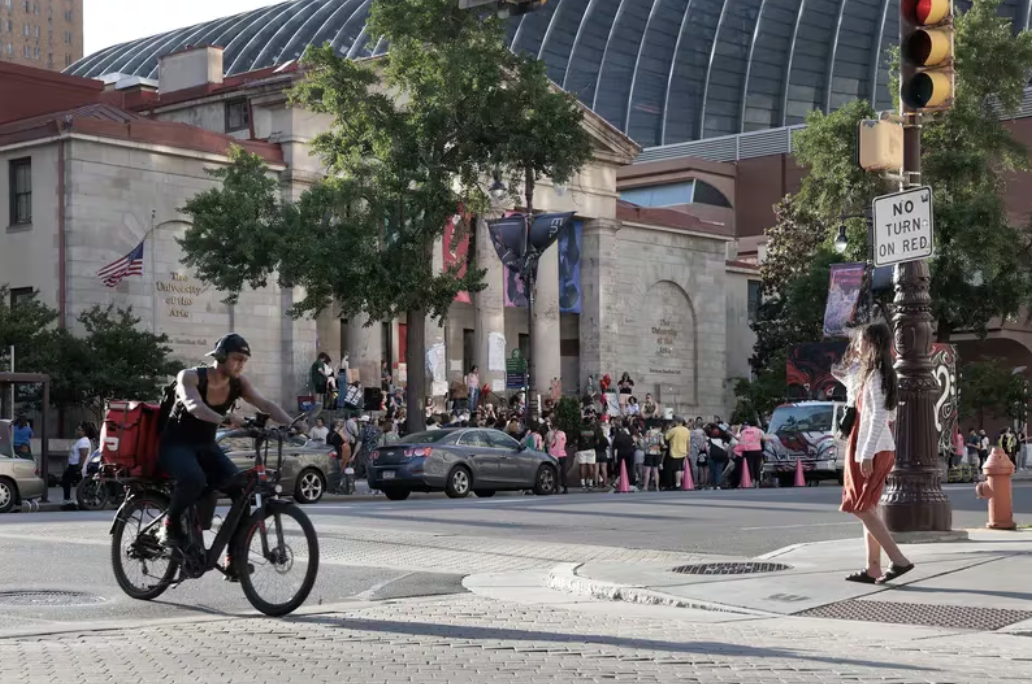
After a year of being an understudy, actor, dancer, and songwriter, Jordan Markus is ready to don the mythical fedora, slip into the rhinestone-encrusted glove, and take on the lead role of the national tour of Broadway’s Tony-winning MJ the Musical, which runs through Jan. 19 at the Academy of Music.

“It just feels right,” he said. “I’m ready to do it.”

Here’s a sneak peek into how Markus becomes MJ.

Becoming the man in the mirror

It all starts, Markus said, with “the man in the mirror.”

To settle into character, he arrives hours before showtime. Once he gets to the theater, he takes a seat in the makeup chair, then “zones in” to character.

Becoming MJ, he said, isn’t as simple as just applying contour makeup or putting on loafers and a densely curled hairpiece. It’s a character and story he’s fully embraced. “I’ve obviously never been Michael Jackson, but we share similarities. Lots of them, actually,” Markus said, whether it’s feelings of loneliness, perfectionism, or the unwavering pursuit of one’s musical dreams.

“Really knowing who I am has helped me become, in quotations, Michael. And I kind of live in it every day.”

Classic wardrobe with a modern twist

Costume designer Paul Tazewell grew up emulating the Jackson 5 with his three brothers. To piece together the show’s wardrobe, he referred to images of Jackson throughout his career.

Jackson’s style, he said, reflected the trends of the times, but always came with a twist that was uniquely his own. The challenge for him lay in styling the character of Jackson, from little Michael (Josiah Benson and Bane Griffith) to MJ the icon (Markus), with many fictionalized moments embedded into the show.

“It was about creating a world the audience could believe and stay engaged within,” said Tazewell, who won a Tony Award for best costume design in a musical for 2016’s Hamilton.

Tazewell’s vision is in full bloom throughout the show. He incorporates classic outfits from Jackson’s career — from his earth-shattering debut of the moonwalk at a Motown 25th anniversary concert, to the iconic outfits seen in the “Smooth Criminal” and “Beat It” music videos.

When the direct references aren’t as readily available, Tazewell takes calculated liberties. During the dance rehearsal scenes, Markus’ MJ wears loose cotton shirts, flowingly trim trousers, and hard-bottom dance shoes.

Moving like a smooth criminal

It helps to have Jackson’s moves, too.

Choreographers Rich and Tone Talauega, who were dancers on Jackson’s “HIStory World Tour," taught Markus the techniques and the “king rhythm” that Jackson possessed.

Rich Talauega said Markus, whom he affectionately calls “too tall,” managed to grasp the dance moves and other idiosyncrasies needed to capture the spirit of Michael Jackson. The movement may appear “simple,” but the two brothers said it requires thousands of rehearsal hours and an unrelenting work ethic to achieve. And Markus embraced it all for the role.

“He’s earned it,” Rich Talauega said. “The amount of work he put in resulted in him being able to walk in those loafers, glide from side to side, hit those notes, and play the role of Michael Jackson so big-time. I take my hat off to [Markus].”

“He did the homework,” Tone Talauega added.

Along with crafting the movement for the musical, the duo also served as authenticators of Jackson’s story.

They talked to Markus about the shared prayers, heated rehearsal sessions, and monumental performances that reflected the man, artist, and cultural phenomenon. And Rich Talauega said the result is an “electrifying, in-your-face, bona fide, and pure” telling of the generation-defying talent.

“It’s really surreal to be able to represent this man’s legacy through his dance style,” Rich Talauega said. “We feel so privileged, honored, blessed, and lucky to be able to replicate this man’s dance style as best we can with this new generation of Michaels.”

– The Philadelphia Inquirer

An in-the-works UArts documentary will show what led to the school’s collapse

Amid the thousands of emails that filled his inbox, former University of the Arts professor Kyle Crichton never expected to receive a message like the one delivered at 6:19 p.m. on May 31.

Crichton froze as the news broke — president Kerry Walk said the school was closing in a week. And on June 7, the historic arts college officially shuttered its doors, leaving hundreds of students and educators wondering how and why the university suddenly collapsed.

Administrators blamed declining enrollment and unexpected financial challenges as the source of the dismay, while some UArts employees and union members pointed to alleged mismanagement. The closure sparked days of protests and class-action lawsuits filed by dozens of ex-staffers.

‘I started filming it’

With uncertainty still looming,Crichton grabbed his camera and began capturing student-led protests on the steps of Dorrance Hamilton Hall on June 5. The award-winning filmmaker had another project on the books, but he decided to chronicle the story he was experiencing and watching unfold.

“As it happened, I started filming it,” said Crichton, who received a Mid-Atlantic Regional Emmy for his work on the 2023 documentary Angel Dose. “I was disappointed financially, but I was also disappointed I wasn’t going to be teaching these kids.”

In need of a cinematographer and co-director, Crichton tapped fellow UArts graduatesKatie Supplee and Michelle Rose Goodwin, who agreed to be a part of the project, still in early stages and currently titled “Reckless Education.”

Along with capturing the devastation of the June 7 announcement, the three filmmakers have interviewed UArts students, staff, and faculty about the lasting affects of the shut down over the past four months.

Goodwin, the co-director and producer of the film, is hopeful the documentary will fully capture the frustrations, anger, and heartbreak felt among the UArts community in the days and months after the unforeseen closure.

“The school dissolving in the fashion that it did shook a lot of people’s foundations, took a lot of control from their lives, and made a lot of people feel powerless,” Goodwin said. “And I think this documentary is a way to try to give them that power back.”

Why did UArts close so suddenly?

Goodwin said they aren’t shying away from the school’s missteps, which ultimately led to its dissolution and Chapter 7 bankruptcy filing. But a goal of the documentary is to figure out what happened.

To unveil the full wreckage of UArts, Crichton said it’s a “multi-pronged” approach that requires the voices of city officials.

Crichton, Supplee, and Goodwin are hoping to land interviews with city council members and attorney general Michelle Henry.

“Art is such a good vessel for spreading ideas, and I feel like that’s what we’re doing here,” Supplee said. “We don’t want to just impact the Philly arts scene with the film. We want to speak to the shuttering of educational institutions as a whole.”

Next steps for production

Supplee, whose fiancé worked at UArts before the university closed its doors, said the small production crew is now following “displaced UArts students who were forced to transfer schools to pursue their creative arts career.”

With filming in full swing, Crichton said the team is aiming for a 2026 release. The next step is to add more interview subjects, researchers, and filmmakers to bolster up the production, and score additional funding to piece the self-funded project together.

The three filmmakers are funding the independent venture while balancing their daily work as documentarians and content creators.

Crichton is confident they can produce the film “rag-tag style” for $100,000. And as they bring on more contributors, preferably UArts alums, he believes the nearly two-year process will be worth the wait.

“It feels like we have lightning in a bottle, and we want to continue pursuing it,” Crichton said. “Things will unfold, and we’ve come to the realization that it’s going to be a little bit of time, but we’re prepared for it.”

For more information, visit recklesseducationfilm.com.

– The Philadelphia Inquirer

After years of decorating parties with balloons, this artist is now making art with them

North Philly artist Brian Ward grew up in the events industry. His family’s kitchen had three refrigerators and he ate Cheerios every morning with drapes, linen cloth, and other party decor hanging from both ends of the dining room table.

His parents, a baker and an event coordinator, brought him into the family business at age 14. He thought about being a part-time magician, party clown, or face painter to earn extra money for school clothes, but none of them stuck. The only one that did was balloon art.

Ward started out making inflatable hats, swords, and balloon animals at kids’ parties. Then he graduated to shaping archways and columns for prom send-offs, birthday bashes, weddings, and other celebrations.

After working as a balloon artist for a decade, Ward, now 26, is pursuing a different kind of art. Instead of contorting balloons into party-ready pieces, he is crafting sculptures and artwork with them. Only this time, they’d all be deflated.

“I wanted to create something that lasted longer with balloons as my medium,” Ward said. “Balloon decor doesn’t have much life expectancy, and I didn’t want to jump to painting or carpentry. People know me as a balloon artist, so I wanted to merge the two.”

With pencils, markers, paint, glue, and deflated balloons, he has made sculptures of basketballs and small dogs. He has also reimagined one of Evelyne Axell’s paintings, whose work inspired Ward to explore vibrant colors.

It’s a tedious process, Ward said. The materials are a small cost, but a typical art piece can take anywhere between 18 hours to three weeks to complete. But he’s found his rhythm and grown more confident in his artistic pursuits.

He went from selling $300 balloon decor packages to $2,000 art pieces bought by a big-name entertainer. And now he’s ready to show his work to a wider audience.

Ward has been a part of hundreds of events, but on Saturday he is putting on his first art show, for nearly 400 attendees at the Bridge Studio in Philly. The self-funded exhibition, titled “Who is Brian Ward?” will be filled with interactive art pieces and installations, including a play pit full of balloon-made balls.

Kamaya Jackson, a friend who has watched Ward evolve as an artist, said he’s always had the ambition to go big, and she’s happy others will get to see his art and know his story.

“I want [Ward] to feel the love the community has for him,” Jackson said. “I hope he can soak up that moment and see how much of an impact he’s made on that community. Just all the good things that can happen, that’s what I want it to be.”

Ward’s first canvas painting will be a highlight of the show.

His father, Brian Ward Sr., gifted him a canvas in July 2023. Ward used it to craft a balloon-filled collage that was inspired by the last painting his grandfather, John Ward Sr., made before his death in 2013.

Ward gifted the canvas back to his dad, who loved it. His father’s reaction gave Ward the confidence to fully pursue his new artistic journey.

“I knew my dad would be proud,” Ward Sr. said. “He was already proud of his grandkids, but he didn’t get a chance to see Brian do the art that he’s doing now. I know he would be proud to see it, and I think that was reassurance for [Ward].”

While the art world is relatively new ground for Ward, he’s establishing himself as an ascending talent. His first and most notable collector is Grammy-nominated artist Smino, who purchased a balloon-made painting of Mickey Mouse during the 2024 Roots Picnic weekend.

The transaction, Ward said, was nothing short of motivational. “[Smino] was like, ‘I’ll Zelle you the money right now. Just ship to L.A.,’ and I’m like, ‘Bro, I’ll carry this jawn on my back and bring it to you.’ I was on my cloud nine after that.”

His new venture hasn’t been without its detractors. Longtime friend Alissa Smith said Ward has encountered naysayers throughout his artistic journey. But the entrepreneurial spirit his parents embedded in him continues to push him forward.

“People didn’t believe in his vision,” Smith said. “He overcame doubt and slower [business] seasons as a balloon artist. People told him it’s not really a normal job. But I think he took that adversity and used it as motivation. He’s created so many different connections, and I’ve seen him push past people not believing in him or trying to slow him down.”

While Ward is still developing his artistic style, he has never questioned whether he had a story to tell. The Strawberry Mansion resident said his upbringing is one of the pillars of his creativity, and he’s driven to inspire others to create their own art — whatever medium they may choose.

“I always tell people I’m inspired by life,” he said. “Some people may say that’s cliché, but I’m inspired by the possibilities of the things that you can do. And I’m just continuing to write my story.”

– The Philadelphia Inquirer

Artists, advocates, and family members rush to save artworks inside UArts

Legendary Philly artist Sam Maitin built a life and career at the University of the Arts. A nearly 50-year-old painting of his still adorns the northside stairwell of the former Gershman Y building, owned by UArts since 2000. The three-panel painting — with a 16-foot-long central piece and two 8-by-4-foot flanking paintings — bursts with vibrant colors.

After the sudden announcement of UArts’ closure, Maitin’s daughter, Ani, made a trip to the arts college to ensure her father’s work would be saved. She covered the triptych with sticky notes with her email and phone number. She left another Post-it with a more urgent message: “Anyone told to remove these artworks please contact me in advance. They require special handling.”

Former staff member Elisa Seeherman understood the urgency.

“It’s not just about the monetary value of these pieces, it’s about the historical value of them,” said Seeherman, who was the school’s director of career services. “He was a Philadelphia icon.”

Ani Maitin talked to Seeherman, UArts Board members, and a representative from the company handling the closing of UArts, and was told she could take custody of the paintings. Still, much like the fate of the students, faculty and staff of UArts, the future of Maitin’s work — and that of many other pieces in the UArts system — remains up in the air.

Seeherman said it would take a crew to remove Maitin’s painting from the building, most recently home to the UArts’ Student Center and Lightbox Film Center. The biggest issue, she said, is finding a place that will properly restore and house the slightly abraded artwork.

“These pieces are huge and won’t fit into most homes,” Seeherman said. “It’s complicated. And that’s probably why the former Gershman Y people left them in the building after they left.”

Sam Maitin: Mayor of the Arts

Sam Maitin was born in 1928 above a grocery store run by his Russian Jewish immigrant parents in North Philadelphia.

After graduating from Simon Gratz High School at age 16, he won a citywide art scholarship to the Philadelphia Museum School of Industrial Arts, now known as UArts. He simultaneously attended the University of Pennsylvania, and would later go on to teach at both schools and the Moore College of Art and Fleisher Art Memorial. He died in 2004.

“His work is an important piece of Philadelphia. But whether or not people loved his work, he was recognized as an endlessly generous person who did so much for other people and organizations,” Ani Maitin said. “It’s an incredible gift to manage his work. ”

The “Mayor of the Arts” — as Maitin was often called — was connected to the Gershman Y through his involvement with the center’s Y Arts Council. He was the in-house designer during the 1960s, working with figures like Joan Kron, Audrey Sabol, and others to promote the Arts Council’s visual, literary, and performing arts programs.

He was commissioned to create a set of paintings for the building’s lobby, and the result was the vibrant three-panel painting adorned with a Hebrew message that represented the mission he and the culture center shared.

The Hebrew phrase “Al tafrosh min hatzibur” translates to “Do not separate yourself from the community.” The painting also contains “Simcha” and “Sasson,” which translates to “joy” and “happiness.”

“I think the message still translates today,” said Craig Stover, Maitin’s former studio assistant and longtime friend. “If UArts made it their mission, their closure may not have happened.”

When the painting was unveiled in the early 1970s, Ani Maitin was only in preschool. But she remembers how it enlivened the Jewish family center, even as the building took on other iterations. “It felt very much like home to me when I was a kid,” she said.

An uncertain future

On Monday, Ani Maitin received a phone call from Alvarez & Marsal, the company tasked with managing and liquidating UArts properties after its closure. Though the consulting firm didn’t respond to The Inquirer’s queries, it informed Maitin that she or anyone from her family could come take Sam Maitin’s artwork from the building.

“Given the circumstances, I’m now feeling more reassured that the company is making efforts to handle things thoughtfully,” she said. “It’s all definitely an unexpected and time-consuming part of caring for my dad’s work and legacy.”

Ani Maitin said she’s scouting for nearby preservation sites and hopes to find a place to house the paintings soon. Her trip to UArts, however, opened her eyes to another glaring problem: No one knows what’s happening to other artists’ works displayed on campus.

“It was clear to me it wasn’t just about my dad’s artwork,” she said. “I felt like I was channeling my dad because he was such an activist. He taught me when you do something, you do it to uplift others too. Don’t just do things to support yourself.”

Based on their phone call, Ani Maitin said Alvarez & Marsal intends “to take their time to deaccession” the other works on UArts campus. This process involves the removal of artwork from an institution’s collection in order to sell or dispose of it. But no further details were provided, she said.

UArts faculty and staff can submit access requests to retrieve their personal items from university buildings, but it’s unclear whether the families of artists are given the same courtesy — or what will happen to artworks that don’t have family advocates like Ani Maitin.

An art piece has slipped through the cracks before, Seeherman said.

In June 2022, Seeherman said, she held a meeting to express concern for a sculpture named A Woman of Courage by Gladys Barry, a donation that had been in the Gershman Hall foyer since 1979.

With a new lobby construction set to begin, she was worried the sculpture would get damaged or misplaced. And when the construction project was completed in 2023, her fears were proven right — the sculpture was missing.

Seeherman is hopeful that outcome can be avoided this time around, citing the work of Ani Maitin and what others are doing to advocate for artists’ work on UArts campus.

“I wish [the art] could find a home where it can be appreciated for the art it is. Whether it’s in a museum, a private collection, or goes back to any of the families connected to it,” she said.

“UArts may have closed, but we’re still a community.”

– The Philadelphia Inquirer

A stolen musket from the Revolutionary War returns to Philly

An 18th-century musket that’s linked to the Revolutionary War was stolen in 1968 from Valley Forge Park, leading to years of investigation. When the cherry wood and brass-made firearm, once a part of the Valley Forge Historical Society Museum collection, went missing, it left many historians and investigators in limbo for decades.

But with help from Upper Merion Township detectives and the FBI’s Art Crime Team, the prized relic was returned to the Museum of the American Revolution on Monday.

The .78-caliber musket was displayed on a blue cloth-covered table, just under the dramatic painting, Siege of Yorktown in Virginia. Museum president and CEO Scott Stephenson held the antique in his hands, noting how the details etched in the gun’s 45-inch barrel and engraved butt plate noted its historic origins.

“There were no machines cranking these parts out,” Stephenson said. “This is literally hammer in hand, steel, iron, brass, and wood carefully pinning these pieces together.”

The retrieval of the 250-year-old firearm was a battle on its own. Until recent months, there was no trace of the musket for 56 years.

In 2009, Kevin Steele of the Montgomery County District Attorney’s Office reopened a cold case on the theft of antique firearms from the Valley Forge Historical Society Museum and several law enforcement agencies joined the effort to retrieve them. Among these firearms was the New England musket.

On the local level, Upper Merion Township Detectives Brendan Dougherty and Andrew Rathfon were tasked with retrieving the musket, as well as other Revolutionary War antiquities. Between 2016-2022, they were joined by the FBI Art Crime Team, the U.S. Attorney’s Office, and others on the investigation.

The collective effort resulted in the arrest of two people and the recovery of 50-60 historic items that were returned to 25 different museums along the East Coast. But dozens of artifacts were still missing, including the treasured musket.

In March, Massachusetts-based arms appraiser Joel Bohy spotted an early 1770s firearm during an antique gun show in Baltimore, which ended up being the one stolen from Valley Forge Park.

Bohy knew it was Rhode Island-made. The engraved butt plate signals its New England origins. But he didn’t know the significance of the artifact until he saw a press release from Upper Merion Township detectives.

“When I first saw the gun at the show, I was pretty excited about it because it’s a really rare gun,” Bohy said. “It was even more exciting when three weeks later, Upper Merion Township police sent me a press release with the missing things retrieved from the cases they worked on before. As as soon as I saw [the musket], I clicked on the images and went, ‘Oh my God, I saw this gun weeks ago.’”

Bohy reached out to Dougherty and Rathfon, who he had worked with on cases before. The next day, the FBI team interviewed Bohy, and the two parties were able to track down the musket and deliver it to the insurance solutions company, Chubb.

Chubb paid the insurance claim for the missing relic back in 1969, which meant that it was now its official owner. Since the Museum of the American Revolution acquired the collection of the Valley Forge Historical Society back in 2003, the organization decided to gift the musket to the museum.

“We’ve obviously devoted many years to this investigation and we’re still going. But it’s special because it was stolen from our home,” Dougherty said. “And to know after 56 years it’s home is nice because it’s such a local historic item.”

With the firearm now in the hands of Stephenson and the museum’s curators just days before July Fourth, Chubb executive Maria Thackston said it’s a “poetic” story of repatriation.

“We’re thrilled to give it back to them, allow them to continue to study it, and make it available for the public to enjoy it,” she said. “It’s our privilege.”

While there are no current plans to exhibit the rare firearm, the museum will continue to study the artifact until plans for display unfold at a later date.

Staff writer Raymond Ragland contributed to this article.

– The Philadelphia Inquirer

Jill Scott is ‘really tickled’ to be featured in a new mural at her alma mater, Girls’ High

After years of fiercely repping her hometown, Philly’s very own legendary vocalist Jill Scott was honored at her old stomping grounds.

On Thursday, Mural Arts unveiled a mural of Scott during a 175th-year celebration of her alma mater, Philadelphia High School for Girls. “I want to live in the moment,” Scott said in a Zoom interview before the ceremony. “I’m very touched and thrilled. I cannot believe this.”

The mural is designed by artist Patrick Dougher and features Scott coronating young girls with replicas of the same golden crown she wears on her head. The Latin phrase “vincit qui se vincit” comes out in a wave from under Scott’s halo-like Afro. It translates to “She/He conquers who conquers herself/himself.”

The 900-square-foot mural, titled Luminaries: The Coronation, is located on the facade of Girls’ High facing Broad Street. Jane Golden, executive director of Mural Arts, said its vibrance is a reflection of the impact Scott has made as an ambassador for Girls’ High and the Philly arts.

“Her artistry, resilience, and dedication to uplifting our community epitomize the spirit of Girls’ High,” Golden said in a statement. Through the mural, she said, “we honor not only Ms. Scott but also the countless women who have graced the halls, leaving an indelible mark on our world.”

Before the ceremony, “Jilly from Philly” chatted with The Inquirer about her fondest memories at Girls’ High, the hidden powers of “Schuylkill ,” — otherwise known as Philly tap water — and her headlining performance at the Roots Picnic on Saturday. A deep feeling of gratitude shined through her smile. “It’s hard to explain how great this is,” she said. “I am really tickled. ”

The interview has been lightly edited for length and clarity.

How does it feel to have this honor?

It’s really crazy. Wow, I know I should be ready for these kinds of questions because I figured you would ask me how it feels, but it’s kind of surreal. I had such a difficult time during high school. I missed 48 days of school my senior year, primarily because I couldn’t get to school. I didn’t have money, tokens, or anything, and I worked at night. It was very hard. I did not pass math, which was devastating. It meant I couldn’t walk and had to go to summer school. But that’s the reason this is so surreal, it was such a challenging part of my life, but an amazing time as well.

This is the kind of stuff that’s in a lot of fairy tales. I would have never imagined that my likeness or any part of me would be on the side of my dang high school. Never, not one day.

How was Girls’ High?

Girls’ High was beautiful. We had perfect pink marble hallways, and walking down those hallways felt like triumph every day. There were so many brilliant young women, and so many friends I have till this day. It was an extraordinary time for me, I just wish I didn’t have the troubles I had at the time.

What do you remember the most from those days? Any particular teachers?

I have a lot of fond memories, the only problem was we didn’t have any money. But yes, I had Mr. William Murphy, the leader of Treble Clef. You had to audition to be in the Treble Clef Choir, and it taught us Latin, German, and Italian songs. He played amazing music, and took us to the Academy of Music. That’s where I first heard and saw Kathleen Battle. I never heard someone sing so lovely and smile so pretty at the same time.

You grew up here. How did the city make you who you are?

People ask me the question all the time: What makes Philadelphia vocalists? I think it’s the Schuylkill punch, and the fact most of the musicians are coming out of church. I think it’s institutions like the Philadelphia High School for the Creative and Performing Arts, and Treble Clef at Girls’ High. I think all these accumulate to make Philly’s musicians, vocalists, and artists great.

And what about the city’s murals?

I grew up looking at murals my whole life, on every other corner. Murals have been an inspiration just by seeing all those beautiful colors. There was a lot going on in the city of Philadelphia. [But] the murals were uplifting, with beautiful quotes and the faces of people we admired. I’ve always appreciated that.

And the Philly arts community? Does its future excite you?

Of course. I think I’ve touched pretty much every portion of it in the course of my lifetime. All the wonderful time I’ve had performing live, whether it was poetry or singing somewhere. There were so many places, and some of them aren’t here anymore, but they are integral to everything that I am and everything that I’ve done. And oh, the block parties. I used to go to so many block parties. All those things made me who I am.

Can we get a glimpse into your Roots Picnic performance on Saturday? Or do you want to keep everything secret?

I’ll keep it a secret. Just know that I’m thrilled and very excited. I had a wonderful time performing at the Met for the 23rd anniversary of Who is Jill Scott? Words and Sounds Vol. 1 last year. I loved that people walked out singing in the streets. It felt so good.

– The Philadelphia Inquirer

A wholesome rap battle promises cash — and takes a stand against gun violence

In the grueling battle against gun violence in Philadelphia, community leader and activist Sajda “Purple” Blackwell has served on the front lines.

At age 7, she lost her brother, Ronnie Easley, who died of a gunshot wound.

In January 2023, Sideic Robinson, the son of her husband, Thomas Blackwell VI, was fatally shot in Rochester, N.Y., while leaving his job at a local Burger King.

As the owner and operator of the online radio station PQRADIO1, Blackwell realized she had a role to play in perpetuating a trigger-happy culture. Her station played music that glorified street violence. And as death tolls rose, she swore only to promote “positive music on purpose.”

While she still plays urban contemporary artists like Lil Baby, Megan Thee Stallion, and Meek Mill, Blackwell doesn’t play or promote records that glorify gun violence.

Adding to her efforts at reprogramming the minds of local listeners, Blackwell also started the West Philly-based nonprofit Blackwell Culture Alliance Inc., which looks to “build stronger communities, neighborhoods, and economies through educating, donating, and volunteering.” It organizes food distribution drives and other outreach programs.

One such program is the open mic series How Dope Are You?, which Blackwell hopes will counteract some of the pervasive pop culture messages she finds so harmful. .

Since 2021, the monthly rap battle has encouraged local rappers to spread anti-gun violence messages through their music. The competition awards Philly rappers, poets, and spoken word artists with a $1,000 prize, but there are two rules: they can’t use curse words and have to firmly address the problem of gun violence.

“We became very intentional on promoting nonviolent music, and to challenge our young people to make the music they talk about, what they want to hear, and to make it hot. People have really begun to step up to the challenge,” Blackwell said.

Inside West Philly’s Holy Apostles & the Mediator Episcopal Church, the rap battle starts with gun violence survivors and their families locking arms in a “healing circle.” After Blackwell welcomes everyone, the attendees share their experiences.

“Whether we have 50 or 100 people, we’re creating a space for nonviolent music,” Blackwell said leading up to a recent showcase. “And if you can make a song about not killing anybody, then you can come get this ‘shmoney.’”

On May 22, South Philly artist Michael “Mike J” Johnson and nearly a dozen other creators exchanged stories and caring words before setting the stage ablaze.

“It just felt like a real encouraging space,” Johnson said. “Nobody was out for each other. The dynamic was genuine, wholesome, and very supportive.”

Johnson, who was inspired to rap after hearing Nas’ “I Gave You Power” at 8 years old, admits his music isn’t always the most uplifting. Days before the competition, he worked tirelessly to craft a song he felt was up to Blackwell’s standards.

He thought about the victims and perpetrators of gun violence, and how both their lives can seemingly end with the pulling of a trigger. He came up with the song “Let’s Rise Up,” which incited a seismic chant from the crowd in attendance.

“Bro, rise up. Sis, rise up,” the audience screamed. “Bro, rise up. Sis, rise up.”

By the end, Johnson and the other performers were awarded portions of the $1,000 prize. The program — and the camaraderie that was formed among the participants — made it feel more like a family gathering than a competition. There were no losers, Johnson said.

“It’s not just West [Philly],” said Reika Safiyya, a singer-songwriter, teacher, and sustainable clothing designer based in West Philly. “When you’re in Philly long enough, you can see the different dynamics. It’s a city full of art and talent, but the resources and support isn’t always there for people to thrive and live healthy lives. What Blackwell is doing is very necessary.”

Along with reducing gun violence, Blackwell said the open mic shows local artists that positive music can still fuel success. “It perpetuates the idea that the music is not corny, and that there are artists out there who can still survive in the rap game that’s not killing anybody,” she said.

What started as a five-person crowd three years ago has bloomed into a more recognizable open-mic series and family outing with catered food and a fresh lineup of local talent.

There’s been a notable drop in gun violence in recent years. According to the Office of the Controller, there was a 20% decrease in total homicides from 2022 to 2023. And Blackwell likes to think the Blackwell Cultural Alliance played a part in the decline.

Having cared for patients impacted by gun violence, Philly pediatrician and How Dope Are You? supporter Vivek Ashok said Blackwell has inspired him to take a more active approach to advocacy. For any program to be sustainable, he said, it requires a healthy investment from community members and elected officials.

“A lot of these community initiatives, specifically run by Black and brown folks, are not adequately funded,” he said. “I think highlighting the resilience and beauty of Philly youth is critical to understanding this group. And How Dope Are You? does that.”

As the program evolves, Blackwell’s goal is to foster more relationships with local organizations and brands. She hopes the city will fully get behind her campaign for nonviolent music. “We’re here to change people’s outlook on what music can be, and for the music industry to follow suit,” she said. “This effort is boundless. There’s no limit.”

– The Philadelphia Inquirer

The Philly artist who gets mistaken for Banksy

Susan Ferrence was in a rush on a December morning as she passed by Jefferson Plaza at 12th and Chestnut Streets. She was late for a workout session when an image stopped her in her tracks.

It was a stenciled mural of a young child, screaming while wrapped tightly in a straitjacket.

Ferrence, an art historian and director of publications at INSTAP Academic Press, took pictures of the freshly stenciled work with darkened shadows and etched grooves. She told her friends she had just spotted a Banksy.

The “Banksy” turned out to be the work of a Southwest Philly artist who goes by Bad Luck. The 33-year-old, who opts to conceal his identity, had stenciled the sketch of the screaming child on a wood-paneled wall hours before Ferrence walked by it.

The idea for the mural, he says, stemmed from a feeling of restriction, like being bound in a straitjacket. Bad Luck wanted to break free of his thoughts, like the child he drew screaming in enraged silence.

That’s how he’s always envisioned his artwork — as a cleansing of thought and emotion. But the comparison to Banksy is something he says he never imagined or wanted.

“I hate it, man,” he said. “He’s so big, talented, and clever. But if you try to do stencil work, then somehow you’re automatically biting off of Banksy. That’s how people view it.”

Philly artist Bleak, who shares an Instagram page with Bad Luck and assists him on select projects, said the comparisons are “wild.” “We admire Banksy’s work obviously, but we’re trying to be our own thing.”

Bad Luck started out as a graffiti writer before transitioning to stenciling after seeing Banksy’s work, but he wants to avoid being labeled a copycat.

“I’m inspired by him for sure, but not as much as people would like to think,” he said. “He showed me a new way to be able to create things years ago, but I try to find my own style. I try to send different messages, which is why my work can be darker.”

Since long before catching Ferrence’s attention, Bad Luck has been fascinated with the art world, but was forced to admire it from afar.

Growing up in foster care, and bouncing around group homes as a teen, the self-taught artist never attended a traditional art school. In time, Bad Luck said, art became his emotional refuge. He embraced the pain of his challenging upbringing and called himself “Bad Luck.”

If it were up to Bad Luck, he would spend most of his nights drawing on street corners and highway overpasses. But with a full-time job and a separate life as a husband and father, it can be a difficult balancing act for both him and Bleak.

“My wife has definitely expressed concern about cops and safety,” Bleak said. Thankfully, there haven’t been any real run-ins with law enforcement. The only real conflict, he says, has been between stencil and graffiti artists.

“For any art form, Philly is all about being respectful and true to yourself, but [Bad Luck and I] have received a lot of love and a lot of hate,” Bleak said. “Stencil artists don’t mix well with graffiti writers. We’ve heard some good things too, so it’s not completely sour.”

Bad Luck said he’s had graffiti artists spray over his artwork, and he has covered theirs in retaliation.

Despite the criticism and infuriating comments — including being called “Fake Banksy” — Bad Luck said his respect for graffiti artists and other Philly creatives has never wavered.

“The art in the city is unreal man,” he said. “The people here are talented with brushes and paint cans. I feel like that’s real art.” But when it comes to stenciling, he doesn’t see anyone else doing it on a large scale.

Conrad Benner, who’s covered the arts for years under his Streets Dept banner, says there are plenty of stencil artists in Philadelphia. But like many trends in the industry, some rise in popularity or grow more obscure over time. While Philly’s street art generally doesn’t have a recognizable Banksy influence, Benner said, there are definitely stenciling artists in the city other than Bad Luck and Bleak.

West Philly resident Tyquaan Bardlavens is surprised by the Banksy comparison.

Bad Luck’s ability to convey his emotions through his work is what drew in Bardlavens. And as they have become friends, he’s encouraged him to take his street art to wider audiences.

Bad Luck said he next plans to place his work in gallery spaces. He’s still figuring out how to navigate commercial art space, but above all, he wants to deliver positive messages through his creations and be known as “the stencil man.”

“It’s not about the money — I don’t want to get paid,” Bad Luck said. “I want normal people that are in the art world to see my s— on a wall and in an exhibit, and for me to get recognition. Oh, and to not get caught by the police.”