Jill Scott is ‘really tickled’ to be featured in a new mural at her alma mater, Girls’ High

After years of fiercely repping her hometown, Philly’s very own legendary vocalist Jill Scott was honored at her old stomping grounds.

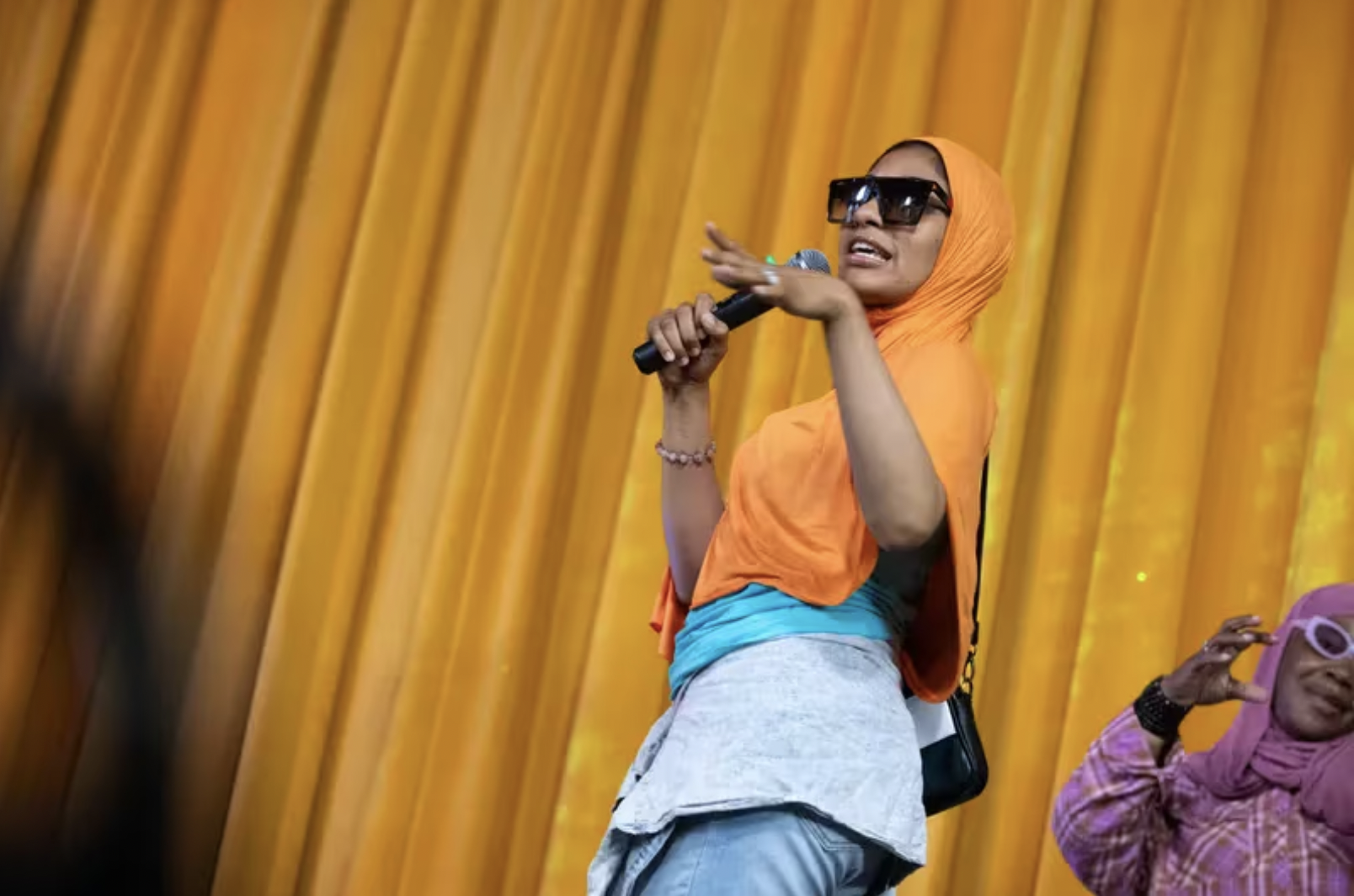
On Thursday, Mural Arts unveiled a mural of Scott during a 175th-year celebration of her alma mater, Philadelphia High School for Girls. “I want to live in the moment,” Scott said in a Zoom interview before the ceremony. “I’m very touched and thrilled. I cannot believe this.”

The mural is designed by artist Patrick Dougher and features Scott coronating young girls with replicas of the same golden crown she wears on her head. The Latin phrase “vincit qui se vincit” comes out in a wave from under Scott’s halo-like Afro. It translates to “She/He conquers who conquers herself/himself.”

The 900-square-foot mural, titled Luminaries: The Coronation, is located on the facade of Girls’ High facing Broad Street. Jane Golden, executive director of Mural Arts, said its vibrance is a reflection of the impact Scott has made as an ambassador for Girls’ High and the Philly arts.

“Her artistry, resilience, and dedication to uplifting our community epitomize the spirit of Girls’ High,” Golden said in a statement. Through the mural, she said, “we honor not only Ms. Scott but also the countless women who have graced the halls, leaving an indelible mark on our world.”

Before the ceremony, “Jilly from Philly” chatted with The Inquirer about her fondest memories at Girls’ High, the hidden powers of “Schuylkill ,” — otherwise known as Philly tap water — and her headlining performance at the Roots Picnic on Saturday. A deep feeling of gratitude shined through her smile. “It’s hard to explain how great this is,” she said. “I am really tickled. ”

The interview has been lightly edited for length and clarity.

How does it feel to have this honor?

It’s really crazy. Wow, I know I should be ready for these kinds of questions because I figured you would ask me how it feels, but it’s kind of surreal. I had such a difficult time during high school. I missed 48 days of school my senior year, primarily because I couldn’t get to school. I didn’t have money, tokens, or anything, and I worked at night. It was very hard. I did not pass math, which was devastating. It meant I couldn’t walk and had to go to summer school. But that’s the reason this is so surreal, it was such a challenging part of my life, but an amazing time as well.

This is the kind of stuff that’s in a lot of fairy tales. I would have never imagined that my likeness or any part of me would be on the side of my dang high school. Never, not one day.

How was Girls’ High?

Girls’ High was beautiful. We had perfect pink marble hallways, and walking down those hallways felt like triumph every day. There were so many brilliant young women, and so many friends I have till this day. It was an extraordinary time for me, I just wish I didn’t have the troubles I had at the time.

What do you remember the most from those days? Any particular teachers?

I have a lot of fond memories, the only problem was we didn’t have any money. But yes, I had Mr. William Murphy, the leader of Treble Clef. You had to audition to be in the Treble Clef Choir, and it taught us Latin, German, and Italian songs. He played amazing music, and took us to the Academy of Music. That’s where I first heard and saw Kathleen Battle. I never heard someone sing so lovely and smile so pretty at the same time.

You grew up here. How did the city make you who you are?

People ask me the question all the time: What makes Philadelphia vocalists? I think it’s the Schuylkill punch, and the fact most of the musicians are coming out of church. I think it’s institutions like the Philadelphia High School for the Creative and Performing Arts, and Treble Clef at Girls’ High. I think all these accumulate to make Philly’s musicians, vocalists, and artists great.

And what about the city’s murals?

I grew up looking at murals my whole life, on every other corner. Murals have been an inspiration just by seeing all those beautiful colors. There was a lot going on in the city of Philadelphia. [But] the murals were uplifting, with beautiful quotes and the faces of people we admired. I’ve always appreciated that.

And the Philly arts community? Does its future excite you?

Of course. I think I’ve touched pretty much every portion of it in the course of my lifetime. All the wonderful time I’ve had performing live, whether it was poetry or singing somewhere. There were so many places, and some of them aren’t here anymore, but they are integral to everything that I am and everything that I’ve done. And oh, the block parties. I used to go to so many block parties. All those things made me who I am.

Can we get a glimpse into your Roots Picnic performance on Saturday? Or do you want to keep everything secret?

I’ll keep it a secret. Just know that I’m thrilled and very excited. I had a wonderful time performing at the Met for the 23rd anniversary of Who is Jill Scott? Words and Sounds Vol. 1 last year. I loved that people walked out singing in the streets. It felt so good.

– The Philadelphia Inquirer

A wholesome rap battle promises cash — and takes a stand against gun violence

In the grueling battle against gun violence in Philadelphia, community leader and activist Sajda “Purple” Blackwell has served on the front lines.

At age 7, she lost her brother, Ronnie Easley, who died of a gunshot wound.

In January 2023, Sideic Robinson, the son of her husband, Thomas Blackwell VI, was fatally shot in Rochester, N.Y., while leaving his job at a local Burger King.

As the owner and operator of the online radio station PQRADIO1, Blackwell realized she had a role to play in perpetuating a trigger-happy culture. Her station played music that glorified street violence. And as death tolls rose, she swore only to promote “positive music on purpose.”

While she still plays urban contemporary artists like Lil Baby, Megan Thee Stallion, and Meek Mill, Blackwell doesn’t play or promote records that glorify gun violence.

Adding to her efforts at reprogramming the minds of local listeners, Blackwell also started the West Philly-based nonprofit Blackwell Culture Alliance Inc., which looks to “build stronger communities, neighborhoods, and economies through educating, donating, and volunteering.” It organizes food distribution drives and other outreach programs.

One such program is the open mic series How Dope Are You?, which Blackwell hopes will counteract some of the pervasive pop culture messages she finds so harmful. .

Since 2021, the monthly rap battle has encouraged local rappers to spread anti-gun violence messages through their music. The competition awards Philly rappers, poets, and spoken word artists with a $1,000 prize, but there are two rules: they can’t use curse words and have to firmly address the problem of gun violence.

“We became very intentional on promoting nonviolent music, and to challenge our young people to make the music they talk about, what they want to hear, and to make it hot. People have really begun to step up to the challenge,” Blackwell said.

Inside West Philly’s Holy Apostles & the Mediator Episcopal Church, the rap battle starts with gun violence survivors and their families locking arms in a “healing circle.” After Blackwell welcomes everyone, the attendees share their experiences.

“Whether we have 50 or 100 people, we’re creating a space for nonviolent music,” Blackwell said leading up to a recent showcase. “And if you can make a song about not killing anybody, then you can come get this ‘shmoney.’”

On May 22, South Philly artist Michael “Mike J” Johnson and nearly a dozen other creators exchanged stories and caring words before setting the stage ablaze.

“It just felt like a real encouraging space,” Johnson said. “Nobody was out for each other. The dynamic was genuine, wholesome, and very supportive.”

Johnson, who was inspired to rap after hearing Nas’ “I Gave You Power” at 8 years old, admits his music isn’t always the most uplifting. Days before the competition, he worked tirelessly to craft a song he felt was up to Blackwell’s standards.

He thought about the victims and perpetrators of gun violence, and how both their lives can seemingly end with the pulling of a trigger. He came up with the song “Let’s Rise Up,” which incited a seismic chant from the crowd in attendance.

“Bro, rise up. Sis, rise up,” the audience screamed. “Bro, rise up. Sis, rise up.”

By the end, Johnson and the other performers were awarded portions of the $1,000 prize. The program — and the camaraderie that was formed among the participants — made it feel more like a family gathering than a competition. There were no losers, Johnson said.

“It’s not just West [Philly],” said Reika Safiyya, a singer-songwriter, teacher, and sustainable clothing designer based in West Philly. “When you’re in Philly long enough, you can see the different dynamics. It’s a city full of art and talent, but the resources and support isn’t always there for people to thrive and live healthy lives. What Blackwell is doing is very necessary.”

Along with reducing gun violence, Blackwell said the open mic shows local artists that positive music can still fuel success. “It perpetuates the idea that the music is not corny, and that there are artists out there who can still survive in the rap game that’s not killing anybody,” she said.

What started as a five-person crowd three years ago has bloomed into a more recognizable open-mic series and family outing with catered food and a fresh lineup of local talent.

There’s been a notable drop in gun violence in recent years. According to the Office of the Controller, there was a 20% decrease in total homicides from 2022 to 2023. And Blackwell likes to think the Blackwell Cultural Alliance played a part in the decline.

Having cared for patients impacted by gun violence, Philly pediatrician and How Dope Are You? supporter Vivek Ashok said Blackwell has inspired him to take a more active approach to advocacy. For any program to be sustainable, he said, it requires a healthy investment from community members and elected officials.

“A lot of these community initiatives, specifically run by Black and brown folks, are not adequately funded,” he said. “I think highlighting the resilience and beauty of Philly youth is critical to understanding this group. And How Dope Are You? does that.”

As the program evolves, Blackwell’s goal is to foster more relationships with local organizations and brands. She hopes the city will fully get behind her campaign for nonviolent music. “We’re here to change people’s outlook on what music can be, and for the music industry to follow suit,” she said. “This effort is boundless. There’s no limit.”

– The Philadelphia Inquirer

Charlamagne tha God is done with the small talk

For millions of morning radio show listeners, Charlamagne tha God has evolved into one of the leading voices in pop culture.

From his days at Z93 Jamz in Charleston, S.C. to his current post as the host of Power 105.1′s The Breakfast Club, the former morning show host of Philly’s 100.3 the Beat says he has lived by an unspoken oath: to think and speak freely.

His social critiques, polarizing political stances, and unpredictable interview moments have stunned listeners, led to national headlines, and turned hour-long interviews into bite-sized viral clips.

His infamously comedic and often vicious interviews with artists like Lil Mama, Kanye West, and Post Malone have generated millions of YouTube views, and his recent observations of President Donald Trump and President Joe Biden’s electoral campaigns have taken him to The Daily Show

In his third book, Get Honest Or Die Lying: Why Small Talk Sucks, he is asking America to stop lying to itself.

In the book, set to release on May 21, Charlamagne writes from the belief that the world’s imbalances stem from a lack of meaningful conversation among people, be it our neighbors or politicians. This, he says, leads to the oversaturation of “small talk.”

“I’m not talking about the pointless chitchat people try to make when you’re at the airport or randomly standing in line somewhere. I’m talking about the small conversations people have on social media every day,” Charlamagne said. “You know it’s micro because it only lasts 12 hours. This book is a way to open up conversation with people.”

The Inquirer talked to the self-proclaimed “prince of pissing people off” about the dangers of unimaginative conversations, the balance between righteousness and “ratchetness,” and hip-hop’s role in freeing America’s intellectual chains ahead of his book release and tour stop at Green Street Friends School on May 23.

The interview has been lightly edited for length and clarity

This is another big achievement for you. How do you feel?

I feel good. It was an effortless process because what I decided to write about in this book is where my mind has been for the past few years. I just think we’re in a society where everybody likes to focus on the micros instead of the macros. And because we spend so much time talking about the micros, we have so much small talk in the world.

Is this a conclusion you arrived at recently?

I’ve never liked small talk. I’ve always wanted to have big macro conversations and discuss big ideas, even when the conversation starts with individuals. I don’t want to discuss people, I want to discuss the ideas these people are presenting. Even on the radio, you may [hear] a headline about something, but I want to talk about the broader deep dive into what it is. Like the Kendrick Lamar and Drake rap beef, I don’t just want to talk about the beef. Let’s talk about the psychological aspect of all this. Let’s talk about where this will lead people or the culture of hip-hop.

Do you think your voice is big enough to steer these kinds of conversations?

I don’t sit around thinking, ‘Oh, my voice is big.’ I just think we need to start having more macro conversations. We have to start discussing things that benefit us and help us grow as humans. I’ve been like that my whole life. I always say I’m the perfect balance between ‘ratchetness’ and righteousness, or at least that’s what I strive to be. There’s never been a time in my radio career, no matter where I’ve worked, that I didn’t have voices we could learn from on my platform. From spiritual leaders to political leaders, it doesn’t matter. I’ve always had people you could learn from.

What about people who say you’re incapable of leading ‘macro’ conversations?

That’s their opinion, and they’re entitled to their opinion. You see that a lot with the conversations we’ve been having in politics [on The Breakfast Club]. This ain’t new. The first political guest to come on The Breakfast Club was Bakari Sellers in 2014. He was running for lieutenant governor of South Carolina, so he came on to talk about his campaign. From that moment on, the ball was rolling and everyone and their mother was coming on.

When it was 2020, all the Democratic candidates were coming through. Even back then, people said, ‘Charlamagne you went too hard on Kamala Harris,’ and ‘Charlamagne you went too hard on President Biden.’ The flip side of that: ‘Charlamagne you’re too easy on Democrats. Y’all are a bunch of Democratic shills and never ask Democrats the hard questions.’

Fast forward to 2024, when it’s a large Republican field and those candidates decide they want to come up to The Breakfast Club. They’re choosing to come to our platform, and all of a sudden people have a problem with us talking about politics. You’re damned if you do, damned if you don’t. And to be honest, neither one bothers me because it’s all a part of the larger conversation. It’s not going to stop me from having the conversations I want to have.

Moving on to hip-hop, is the genre and culture ready to have these ‘macro’ conversations?

Of course, and that’s why I wrote this book. One aspect of small talk is that we confine ourselves to these small echo chambers for no reason. Hip-hop has always been able to talk about these things. We used to say N.W.A was the CNN of the Hood. So the notion that hip-hop is not mature enough to listen. Says who? I guess that’s why it’s so easy for people to tell us to shut up and do what they say regarding politics. It’s probably so easy simply because maybe some of us aren’t sophisticated enough to know what’s going on politically. But I think that’s a bald-faced lie.

Was there a topic or chapter you second-guessed writing about?

Hell no. This book is about big conversations and focusing on the macros. I want [readers] to have conversations about the things I’m talking about. I’m not saying I’m right or the end all be all. I’m just sharing my experiences with the readers, and I’m hoping they get something from it.

I know your time in Philly was short, but what are some of your fondest memories of the city?

I love Philly because it’s one of the realest places on the planet. Almost everyone you meet will tell you the truth. The brothers and sisters in Philly are very honest, and I think that’s why they appreciated me while I was there. And any time I come back to Philly, it’s always love. I don’t take any of the support for granted.

At last year’s Roots Picnic, you named your top five Philly MCs. Who fills out the ranking?

I have to be objective here, so I won’t give a personal top five. I have to put Black Thought at No. 1 and Beanie Sigel at No. 2. You have to put the Fresh Prince at No. 3 — not Will Smith, the Fresh Prince. Then I’ll put Freeway at No. 4. My No. 5 coming out of Philly all-time, I want to salute the OG Schoolly D, but I feel like I got to put Young Chris at No. 5. He didn’t get his just due but Chris was very nice, and if you’re so nice that you’re influencing people like Jay-Z, that’s big.

– The Philadelphia Inquirer

N.Y. State of Mind: Nas’ ‘Illmatic’ at 30

Few hip-hop albums transcend eras or withstand the disposal of one sound for another. But one body of work that’s weathered the ever-evolving terrain is Nas’ landmark debut, Illmatic.

Opening to the cascading sounds of subway train cars, screeching from one New York City rail line to the next, Illmatic draws listeners into the world of the chipped-tooth, Queens-bred MC. 

Anticipation for Nas’ debut was high. At age 20, he was three years removed from his legendary verse on the Main Source posse-cut “Live at the Barbeque,” which attracted label execs wanting to ink a deal with the promising lyricist. 

Through a connection with former 3rd Bass rapper MC Search, Sony Music’s Columbia Records managed to strike a deal with Nas in 1992. And on April 19, 1994, the poetic rhymer was crowned a prophetic child of hip-hop, one in a position to restore New York’s musical dominance.

With Dr. Dre’s The Chronic and Snoop Dogg’s 1993 classic, Doggystyle, the hip-hop mecca fell to the background for the first time. The G-funk sound was the sound of the era, and alternative acts like Souls of Mischief and the Pharcyde were strengthening the West Coast’s grip. 

New York needed a new legion of artists to spark its reemergence, and Nas’ Illmatic swung the momentum back to the East Coast. It also restored the reputation of Queensbridge, home of the fearsome Juice Crew (featuring such pioneers as MC Shan and Marley Marl), who fell to South Bronx’s KRS-One and Boogie Down Productions during the legendary “Bridge Wars” in the late ‘80s. 

Nas, inspired by the classic battle, was driven to enliven the housing project that shaped him. “I had to represent,” Nas said in a 2019 interview with Drink Champs. “The pressure was on the borough and my project. And just getting into the game, you had to have something to say, so I definitely had to push the pen hard because, if not, it would’ve never [flown].”

The 10-song LP was a memoir that chronicled Nas’ days on hardened street corners, witnessing the perils of drug abuse and street violence from a bird’s eye view. Nas’ vocal command, silk-smooth delivery, and the potency of his poetic rhymes elevated each track. 

The timeless boom-bap soundscape laid the ground for Nas, who unloaded vibrant tales of street life, declarations of lyrical supremacy, and prophecies on “It Ain’t Hard to Tell,” “Represent,” and the nostalgia-fueled “Memory Lane (Sittin’ in da Park).”

“One Love” is a soul-stirring tale of incarceration, and “Life’s a Bitch” is a celebration of life through the growing pains of adolescence. “N.Y. State of Mind” quickly became a Tri-State anthem. Nas said in the 2014 documentary Time Is Illmatic that it was strategically placed near the top of the tracklist to “bring [listeners] to hell and back.” 

The architects behind Illmatic’s sound were legendary producers like DJ Premier, Large Professor, Pete Rock, Q-Tip, and L.E.S. And while their avant-garde jazz templates, reverberating drum patterns, and mesmerizing loops were top of the line, Large Professor said they wouldn’t have the same effect without Nas’ masterful touch.

“The beats were cool,” the producer told HipHopDX in 2014. “They were good backdrops, but just the lyrics and the experience that he was putting down over those beats is why that album is heralded the way it is today.”

Following the release of Illmatic, Nas was championed as the second coming of Rakim, and the album received sweeping praise from fans and critics. The project scored a five-mic review from The Source, which was dubbed the “Bible of Hip-Hop” in the early ‘90s.

Former Hot 97 radio personality Minya Oh, who worked at The Source as an intern, was the one who penned the review under the moniker “Shortie.” In a 2014 interview with NPR, Oh talked about how the album’s vivid stories and production inspired her to award Illmatic with the rare distinction.

“Everything that I tried to analyze, I just couldn’t get away from the fact that I couldn’t find anything wrong, and that I also didn’t think it was ever gonna go away,” Oh said. “Or that I was never gonna not want to listen to this.”

The praises didn’t immediately translate to album sales. Illmatic reportedly debuted at No. 12 on the Billboard 200, only selling around 60,000 in its first week. The LP’s iconic singles also failed to scratch the charts. 

The underwhelming numbers were partly due to the album’s pre-Internet bootleg leak, which led to the album’s premature circulation. “Columbia was tripping,” Nas told Clash. “It was everywhere, months even before it was released.” 

But 30 years after its release, the album has finally earned its due. According to the Recording Industry Association fo America, Ilmmatic has sold more than two million copies, and it’s still heralded as one of the best albums of all time, regardless of genre. (Rolling Stone ranked Illmatic no. 44 on its list of The 500 Greatest Albums of All Time in 2020.) “I think it’s a perfect record,” Nas told Fuse in 2012. “I couldn’t say that before, but there’s so many different dynamics to it.”

Nas’ debut propelled the Grammy-winning artist to a spot he’s comfortably occupied for decades—atop the pantheon of all-time great MCs. It also helped reignite East Coast rap and set the stage for other New York artists to rise to stardom. And with each passing anniversary, Nas proves that time is truly Illmatic. 

While Nas told Billboard he no longer listens to his debut, the continued support and admiration for his work proves the immortality of classic records, no matter how much time elapses. “It means hip-hop is here to stay,” he said. “I said hip-hop was dead, and of course, the shit died, but the core of it was never touched. You can’t erase what happened.”

– SPIN Magazine

Erick The Architect Steps Into A New World On 'I’ve Never Been Here Before'

Rapper/producer Erick The Architect is no stranger to reinvention. 

The Brooklyn-bred MC cut his teeth over alt-East Coast beats as Erick Arc Elliot before forming psychedelic rap trio Flatbush Zombies with childhood friends Meechy Darko and Zombie Juice. But after multiple mixtapes and two albums with the group, Erick is returning to solo form and venturing into new creative ground. 

Following 2021’s Future Proof EP, Erick is embarking on new musical travels with the release of his official debut album, I’ve Never Been Here Before. Out Feb. 23, the double album explores Erick’s flowy instrumentation, poeticism, and artistry at full scale. The project is fueled by singles "Shook Up" featuring FARR and Joey Bada$$, "Ezekiel’s Wheel" with funk forefather George Clinton, and the breezy "Instincts" with Westside Boogie.

Erick says I’ve Never Been Here Before is more than a collection of catchy introspections, melodic monologues, and '90s-inspired jams. It’s the shedding of one persona — and sound — and the beginning of a new: the Mandevillain. 

"This album is an identity of a new person," Erick the Architect tells GRAMMY.com, noting that the moniker is an ode to his father’s hometown of Mandeville, Jamaica. "A lot of people may have thought there was a ceiling to what I’m capable of, but I think this album will showcase a brand new artist and identity, which is really hard to do when people think they already know you. But I really think this is unique." 

The switch isn’t just in name — he’s taken on a new approach to music, too. For the first time in years, Erick says he’s prioritizing himself and his specific musical world. "It’s the first time I have created with the headspace that I’m free," he says. "I find that other artists don’t listen to other people’s music when they’re in a creative space, but this is the most locked off I’ve been from things."

As much as I’ve Never Been Here Before signals new creative ground for Erick to fertilize, it also represents his collective efforts to limit distractions and break free of any barriers — personally and sonically. 

While it was difficult to stay so focused and inward-looking while creating his debut album, turning to some of his legendary collaborators provided some clarity. After having conversations with James Blake, George Clinton, and other artists as part of the project, Erick no longer feels forced to fit a mold or address outside criticism. 

"This album is about sacrifice, and I’ve Never Been Here Before is me being okay with losing things," he says. "I think that losing has always a negative connotation because nobody wants to lose, everybody wants to win. But it's the first time I'm losing stuff and it’s better being lost. Whether it's a habit or a person in your life, you don't need to hold everything."

I’ve Never Been Here Before lives up to its title in both theme and creation. Where Erick previously wrote songs in moments of vulnerability, the rapper says he "doesn’t feel that way anymore." 

Citing the work of Keith Haring, Miles Davis and Pablo Picasso as inspiration, Erick says he was driven to write more high-spirited songs, rather than ones tethered to struggle and hardship. As a result, the album is more accessible than some of his previous work.


"I’m tired of writing from a perspective of just being like, 'I’m sad today, bro,'" he says. "I haven’t made a project that I feel like you can just put that joint on and just play it, don’t even think about anything else because it’s commanding an energy that we all need." 

In transforming the project, the "Die 4 U" artist pieced together a blend of new and older songs he recorded five years ago. And while a double album is a "death sentence" in the eyes of most rap fans, Erick says he’s prepared for both heaps of praise and hurls of "he’s overrated" from listeners. He would feel more anxiety only if the music never came out.

"I’ve always believed that I had another special part of me that I think people didn’t witness because I didn’t put it out in the forefront," he says.

While getting a new release across the finish line can be a heavy weight to bear, Erick says he’s determined to prove his doubters wrong and own his legitimacy as a solo act. "I didn’t get lucky or sneak in here and steal beats from somebody’s laptop," Erick says. "This project is great to defeat people who have perceptions about me that are incorrect."

With the momentum of I’ve Never Been Here Before, Erick is set to test his new music and moniker on the road during his upcoming Mandevillain Tour, which kicks off in Austin on March 25.

Now that he’s fulfilling his ambitions as a solo act, the artist has a few more mediums he plans to explore – TV and film. After being a rapper/producer for more than a decade, Erick says he’s ready to take grander creative leaps.  "I’m just trying to take this to the highest caliber," he says.

– Grammy.com

Inside The Metro-Verse: How Metro Boomin Went From Behind-The-Scenes Mastermind To Rap's Most In-Demand Producer

Metro Boomin isn’t your ordinary hero. Instead of scaling walls and flying over cityscapes, he possesses the rare ability to generate hits across a myriad of genres while remaining true to form. Like heroes in the Marvel and DC universes, the often withdrawn producer has played a not-so-quiet role in hip-hop for a decade.

For his superpowers, Metro has become one of the most in-demand sonic architects in the game. His collaborations with Future, Travis Scott, 21 Savage, Big Sean, and other big-name artists defied convention, turning Southern trap into high-performance art. Despite his reserved demeanor, Metro Boomin has been behind the board of more than 100 Billboard Hot 100 songs, including top 10 hits like the Migos’ "Bad and Boujee" and 21 Savage’s "Mr. Right Now" with Drake

Metro spread his heroics even further last year. He produced standout tracks on Young Thug’s Business is Business ("Oh U Went), Lil Durk’s Almost Healed (War Bout It") and other major releases, while cranking out his own viral hits – "Am I Dreaming" featuring A$AP Rocky and Roisee and "Superhero" with Chris Brown and Future. His contributions led to his nomination for Producer of the Year, Non-Classical at the 2024 GRAMMYs, and showcased his versatility as an artist. 

Thanks to Metro, and his unmistakable calling card — "If young Metro don’t trust you, I’m gon’ shoot you" — trap's appeal has grown outside of the rap community, influencing pop and R&B. And his string of hits with the likes of The Weeknd, James Blake and Solange further proves Metro's musical wizardry. 

But on his second album, Heroes & Villains, which is nominated for Best Rap Album at the 66th GRAMMY Awards, the St. Louis native proves that he's as strong a solo act as he is an engineer of others' hits. Driven by lead single "Creepin’" featuring  21 Savage and The Weeknd, the 2022 album topped  the Billboard 200 charts and became Metro’s third project to land at No. 1 

It’s the second installment of an ongoing album trilogy, which follows 2018’s Not All Heroes Wear Capes. 

Boasting features from John Legend, Future, Chris Brown, Travis Scott, Don Toliver, and Young Thug, Heroes & Villains is the second installment of an ongoing album trilogy, which follows 2018’s Not All Heroes Wear Capes.  

According to Luminate, Heroes & Villains netted Metro his biggest opening week to date, with an estimated 185,000 equivalent albums sold in the U.S. "I didn’t see that coming," Metro told DJ Drama in January 2023. "A lot of times my stuff will grow slowly because I’ll put my time into it and people will realize, Oh, this is dope. I thought it was going to be one of those usual things … But it definitely caught me off guard." 

In a recent renaissance of soundtrack projects, the multi-platinum producer also created the soundtrack to the animated blockbuster Spider-Man: Across the Spider-Verse. Metro flexed his versatility on the 13-song project, which combined sonorous trap beats, reggaeton and Afrobeat-inspired jams, and lush pop ballads. 

Metro's success and recent GRAMMY nominations have been the result of years of Herculean feats.  Never content to follow a single sonic thread, Metro has continually expanded his reach to other genres and mediums. He’s dabbled in film and TV, producing songs for the short-lived and The Weeknd-starring HBO series "The Idol," and embraced live orchestration both in song and performance. On songs like "On Time" with John Legend, the producer amplified the grandiose record with stringed instruments, then performed the song with a live orchestra at the Dolby Theater for the Red Bull Symphonic back in November 2023.

Despite his vast production credits, Metro says he’s been unfairly labeled a "trap producer." He’s conjured pop and R&B hits, too. "I love R&B music, I love making this, love making that," he told GQ in 2022. "Why would I wanna do something that I did?" Along with producing The Weeknd’s No. 1 song "Heartless," Metro laid his hands to tracks on James Blake’s Assume Form and Solange’s When I Get Home, then later produced Coldplay’s "Let Somebody Go" featuring Selena Gomez in 2019.

Metro’s venture into solo stardom shouldn’t be a surprise either; the 30-year-old producer told Billboard he wanted to be a rapper as a teenager. "In order to do that, I needed some beats, so I started to make my own beats." At age 13, Metro took notice of artists like Soulja Boy, who also made his own beats. "It was like … it’s possible." 

Now, after years of playing the background, the man behind the blistering trap beats and rattling hi-hats is finally unmasked and fully embracing his solo artistry. There were flashes of his genre-bending genius on Not All Heroes Wear Capes, with the Offset, WizKid, and J Balvin-assisted "Only You" melding trap, Afrobeats, and reggaeton in euphoric form, but Across the Spider-Verse fully showcases Metro's musical dexterity both behind the board and in front of the mic. 

On the film’s soundtrack, the roaring orchestral sounds of "Am I Dreaming" form a transcendent exchange between A$AP Rocky and eclectic vocalist Roisee. Songs like "Hummingbird" see Metro return to his trap roots, but James Blake’s harmonious croons breathe mists of pop magic into the track. 

The hip-swaying "Silk & Cologne" and "Link Up" fuse reggaeton and Afrobeats, but "Nas Morales" is a complete step in unfamiliar territory for Metro. The unlikely collaboration between him and Nas closes out the 13-song project — Metro’s most experimental to date. 

The album Heroes & Villains is more in line with Metro’s roots, with songs like "Superhero (Heroes & Villains)" and "Niagra Falls" highlighting the producer’s darker, more mystifying trap wizardry. He also, for the first time, conjured a rollout for the project. 

Before the album’s release, Metro dropped a short film that featured cameos from Gunna, Young Thug, and actors LaKeith Stanfield and Morgan Freeman. The video, directed by Gibson Hazard, shows TV journalists (Gunna and Thug) reporting on a firetruck driver (Stanfield) setting flames to a city’s streets. Metro, overlooking the destruction alongside Morgan Freeman, decides to take action and stop the arsonist. 

Last year was a big one for Metro, but the producer isn't driven by accolades.  He wants fans to know that no amount of fame or hardware can take him away from his calling. "More than any accolades, sales, and everything, I just want people to know at the end that I cared the whole time. Every ounce of effort that I possibly could put into the art, I did," Metro told Complex.  

With a new year in full swing, Metro has already hinted at a possible hat trick in 2024. While interacting with a fan on X, formerly known as Twitter, Metro wrote, "2023 was great but just watch what I do 2024!!!!!." The fan then asked how many albums to expect, with Metro responding, "3 at the very least." 

GRAMMY.com

Benny The Butcher Is Ready To Rise On 'Everybody Can’t Go'

Benny The Butcher is prepared to spar with the biggest names in rap music to prove he’s one of the most prolific MCs in the industry. 

"My confidence comes from my talent, and my talent comes from my preparation," Benny tells GRAMMY.com. 

For the uninitiated, the East Buffalo rapper's brash delivery and unshakeable confidence could be perceived as arrogance. But for Benny and long-time fans of the Montana Avenue vet, he’s more than earned the distinction. 

"If you see these dudes, they’re not confident because they’re not prepared to talk that talk. We stand behind this music, man," he continues. "I’m only on this interview with you because I rap good. I’m not on this interview with you because I’m dating an R&B chick, or because I have a Rihanna feature.”

Benny The Butcher is just days ahead of releasing Everybody Can’t Go, his debut album with Def Jam Recordings. Out Jan. 26, Everybody is Benny's major label launch but it's far from his first foray.

Off the heels of his critically acclaimed album Tana Talk 4 in 2022 — which boasted the viral hit "Johnny P’s Caddy" featuring J. Cole — Benny has kept a steady hand on the pulse of the rap game. Since then, he’s been heard on DJ Drama’s "Forever," G Herbo’s "Real Rap" and memorialized a Buffalo legend on the BSF project Long Live DJ Shay.  

In that time, Benny, born Jeremie Pennick, has fashioned himself as the proprietor of "caviar drug rap," and he’s not afraid to remind you, either. He’s confident the release of Everybody Can’t Go will showcase his evolution as an artist.

"I’m on a higher level than I was. Everybody gets to watch my career elevate and it’s right in front of me," he says. "From the mixtapes, from the freestyles, featuring on Westside Gunn and Conway The Machine’s s–, and people share that journey with me. It’s high-level drug rap."

After switching his moniker from "Benny" to "Benny The Butcher," he veered away from rapping over other artists’ beats and started working with in-house Griselda producers like Daringer to round out his nostalgic, boom-bap sound that’s become synonymous with the Griselda imprint. 

If the album’s lead singles "Bron," "Big Dog," and the title track are any indication, Benny isn’t deviating from the sound that made him. Tales of his past exploits are coated in Hit-Boy and Alchemist beats, with features from Griselda and BSF collaborators Westside Gunn, Conway the Machine, 38 Spesh, Lil Wayne, and others. But the method behind the music, Benny says, was all the same. 

"I didn’t take no new approach, I just wanted to deliver some dope music and make sure I sounded how I felt," the 39-year-old MC says. "I feel like my sound is more refined and I switched my flow up."

To casual connoisseurs, Benny is a burgeoning star who’s aiming for wider success and acclaim. But for fans of the "Trade It All" lyricist, who saw his rise as the younger cousin of Westside Gunn and Conway the Machine on Griselda, he’s earned the right to share his vivid tales and signature brand of mafioso rap on a larger scale. And he’s already made good use of the label’s platform.

He’s rubbed shoulders with artists like J. Cole, connected with legends like Snoop Dogg for his Def Jam signing, and now has his sights on more R&B-oriented records. Benny wants to work with the "Queens of R&B and hip-hop," naming legends including SZA, Teyana Taylor, Coco Jones, Summer Walker, and others at the top of his list.  

With his ascension, Benny is continuing to discover the perils of fame. He admits it’s challenging to deal with trolls and faceless critics on X (formerly known as Twitter). "You have to remind yourself it’s only a fraction of the people. Their voice is so loud on social media that it tricks the artist into thinking that’s the general population that feels like that, but it’s not," Benny says.

He’s also accepted the fact that not everyone is meant to be a part of his journey. The sentiment inspired the new album title and is reflective of his new attitude: Whether friend or family, hindering his growth is too hefty a price tag. As his career continues to take flight, others will be left at the terminal. 

"Everybody Can’t Go is me realizing, Wow, it’s not for everybody even though I got this far to help provide opportunities," he said. "You could make someone the president or an A&R at Def Jam, but that doesn’t mean they’re ready for it. A lot of people don’t want to work, they just want what comes with the work —  the lifestyle, the fame, and the money."

After the project’s release, Benny intends to expand as a legitimate businessman and do more executive production, starting with his roster of BSF talent, which includes Rick Hyde, Heem B$F, ElCamino, LoveBoat Luciano, and other members. 

With Griselda, Benny already has his two cousins as counterparts, but Benny talked about having his daughter by his side during the album’s press run. He was impressed with her vocal ability and is open to exploring her musical side. "This is a family business," he says. "I encourage everybody to get into music because it’s therapeutic, it keeps you out of the way, and it’s lucrative if you do it right."

Of his growth as a solo artist, Benny says, "It feels like I’m on pace to keep doing great things." In the near-future, he's already making plans to dive into the film industry and drop another project to close out yet another big year in music. 

– GRAMMY.com

‘There’s no edge like Philly’: Why the city’s most talented won’t leave their hometown

Philly’s “got major talent,” as entertainment mogul Charles “Charlie Mack” Alston says. “There are some remarkable people and talent that have come out of Philly, and the city has a surplus of it.”

But the demands of the industry often pull artists, musicians, and actors away from their beloved hometown, forcing them to pack their bags and migrate to cities like New York, L.A., Atlanta, and Miami.

But for Mack, who was Will Smith’s long-term bodyguard and personal assistant before becoming a notable Hollywood power broker, there’s only one place he calls home — and that’s Philly. And he is not alone.

Some entertainers born and bred in the region can’t seem to leave the city behind. We asked them why.

Responses have been lightly edited for clarity.

DJ Jazzy Jeff

DJ and hip-hop pioneer; West Philly native

Where do you live?

I’ve lived in Delaware for almost 20 years, but I never had a desire to move far away. It’s what I know. This is home.

Does the Philly area’s affordability play a factor?

It’s true – Philly isn’t as expensive as New York or L.A., and I know the city so I feel more comfortable here. I know how to navigate Philly; I don’t know how to navigate New York or L.A. In Philly, I know my surroundings.

Why do you think some Philly-born entertainers choose to leave the city?

Philly is a tough town. It prepares you to go off into the rest of the world because Philly doesn’t show love to those who don’t deserve it. Nothing comes easy, and it prepares you to go to places like New York and do a good job.

I think the people who move out of Philly never lose the love for Philly.

What does Philly’s future as an entertainment hub look like?

If you look at the history, [the Philly scene was lively] with Kenny Gamble and Leon Huff, then it left. That was the neo-soul movement and [then came] The Roots, it all goes in cycles. I tell a lot of inspiring musicians to just be ready when it comes back because it’s coming back.

Tierra Whack

Rapper; North Philly native

What’s inspired you to stay in Philly?

I love to travel, visit new places, and experience new things but nothing feels better than waking up in my hometown, with people that look and feel just like me.

Did you always see yourself staying in Philly?

I am Philly [and] Philly is me. I love my city and everything it has to offer. I want to put my city on the map. I’m not sure why other people leave, but I’m here to stay.

In a past interview, you talked about pouring back into the city. What does that look like for you?

My goal is to build a creative space here in Philly. Not only where I can go and be creative, but where others can, too. I love what’s happening in our city right now, [and] I want to be a positive light for everyone coming up after me.

Eugene ‘ManMan’ Roberts

Producer and musical director; South Philly native

Why do you think so many popular entertainers from Philly prefer to live in Philly?

A lot of people pull from Philly. Every major album, tour, and every band — someone from Philly is in the mix. And sometimes when we leave home and go to these other places, you’re filling them up with your energy, your presence, and your sound, but they can’t refill that cup. You got to go back home to get that vibe, inspiration, and aesthetic that makes home, home.

What’s stopped you from leaving the city?

We got rich history here. We have amazing producers, songwriters, and artists. We’re really good, and I never wanted to turn my back on the place that made me who I am. I’ll always be that no matter where I go.

Do you see Philly becoming a renewed musical hub?

Philly used to have Philly International, Sigma Sound, and all these other studios, and people came here to cut records. But when the world went digital, it took away needing studios. Until we build up an empire of entertainment with studios and rehearsal facilities, I don’t think any city can [become a musical hub].

L.A. is all that because that’s where all the celebrities live, and there’s good weather but I think the pandemic made it a level playing field for everybody.

Charlie Mack

Entertainment mogul and community leader; Southwest Philly native

Why do you think big-name entertainers from Philly choose to venture elsewhere?

Philadelphia is like a character, and people that used to come here admired it, but admired it from afar. If you don’t feel safe, you can’t relax and let your hair down. Right now, we’re in a place where we’re hemorrhaging and going through a very horrific transition, and I hope and pray that the kids here have an opportunity to experience Philly the same way I did.

I love my city, but the reality is people don’t feel safe. And home is supposed to be just that: a place you feel safe and welcome.

How can Philly go back to being what it used to be?

The natives of Philadelphia are in a space where they don’t love themselves. That’s the harsh reality, and it’s hard for someone to stay put when they’re not received or revered from their own people. Artists need validation and love, it’s a part of their makeup. Philly is real and harsh, it will hit you right in your face. Residents won’t give you fanfare if you’re not tapping into the things that make them move.

How can we better retain the talent that comes out of Philly?

I feel like the men of the city of Philadelphia have to restore safety. Women are stepping up in major ways, but men have to restore everything that is amazing about Philadelphia: the artistry, the streets, the sports, the politics, city government, and everything that it’s about.

Adam Blackstone

Multi-instrumentalist and songwriter; Trenton native

What does being close to Philly mean as an entertainer?

One thing is the culture of Philadelphia. There’s a go-getter and hustler’s spirit. For me, no other city has embraced the arts like Philly.

In Philadelphia, we just want to see each other win and we represent our city from all over the world, no matter where we’re from. That’s always a plus we have that maybe other cities don’t.

Are there certain Philly spots that give you inspiration?

When we go to any sports event, whether it’s the Philadelphia Eagles, Sixers, or Flyers, I feel a sense of oneness and a feeling that we’re all fighting for the same thing.

Don Cannon

DJ and record executive, West Philly native now living in Atlanta

Why does it seem like more Philly artists are staying in the city?

I feel like people just love the culture. I can walk through Society Hill and Parkside, and it just feels different than anywhere else in the world, from Brooklyn to Compton. It’s just a different feel, and I think that’s why people want to stay here. And sometimes you get away from home and think, “Man, it’s not the same,” and go back.

I know you relocated to Atlanta, but do you ever come back to Philly?

I left when I was 18, but I often go back to see what’s happening there, what’s the newest trends, and to get some edge. Sometimes you travel across the world, but there’s no edge like Philadelphia.


– The Philadelphia Inquirer