Philly nightlife takes a hit as noise complaints force relocations, unexpected shutdowns

Philly nightlife is an ever-revolving door of happy hour hangs, lavish soirees, laid-back beer gardens, and weekend stay-puts. The city is also home to niche party cultures, intimate music venues, and stylish speakeasies.

Philly DJ David Pianka, better known as Dave P, believes these spaces make the city’s nightlife more vibrant than most. But in recent years, noise complaints have diminished much of its allure.

“Nightlife brings so much to cities, culturally and economically, and it needs to be prioritized more here in Philadelphia,” said Pianka, who founded the electronic music festival Making Time ∞. “So many other cities around the world celebrate and support nightlife and understand its value. Philadelphia needs to do the same.”

Noise complaints, Pianka said, have crippled many of Philly’s outdoor music experiences through the last few years. Fellow DJs and party promoters have been forced to relocate, or even cancel entire events, due to the stockpile of protests brought on by disgruntled residents and nearby establishments.

These complaints often come from neighborhoods with nightclubs and music venues, and newly constructed residential buildings. As, Pianka said, more people and businesses move into these neighborhoods, there is a growing divide between partygoers and residents looking for a quiet place to lay their head.

As new condominiums and high-end apartments are built, more buildings and residents are being squeezed closer together. The city’s growing infrastructure leaves little room for outdoor parties and events to happen without disturbing local residents.

On Memorial Day weekend, DJ Joshua Lang hosted a day party at Cherry Street Pier’s back garden. The event, on Saturday from 3 to 9 p.m., was “before the city’s ‘quiet hours,’ ” Lang said. He hired a sound engineer to monitor the volume, “to make sure it didn’t go over a certain decibel level — which we didn’t.”

The event was a success, Lang says, with over 5,000 people attending. He has hoped it would turn into a series, but in June he posted on Instagram that he would not be returning to the venue “due to neighbor’s complaints about sound.”

A representative from the Cherry Street Pier said they were not aware of any noise complaints, and that while the event was well received, it was only every planned as one-off.

In his Instagram story, Lang added: “it’s frustrating that we already don’t have many options in this city when it comes to venues.”

The city, “is in dire need of an event like this” Lang told the Inquirer. “Philadelphia is an amazing city and what’s happening right now is beautiful between different industries and scenes, but there’s just a ceiling here that seems to keep creatives at a certain level due to city restrictions.”

According to the Philadelphia Department of Public Health, noise complaints are considered a health risk and commercial properties are prohibited from creating sounds that exceed five decibels above the “background level” at a property’s boundary line. The penalty for an initial violation is between $100 and $300, and the fee increases with subsequent violations.

Based on data from the department, there hasn’t been a dramatic rise in amplified music complaints in the past five years. But as of July 27, there were 10 amplified music complaints directed at Philly bars, restaurants, and nightlife spaces in 2023, which matches the total reported in all of 2022.

Pianka said it’s hard to blame a specific group for the noise complaints, but he said new developments are likely the cause of the issue. “The city needs to make culture and community more of a priority over development,” he said. “...[And] there needs to be more communication between nightlife promoters and city officials.”

“We need more venues, nightclubs, and diverse festivals. We need people who understand culture to be in these rooms where they’re making these decisions,” added Lang, who is also the music director for the W Hotel Philadelphia.

Disputes between residents, party promoters, and business owners in the Philly area are not new. Back in 2012, the New Tavern Bar Restaurant, then known as Watusi Pub II, drew complaints from West Philadelphians about the bar’s rowdy patrons and live music performances.

“I hear from people who have had bars in certain areas forever,” said Sara Walker, general manager of the Khyber Pass Pub. “And now that there’s some development next door, all of a sudden people are angry.” Walker, who recently revived Khyber’s live performance space after the longtime music venue was turned into a New Orleans-inspired eatery, believes that “in order for this city to be successful and have people come here to spend money, these [venues] need to be successful.”

She agrees that there are certain “nuisance bars,” but residents often blame establishments for little noise, or even rumblings generated outside their walls.

Public outcry has even forced outdoor restaurant and music venues to shut down operations.

In an Instagram post, Terra Philly announced on July 19 that it would shut down for the season due to increased noise complaints. “We worked both quickly and openly with both city and state officials to update our facility in a way that would allow us to continue operations. However, it seems a compromise could not be reached with our neighbors,” the post stated.

Health Department spokesperson James Garrow said a “warning letter” was issued to the Fishtown garden restaurant and outdoor music space after noise complaints were filed. The letter outlined the city’s noise and vibration law and noted a potential noncompliance fee of $300. But after an inspection was conducted on June 28, no violation was found, Garrow said. “Terra was not given a notice of violation or asked to close. If they have closed for the season, it was not due to Health Department action.”

Terra staff declined to make further statements, but confirmed there will be measurements in place to address the noise complaints ahead of the restaurant’s reopening next year.

Raheem Manning, the city’s first director of nighttime economy, said he doesn’t have economic data to illustrate how noise complaints affect nightlife revenue, and it’s not known if it does. But having met with nightlife mayors and directors in Austin, Pittsburgh, Amsterdam, and Berlin, he’s confident Philadelphia can be an international destination for its nightlife.

For Philly to contend with global nightlife destinations and minimize noise complaints, Manning, who was appointed nightlife mayor by Philadelphia’s Commerce Department in July 2022, said there needs to be a soundproofing fund, like in Berlin, which will shield venues from receiving noise complaints from new neighbors.

“An agent-of-change policy basically makes it so that whoever is new to the block is responsible for mitigating the sound,” Manning said. “If a club has been on the block for 20 years and a developer wants to build an apartment building across the street, it is on the developer to either soundproof the apartment building or they could soundproof the club, because the club was there first, the burden is not on the club.”

– The Philadelphia Inquirer

No fade on prices: Why Philly barbers are charging $100 and up for haircuts

Kenneth Carruth IV, the North Philly native known as The4thKen on social media, has made waves (literally) with his haircut tutorials and videos. The 20-year-old barber has amassed more than 1.8 million likes on TikTok, with his biggest video reaching over 2 million views. But it’s not always his clean lines and tight fades that are attracting attention.

In one video, Carruth showed off a mid-fade and noted, “My client paid me $80 for this haircut.” Other videos list prices well above $100. While some viewers were in favor of the price tag, others called the haircut a “scam” and wrote how their barber could do the same job for $15.

Before the COVID-19 pandemic, Carruth also charged $15 per head. But with more demand, and the rising cost of running a business, he had to raise his rates.

“I feel like pre-pandemic, barbers were undervalued,” Carruth said. “Now, barbers are starting to realize their worth and see that it’s not just about the cut. You’re providing an experience.”

And he isn’t alone.

According to the Bureau of Labor Statistics, haircut prices rose 6.8% in November 2022 from the same time a year before, which is the largest annual increase since the fact-finding agency started tracking the category. Men — who are used to paying with a single bill for their cuts — are noticing.

In the past, local barbers engaged in price wars with neighboring shops to have an edge on clientele. If one shop offered cuts for $20, another would offer them for $15. But the pandemic crippled small-business owners, said Damon Dorsey, 61, president of the American Barber Association. Barbers and other service workers were among the hardest hit.

To stay afloat, many chose to raise their rates.

Southwest Philly barber Nicky Prosseda, 40, said the seismic blow of the pandemic also inspired barbers to sharpen their business practices.

From the mid-20th century to recent years, Prosseda said, barbers enjoyed the benefits of cash-in-hand transactions and tax-free loopholes. But as the industry evolved, the slow rise in haircut prices didn’t match the hikes in beauty product prices, booth rentals, and Venmo and CashApp fees. And for many, it made barbering unlivable as a primary income source.

Prosseda, who charges $75 a cut, is the director of Philly’s Modern Male Barber Academy. “I truly believe that there’s this kind of pain for the sins of our forefather barbers and the past owners,” he said. “They didn’t teach us the best things in the industry, so you pass it down.”

Based on data collected in May 2021, the Bureau of Labor Statistics estimated that most barber salaries range between $22,430 and $53,260. Prosseda said that may be barbers’ reported income, but a lot have been making $50,000 to $100,000 for years. And with even more resources at their disposal, he estimates they will start to rack in upward of $150,000 per year going forward.

Along with better business practices, Dorsey said, barbers are now able to leverage their social media presence to draw in more clients willing to pay top dollar. Apps like Booksy and StyleSeat help barbers manage customer information and schedule haircuts. Barbers like Carruth have used them to expand their brands beyond their corner or neighborhood.

By building his social media brand, Carruth was able to open his own barber studio in Kensington. After turning his social media followers into loyal clients, he saved enough money to get a business license and land the small commercial space in August 2021.

“I know a lot of barbers that are great at cutting hair, but they suck at running a business,” Carruth said. “And with that, you can’t charge what you want because you’re just going purely off skill.”

While most of his clients understand his raised prices, West Philly barber Jalen Thompson, 23, said he’s had customers leave to look for lower rates. Thompson, who charges $45 to $75 for haircuts and more than $120 for house calls, is comfortable with that risk.

“We stopped being hustlers and turned into CEOs,” he said. “I became a barber because I love cutting hair, but I also knew how much money there was to be made in this industry. ... There’s an opportunity to retire early and really enjoy life and take on other business ventures.” Prosseda agrees that it’s allowed him and others to live a better, more balanced life.

“A barber’s career is not one of mental easiness or physical, so you have to raise the prices for the barber to have a work-life balance where you can put your kid on the bus, and go be the coach to your son’s football team, or whatever it is. You have to raise the prices in order for that to happen.”

The fruits of the industry, Carruth said, are enjoyed by barbers who learn how to adapt. Along with cutting different hair textures and embracing products like semi-permanent dye, man weaves, and other enhancements, it’s important to provide other services like hair washes, snacks, TV, and WiFi.

“There’s a lot of older barbers that are stuck in their ways that refuse to change, and unfortunately, they’re more than likely gonna get left behind,” he said.

Overbrook resident Ian Watson, who’s been a client of Carruth’s for nearly a year, said customers are willing to pay for the right experience.

“Depending on the quality of the cuts and the level of professionalism, people will pay to avoid the stereotypical barber,” Watson said. “I say it’s worth it.”

– The Philadelphia Inquirer

Community Vegan makes veganism accessible for all through familiar, savory bites

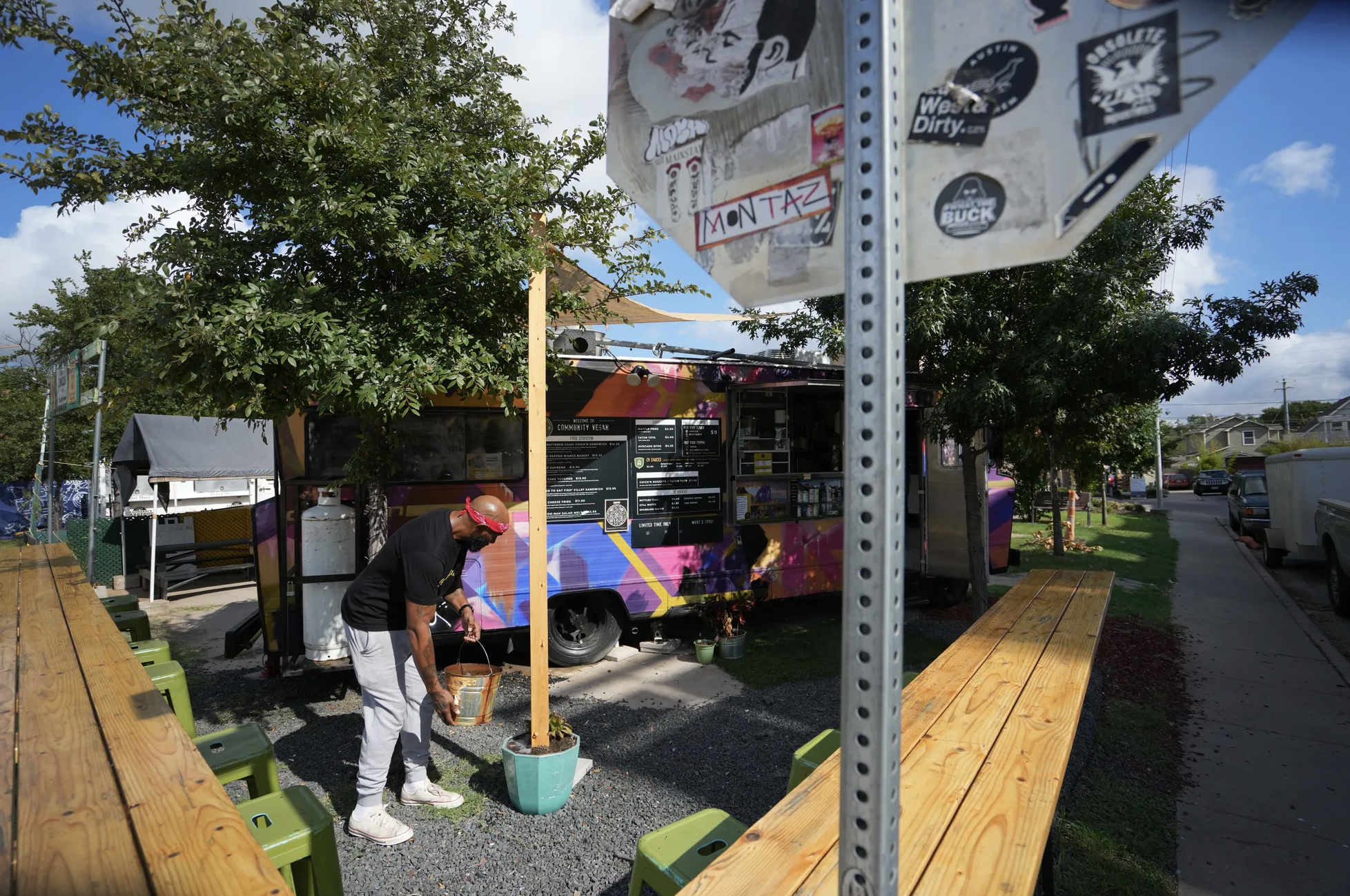
On the corner of East 11th and Lydia streets, the sweet aroma of Community Vegan’s savory bites draws onlookers and customers to the bustling food truck.

The micro-eatery has become a popular food spot in the East Austin Cultural District with dishes such as oyster mushroom wing baskets, beer-battered cauliflower chicken sandwiches, avocado bites and the truck's signature Vegan Lickin' Good Buckets.

Nearly every meal is crafted by co-owners and vegan cooks Marlon Rison and Ericka Dotson, who shape the restaurant’s flavorful dishes to satisfy cravings for nachos, chocolate milkshakes, southern fried chicken pieces and other popular items.

“It’s all about flavor, right? I know we’re bringing that to the block,” Rison said.

As the Community Vegan name spreads through the city's dining scene, Rison's face grows more familiar, too. Inspired by the logos of KFC, Wendys and other food chains, his radiant smile is at the center of the food truck's sign and its branded products. But beyond the logo, Rison's magnetic energy is the heart and soul of the East Austin operation that opened in September 2021. 

Along with its brunch and main menu items, Community Vegan also offers raw, wildcrafted sea moss packages from Dotson's company, Lott’s Herbs & Remedies; Dotson is a certified herbalist. Sea moss is a species of red algae that grows on coastlines across North America, the British Isles and continental Europe. Advocates say when it's consumed in supplement form, it can help improve heart and gut health and strengthen the immune system.

After seeing an advertisement for Community Vegan, North Austin resident Jai'Sun Alexander stopped by the food trailer in March and since has become a loyal customer because of the eatery's variety and Rison's personal touch.

"(Rison) does a really amazing job at engaging with all of his customers, whether they're first-timers, regulars or whoever," Alexander said. "He makes sure everybody's enjoying themselves or enjoying the food and enjoying the atmosphere. He does a really great job at making great food and making an even greater experience out of it."

Success is still a surprise for Rison. 

“We didn’t expect to create a product and service that could grow into this,” he said. “Like yo, let’s pay these bills and have some fun and be responsible. But fortunately, we’ve been able to do more than that.”

Despite the focus on vegan and herbal options, Rison said they are not trying to convert non-vegans to a meat-free lifestyle with Community Vegan. Only about a third of their customers are vegan, Rison said, and the goal is to broaden the minds of patrons by introducing a veggie-based substitute for the foods they already enjoy, including menu items such as Crab Cake Totchos, "I Used To Eat Fish" Filet Sandwich and Chilli Cheeze Fries.

"By no means are we ‘diet food’ and we don't even put it out there," Rison said. "For us, what we want to do is expose as many people as possible to vegetables, and if that means making it comfortable, we'll make it easier to digest."

Community Vegan co-owners wants to inspire others

Before opening Community Vegan, Rison was a radio host in Dallas and weighed upwards of 360 pounds. As a former powerlifter, he ate chicken, fish and turkey constantly throughout the week and consumed 350-400 grams of protein daily. He quit eating beef in 2004 and pork over 30 years ago, and he decided to make a complete switch to veganism after watching the documentary “What The Health” on Netflix in 2017. 

The film, which focuses on the role of food in health, inspired Rison to take his health into his own hands. He altered his diet – cutting out all meats and processed foods – and dropped 140 pounds in the process. 

Under the “Plantbased G” name, Rison started to share his health journey at speaking engagements and posted vegan recipes and cooking demos on his Instagram page. After seeing his audience grow on social media, Dotson encouraged Rison to write a digital cookbook filled with his top recipes.

In 2020, Rison released “The Quarantine 15,” an e-book filled with 15 (plus one bonus) vegan recipes curated by the Victoria-native.

Rison said he was driven to share his passion for plant-based foods and to encourage other people of color to pursue healthier diets, especially people susceptible to high cholesterol, heart disease and other serious health issues.

“We’ve got some of the worst health out of any of the groups that are out there, and it’s because of what we eat and we’re trying to change that tradition in terms of what we eat and how we eat it,” Rison said. “We want to make sure we give (patrons) options that are veggie-based and healthier for you, and hopefully, that will kind of change the way they approach food.”

Months after the release of the ebook, Dotson and Rison started thinking about opening their own restaurant.

Rethinking his life's path during the pandemic

While Rison enjoyed a career in radio, he said time spent in lockdown made him re-evaluate his life’s purpose. Instead of working for a corporate brand, he wanted to pursue something that added to his family’s legacy, and establishing a restaurant was at the top of his list. 

“For me, I said I have to be more responsible for taking care of myself, my family and my loved ones,” Rison said. “(Dotson) was still hitting me with the idea of the food truck thing, and then I said to myself, you know what, that might be the move for me to take control of my future, my destiny and build something that I can pass down to my kids and grandkids.”

Rison didn’t know whether it would be a traditional brick and mortar space or food trailer, and the only commercial dining experience he had before Community Vegan was as a cook at Popeyes at age 16. Dotson, a native Austinite, saw the potential in a mobile vegan restaurant in the central Texas city. 

The couple scoured the web and saw a listing on Craigslist for a 1973 Winnebago Chieftain in San Angelo. They drove three hours out to the seller, who was willing to lower the price of the rugged 27-foot-long RV once he heard their plans to open a restaurant.

They towed the RV to Austin and spent 10 months and thousands of dollars to gut the worn trailer and replace decades-old appliances. Once the kitchen and other items were installed, Rison and Dotson commissioned local artist Andrew Horner, known as APSE, of the ColorCartelto give the food truck its signature coat and began taking their first orders for food.

To find a home for Community Vegan, Rison and Dotson also reached out to Stuart King, president of King-Tears Mortuary on East 12th Street, who referred them to Austin Revitalization Authority President and CEO Gregory Smith. He directed the two co-owners to the Lydia food truck park.

"We knew we could thrive in the East Austin Cultural District while securing the presence of a Black business on the block," Rison said.

Sharing East Austin’s history, reclaiming the district’s influence

Dotson, the great-granddaughter of Ira Lott and Viola Madison Lott, who built a thriving lumber and housing business in the area, said there’s no better corner for the food truck.

Growing up in East Austin and Round Rock, Dotson said it was an area she used to speed past, as crime was an all too familiar occurrence during the 1970s and 1980s. But she said East Austin also was a community filled with Black and Latino-owned businesses and cultural happenings that reflect the area’s rich history. 

Over the decades, the character of East Austin has transformed dramatically as high dollar residential and commercial real estate companies razed old buildings, priced out longtime residents and crippled the traditionally Black community's past influence.

With Community Vegan’s placement, Dotson said she wants to reclaim the district’s cultural roots and remind folks of the area’s origins. 

“With us being planted here, we can share the story about what was here,” Dotson said. “At one time, it was a happy time. My mom would talk about the time there was a theater down here, and they would all take the bus down and go shopping and all sorts of things. But it’s turned into something very different. So, it’s time to turn over the lead, but with us included. It’s important our faces are here.”

Plans to open second food truck, vegan grocery store

After a year in business with the food truck, Dotson and Rison said the next step is to expand. The duo is working on putting together a second food truck in the fall that is drivable and can directly serve patrons in all corners of the city.

As far as big picture goals, Rison said he's thinking about building a Community Vegan grocery store somewhere in the East Austin Cultural District. That way, more people of color will have access to vegan ingredients and herbal supplies. 

Rison's hope is that Community Vegan becomes a national brand. But right now, he said his focus is to continue advocating for healthier lifestyles and continue putting smiles on the faces of the customers and community members who support the business. 

“We got to represent the block and say thank you,” Rison said. “This is our opportunity to say thank you every day. With every meal, we show our appreciation.”

— Austin American-Statesman

A passion forged: Founder of Austin Warrior Arts shares love for martial arts

At 9 years old, Da'Mon Stith knew his life's purpose. He was going to be a ninja, and there wasn't an invading kick, sword or blade powerful enough to stop him. 

When Stith was 8, his father gave him a toy sword with a bright red ruby on its hilt and a streak of jewels that led to the plastic white blade. It was about as sharp as a cafeteria spork, but once he got his hands on the flimsy dagger, no other toy in his collection mattered and his young, swirling mind was fixated on the world of martial arts. 

What was once a young boy's dream has grown into a lifelong passion, and Stith has explored every corner of it through his practice, his teachings and his own armory. He discovered his true identity in the process.

Growing up with Bruce Lee and Taimak as idols

Before then, Stith idolized martial arts legends and movie stars like Bruce Lee, whose high-flying kicks, rapid strikes and cosmic-level charisma drew the young padawan in. He imitated Lee's moves and tried his best to embody his effortless swag. 

Stith's obsession with martial arts culture grew once he started studying karate at age 9. But with his passion came confusion and, for a time, a sense of self-loathing and displacement. As he was going deeper into East Asian art forms, he was unknowingly pulling away from a culture of his own. 

Without any notable Black martial artists in movies or on TV screens during the era, Stith said he clung to the Asian actors of classic action films and shows of the 1970s and '80s.

"I would tell my mom and other people I was Asian, and I don't look any part of Asian," Stith said. "It was different, but things happen in pieces and in stages. When I found my inner-self, it was like holding my breath for a long time and finally being able to breathe."

It wasn't until Stith saw 1985's "The Last Dragon," which starred Taimak as Leroy Green (or Bruce Leroy), that the 11-year-old Austin native saw a martial arts hero that looked like him and shared his affinity for the combative arts. 

Taimak's Bruce Leroy character became a figure of inspiration for Stith, who started studying karate more intensely when his family moved to Okinawa, Japan, for his stepfather's job on a military base. Okinawa — the birthplace of karate — is also where Stith first recognized African history as his second passion, a discovery that later led to a 25-year career of teaching and practicing African martial arts. 

Through the teachings of his eighth-grade teacher Ms. Gross, Stith learned about the kings and queens of ancient Egypt and the leaders of African empires who ruled the continent and conquered neighboring lands. 

Stith discovered his love for capoeira, African warrior tradition

Stith was struck by his teacher's history lessons, and he started researching warrior traditions rooted in Africa and throughout the diaspora. His curiosity grew after he was introduced to capoeira, an Afro-Brazilian martial art that was created by enslaved Africans in the South American country in the early 16th century. 

Stith, who was studying Jeet Kune Do at the time, began studying capoeira after watching the 1993 film "Only the Strong."

As with "The Last Dragon," Stith was enraptured by the sweeping movements and high-flying kicks in the movie. But more anything, he was drawn to the art form's ties to Western and Central African culture.

"People who looked like me were doing a martial art that I felt I had a kinship to," Stith said. "It wasn't based in Asia or Europe, it was an art form that was very Black and African in its presentation and it filled that void for me.

"I didn't understand the art. I just heard the music and saw the movement and it connected with me."

After moving back to Austin at age 17, he became a capoeirista and began studying the movements of Detroit-based martial artist Kilindi Iyi. He saw an advertisement for $80 worth of Iyi's videos in Black Belt Magazine and watched his instructional tapes for hours on end.

From there, Stith adopted Iyi's deceptive kicks, Zulu and Egyptian stick fighting techniques and sweeping takedowns from historical African martial arts and incorporated them into his form of capoeira. 

Stith said the art form opened up his stiff frame, allowing him to enter a state of free flow he never experienced in other disciplines. But capoeira also debunked the thought that African people willingly gave up their bodies, their names and their cultures during the Trans-Atlantic slave trade.

He began practicing and teaching his own style of the historic art form

As he dove further into African history and martial arts, Stith recognized how many Black men and women fought to obtain their freedom and retain their heritage, often times using the combat skills they learned as warriors of battle. 

"What we're told is they brought us over, we were slaves and lost everything, but capoeira shows that we resisted what was happening to us by taking up arms and passing on our DNA and culture," he said."We tried to retain what we had in this motherland to the new land, which would become the breeding ground for new martial arts found in the diaspora."

By 1997, Stith was teaching to students capoeira da rua, or capoeira of the streets, which is a more practical form of the Afro-Brazilian style that he and his training partners developed in Austin. 

Stith started teaching alongside other martial artists at various sites around town and on the University of Texas campus, including the Anna Hiss Gymnasium and an undisclosed space they nicknamed "The Boiler Room" that a faculty member opened up for his group.

He taught students of all ages and backgrounds the footwork, bladed weaponry, counter and defensive strikes of capoeira. And ever since then, Stith has dedicated his life to teaching the art form. 

"I felt I had a purpose and a destination I was heading toward," he said. "I'm the best when I'm doing teaching and sharing my practice. Seeing them grow, being a part of their lives and giving them a piece of their culture makes me feel good." 

Stith began making the weapons he spent years wielding

In 2012, Stith formed the Guild of the Silent Sword, which includes his group of students and experienced capoeiristas. Even before then, he and fellow capoeira practitioner Jeffrey DaShade Johnson started making African weapons under the Street Forge Armory name. 

At first, the duo wanted other companies to make their weapons, but when they saw how costly it would be, they started crafting them on their own.

Stith and Johnson make sickle swords, short and long takoubas, filipino swords, nimcha sabre and other items under the armory brand inside of Co.lab, a creative space that's free for residents of color. They have shipped custom pieces across the country and as far as Australia and Germany, with items priced between $30-65. 

"I love using swords, and now we have the ability to create and make these instruments that can be used for destruction but also require skill, math and science," Stith said. "It's a good feeling to have a skill nobody can take from you. As long as I have access to material and tools, I can provide for my family and there's something very empowering about that."

While the brand has been official for some time, Johnson said Street Forge Armory really got its start when he and Stith were kids.

When Johnson was 9 years old, he also idolized the martial arts icons of the time and began making his own swords from hacksaw, duct tape, hammers and a screwdriver as a chisel. In Japan, Stith created his own weapons by hammering down old golf clubs and shaving them down into make-shift katana swords. 

The two Austinites didn't know each other then, but their passions would bring them together in 1999. Johnson trained under Stith and years later he decided to go into business with him, hoping to enlighten others with the skills that come with capoeira and the confidence that sprouts from the knowledge. 

"What we're finding is people want to be more healthy and more confident in themselves, but when they go to a mixed martial arts gym, they don't see people like them, or the people that look like them don't identify or think like them," Johnson said. "We're trying to make it accessible to everybody in the community."

While Johnson was aware of the martial arts rooted in Africa and the diaspora, he said there are few people as well-versed on the history and are able to pass it on to students as seamlessly as Stith. 

'It's honestly been a healing space for me'

Four days a week, Stith teaches hand-to-hand combat and stick and sword training to students as young as 8 at his Austin Warrior Arts studio at 9705 Burnet Road. On Saturdays, the groups meet at Mueller Park to trade friendly blows with Ancient Egyptian, Ethiopian and North African weapons. 

Student Natalie Joy, whose been working under Stith for a year, said she's found community in a city she's long felt isolated, especially in the martial arts world. 

"It's honestly been a healing space for me," Joy said. "I've always loved martial arts, but I always felt in those spaces kind of 'othered.' But in this space, I feel very included and very accepted. It is healing to do something that my ancestors did way back, and another way I can connect with them and that's very important and impactful for me."

Beyond learning the combative stances, student Erika Crespo said Stith has lifted her confidence and opened her heart at times when she's needed it most. 

"Coming to these classes has helped me learn how to get close to somebody and trust them," Crespo said. "When you come from a trauma history or you're anti-social, you don't get close to people. But in this case, I had to learn how to go with the flow and trust that I don't react too much out of fear or anxiety. I'm really doing something that's making me feel whole and it's been a hard but really beautiful journey."

In continuing his practices and weapon-making, Stith's dreams as a ninja have taken shape in other ways. While he's far from an agent of espionage, he's dedicated his life to education and craftsmanship, and he's looking to amplify everything with the opening of his own studio.

Having taught at local schools, community center, daycares, fitness centers and other spaces for 25 years, Stith said having a place fully dedicated has been his ultimate goal, and he's been living it for the past three months. 

Stith said he has the studio, but they need help keeping the doors open until they can build up their student base, so he and the Austin Warrior Arts team started a GoFundMe  to help pay for the space's rent. 

So far, the group has reached $9,115 of the $12,000 goal from current and former students of Stith and community members, which Stith said is a testament to the support and importance of African martial arts and history. 

"It's like mind-blowing to be honest," Stith said. "I can't describe what it feels like having this space and knowing it's dedicated solely to this is really humbling."

– Austin 360

Where to find Austin hotel pools with day passes this summer, including rooftop decks

It's time to soak in this Texas sun.

Now that the smoldering summer heat that lifelong residents have grown up with (and transplants like me are nervously anticipating) is here, it's time to pull out your swimsuits to kick back poolside under some shade, with a fruity cocktail in hand.

Lucky for us, Austin is home to plenty of hotels that open their pools to the public for a fee. If you're looking to lay back in a lounge chair or dive into a lagoon overlooking the city's skyline, we have a few places for you to explore.

Read More